Israel Enslaved in Egypt, Exodus 1

But the Israelites were fruitful and multiplied greatly and became exceedingly numerous, so that the land was filled with them.” –Genesis 1:7

You may read Exodus 1 here: Bible Gateway.

Connecting the Past to the Present (vs. 1-7)

The Old Testament books of Genesis and Exodus are meant to be understood in relationship to one other. Genesis sets the stage for Exodus by reminding the Israelite nation not only of her roots, but also the grounds for blessing that would come soon. The first six verses summarize Israel’s history as a clan, detailed in Genesis 12-50.

In Genesis 15:12-14, God told Abraham: “Know for certain that your descendants will be strangers in a country not their own, and they will be enslaved and mistreated four hundred years. But I will punish the nation they serve as slaves, and afterward they will come out with great possessions.”

Verse 7 spans this 400 year gap from Joseph’s death to the Exodus. God’s covenant promise to Abraham of blessing his descendants and greatly multiplying them is also evidenced during this time (Gen. 12:1-3; 15:5; 17:2, 6; 22:17). Direct descendants from Jacob’s family now number nearly two million people!

Pharaoh’s Plan of Affliction (vs. 8-14)

The new Pharaoh—under the Eighteenth Egyptian Dynasty—fears the booming Hebrew population will threaten his kingdom. True to God’s word, the Pharaoh implements controlling measures in hopes to set them back.

So he places slave masters over the Hebrews. They work them ruthlessly to build cities with bricks and mortar, and use them for grueling field work. But instead of destroying their spirits, the Hebrews forge into a mighty nation (Gen. 46:3).

Pharaoh ups his game plan to a disgusting level.

Killing the Jewish Boys at Birth (vs. 15-22)

Some scholars suggest that women who were barren were often used as midwives. Pharaoh orders the Hebrew midwives, Shiphrah and Puah, to kill all the Jewish male babies at birth.

But their fear of God is stronger than their fear of Pharaoh. They show great courage and refuse to do his dirty work of killing innocent children.

God rewards these ladies by blessing them with families of their own. The fact that their names are mentioned, unlike Pharaoh’s, also presents them as honorable examples of ones who follow God.

Pharaoh stoops even lower when he orders all the Egyptians to throw every newborn Hebrew boy into the Nile.

Reflect

As it probably seemed to the Hebrews during a9fb9994d0a234774636ba0bed7aae98their 400 year stretch in Egypt, God appears silent at times. But He is constantly at work through history, our present, and the awesome future planned for those who unashamedly walk with Him.

During the furnace of trials, God was preparing His people for the following purposes: being a witness to the true and living God; writing the Holy Scriptures, and bringing the Messiah into the world.

Although Pharaoh sought to destroy the Hebrews spirit, they multiplied and grew stronger instead. Pharaoh’s reason for his cruel treatment was because of the threat of their large population. However, Scripture tells us about the underlying conflict of spiritual warfare: “Enmity between God’s people and Satan’s children,” (Genesis 3:15).

Persecution isn’t a fun topic. You won’t hear about it in prosperity gospel circles. But God uses persecution to refine, strengthen, and grow His church. America hasn’t experienced persecution, not like in middle-eastern countries. But while tolerance is exalted in our society, we’re seeing an increase of intolerant attitudes toward Christianity.

It shouldn’t come as a surprise when persecution knocks on our doors.

Now is the time to decide: Will I follow God when forces of evil pressure me to disobey or disown Him? Or will I give in to what is easy and popular? We can’t be overcomers without obstacles to overcome. We know who wins in the end. Let’s ask God for His eternal perspective, pray for strength to be faithful, and encourage one another as we see the day of Christ’s return drawing closer (Heb. 10:25).
Exodus

Unless a man has the talents to make something of himself, freedom is an irksome burden.” – Eric Hoffer (The True Believer)

“You’re free to go!” For some prisoners who have been enslaved for years, freedom must feel like a breath of fresh air. But for others, the loss of familiar surroundings and embarking on a new journey is an unsettling and overwhelming experience.

Leading up to God’s salvation story, Exodus describes a series of God’s call to freedom and how his people respond.

Four hundred years have passed since Joseph’s family moved and thrived in Egypt. After multiplying to over two million strong and being enslaved to cruel bondage under a new Pharaoh, God responds to the Israelites’ cries. The time is ripe to send His leader, Moses, to set His people free from their oppression and bring them into their inheritance (Duet. 4:37-38).

God’s people, however, fail in their newfound freedom. They repeatedly falter after short bursts of confidence in God, their fear chipping away their trust. What was a consequence of their disobedience and lack of faith? Wandering in the desert for 40 years.

God, however, continues to faithfully provide and extends His gracious hand of deliverance.

Warren W. Wiersbe in his Bible Study, Be Delivered writes: “Exodus teaches us that freedom is not license and discipline is not bondage. God tells us how to enjoy mature freedom in His will, a quality that is desperately needed in our churches and in our world today. The privilege of freedom is precious, the responsibilities of freedom are serious, and we can’t have one without the other.”

Exodus was written about the same time as Genesis, around 1450-1410 B.C. Scholars believe that Moses wrote these accounts in the desert—somewhere in the Sinai peninsula—during Israel’s desert wanderings. This book contains the Ten Commandments and relays more miracles than any other Old Testament book, including the famous account of the Israelites crossing the Red Sea.

Reflect

Freedom is the theme of Exodus.

Deliverance is the theme in Exodus.

Just as God heard the Israelites’ cries, we can also be confident He hears our prayers. God led Moses and the Israelite nation. He also wants to lead us. Just as He delivered the Israelites, He wants to deliver us from evil, sin, and eternal death (separation from Him).

As you read Exodus, ask yourself the following questions:

  • Do I believe God’s promise, “My grace is sufficient for you, for my power is made perfect in weakness?” (2 Cor. 12:9).
  • Do I trust God in this situation?
  • Whether it be through deliverance or given strength to endure, do I believe God really loves me and will work all things together for my good?” (Rom. 8:28).

We can rest in the fact that our powerful God loves us and He will never leave us. For faithfulness is the cornerstone of who He is.

Parallels Between Joseph and Jesus

The New Testament is in the Old concealed; the Old Testament is in the New revealed.” -Augustine

The Old Testament points to Jesus Christ through foreshadows of situations and actions of several people. Joseph is one of those people. I imagine that Joseph and Jesus’ conversations go way beyond small talk. After all, they shared many similar heartfelt experiences.

Here are some of the parallels between Joseph and Jesus:

  • Both men were greatly loved by their fathers (Genesis 37:3; Matthew 3:17).
  • As shepherds, they both took care of their father’s sheep (Genesis 37:2; John 10:11, 27).
  • Both Joseph and Jesus were sent to their brothers by their father (Genesis 37:13, 14; Hebrews 2:11).
  • Both men were ridiculed and rejected by their brothers (Genesis 37:4, 19-20; John 1:11; 7:5).
  • Both were sold for the price of a slave (Genesis 37:28; Matthew 26:15).
  • Both were taken to Egypt (Genesis 37:25; Matthew 2:14, 15).
  • Both were falsely accused and condemned (Genesis 39:13-20; Matthew 26:57-68; 27:11-25). Both were placed with two other prisoners; one was saved and the other lost (Genesis 40:2, 3; Luke 23:32).
  • Both were bound in chains (Genesis 39:20; Matthew 27:2).
  • Both men were 30 years old at the beginning of public recognition (Genesis 41:46; Luke 3:23) and were exemplary servants (Genesis 39:1-6; Philippians 2:7).
  • Both were tempted. While both Joseph and Jesus didn’t give into the temptation (Genesis 39:7-12; Matthew 4:1); Jesus also never sinned (Hebrews 4:15).
  • Both were stripped of their robes (Genesis 37:23; Matthew 27:27-28). Joseph was thrown into a pit (37:24) and later cast into a dungeon (Genesis 39:20). Jesus was condemned to death before descending to hell (John 19:23; 1 Peter 3:18-20).
  • Both forgave those who wronged them (Genesis 45:1-15; Luke 23:34).
  • While men plotted evil against them (Genesis 37:20; John 11:53), God used it for good (Genesis 50:20; 1 Corinthians 2:7-9).
  • Both saved not only their people, but also many others (Genesis 45:7; 50:20; Matthew 1:21; Luke 24; 1 Corinthians 15:1-11).
  • Because Joseph’s actions helped the nations of the world survive the famine (Genesis 41:57), God partially fulfilled his promise to Abraham to bless all nations (Genesis 12:1-3). God completely fulfilled his promise to Abraham when Christ died for everyone’s sin and commanded to “make disciples of all nations. . . .” (Matthew 28:19).

Reflect

Like Christ, Joseph endured rejection and persecution. Yet—like Christ—he forgave. Joseph and Jesus not only became a blessing to those around them, but were also a blessing to those who hurt them. How can we apply this principle to our lives?

Jacob’s and Joseph’s Final Days, Genesis 49:29-33; 50:1-26

I am about to be gathered to my people. Bury me with my fathers in the cave in the field of Ephron the Hittite, the cave in the field of Machpelah, near Mamre in Canaan, which Abraham bought as a burial place from Ephron the Hittite . . .” -Genesis 49:29-30

Jacob’s instructions for his sons to bury him where his fathers are buried in Canaan reveals his faith that God’s covenant promises to give them the land will come to pass. (Related: The Death of Sarah)

You may read Genesis 49:29-33; 50:1-26 here: Bible Gateway.

Interesting Facts and Observations

  • Jacob dies at the age of 147. Although he claimed his years to be “few and difficult” (Gen. 47:9), his relationship with God became a priority. God changed his name to Israel, meaning “he struggles with God.”
  • Joseph never appears to shed tears for himself, but rather tears for his brothers’ plight. He also mourns his father’s death for months.
  • The Egyptians show Joseph great respect when they mourn 70 days for Jacob after his death. This is just two days shy of the mourning period given for a pharaoh’s death. Also, all of Egypt’s elders—including Pharaoh’s elders and servants—accompany Joseph to bury his father.
  • Joseph hadn’t stepped foot in his homeland since he was 17 years old. Although Canaan is the land connected to God’s promises, Joseph keeps his word to Pharaoh and returns to Egypt, the place God called him.
  • Joseph dies at the age of 110. Even though he prevailed through much adversity, he also received great blessing from God.

Joseph’s Brothers Devise a False Claim

With Jacob’s (Israel’s) death, Joseph’s brothers are terrified that Joseph will punish them for wronging him. So they devise a false claim, stating that Jacob admonishes Joseph to forgive them after Jacob dies.

On the positive side—though the brothers scheme up a lie—they own up to their sin against Joseph. The brothers throw themselves down before him and beg for his forgiveness. God’s heart of grace is mirrored in Joseph’s response.

Don’t be afraid . . . You intended to harm me, but God intended it for good to accomplish what is now being done, the saving of many lives.” – vs. 19-20

Joseph had already forgiven his brothers. He not only reassures them, but also pledges to care for them and their families.

Joseph’s Death

These verses set the groundwork for the Israelites plight in Exodus; the book of Joshua brings it to completion. The Israelites would have to rely on God's promises to make them into a great nation, lead them out of Egypt and bring them into Canaan, the promised land.

These verses set the groundwork for the Israelites plight in Exodus; the book of Joshua brings it to completion. The Israelites would have to rely on God’s promises to make them into a great nation, lead them out of Egypt, and bring them into the promised land.

More than 50 years lapse between verses 21 and 22. Joseph—an extraordinary man of faith and integrity—is blessed with a long life and is honored to see his great-great-grandchildren.

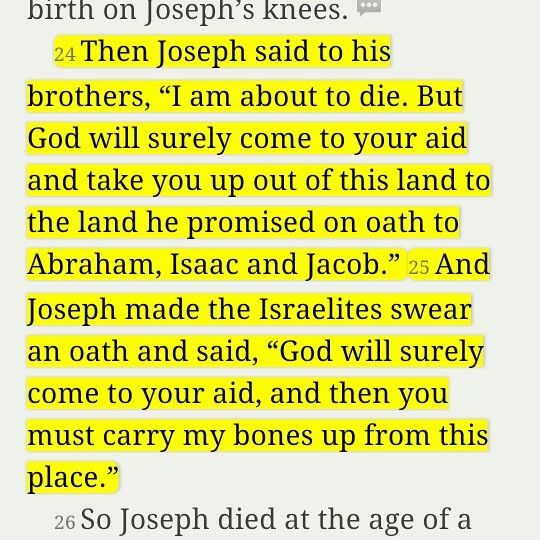
With the confidence that God would carry out His covenant promises, Joseph also requests that he be buried in the promised land. Although his coffin would lay above the ground for over 400 years as God’s people are enslaved in Egypt, the Israelites carry it back to Canaan under Moses’ leadership (Exodus 13:19).

Joseph’s faith is the perfect climax to the end of Genesis.

Reflect

Pharaoh didn’t doubt Joseph’s return to Egypt after burying Jacob. Because Joseph’s past record as Pharaoh’s advisor proved him responsible, Pharaoh trusted his word. Are we reliable even in the little things? Over time, privileges and freedom usually reward those who demonstrate trustworthiness.

Joseph gave complete forgiveness to his brothers. God also forgives us even though we don’t deserve it. Because God graciously accepts and forgives us, we should also graciously offer forgiveness to others.

God bringing good from evil is the theme in Joseph’s story. Like Joseph, do we trust God enough to work good out of our difficult situations?

Next week will be my last post in Genesis. Exhale. 🙂 I’ll give a brief summary of the parallels between Joseph and Jesus. Thanks for your visit!

Jacob Blesses His Sons, Genesis 49:1-28

Then Jacob called for his sons and said: “Gather around so I can tell you what will happen to you in days to come. Assemble and listen, sons of Jacob; listen to your father Israel.” –Genesis 49:1-2

Jacob’s final words to his twelve sons are recorded here in Genesis 49. Layman’s Bible Commentary notes: “Jacob’s prophecies refer to the distant future (49:1). The double exhortation to give attention to Jacob’s words stresses the importance of what he is about to say (49:2). The prophecies included here are not the spontaneous thoughts of a dying man, but the carefully prepared words of a prophetic poet.”

You may read Genesis 49:1-28 here: Bible Gateway.

Although the oldest son was supposed to receive a double inheritance, Reuben would not be granted this privilege. Jacob asserts: “Turbulent as the waters, you will no longer excel, for you went up onto your father’s bed, onto my couch and defiled it,” (vs. 4). Reuben’s former dishonorable ways cost him in the end (Genesis 35:21).

True to Jacob’s prophecy, Reuben’s descendants never produce a significant leader or inherit the promised land.

The next two oldest sons—Simeon and Levi—also disinherit the land due to their unfaithfulness and unwillingness to repent (vs. 5-7). Jacob characterizes these two as remaining angry: “Cursed be their anger, so fierce, and their fury, so cruel! I will scatter them in Jacob and disperse them in Israel,” (vs. 7).

This prophecy is fulfilled as Simeon’s tribe later inherits land scattered throughout Judah’s territory (Joshua 19:1-9; 1 Chronicles 4:28-33, 39). Although the Levites become priests, they are scattered throughout the rest of the tribal lands. Notable descendants of Levi include: Aaron, Moses, Eli and John the Baptist.

These first three tribes disqualify from their reward for unrepentant sin (Ezekiel 18:30). However, Jacob’s prophecies about them are still a blessing as they remain in the chosen family and reap God’s promises as Jacob’s heirs.

Greater Responsibility Given to the Faithful

The principle of God giving more responsibility to those who use their gifts and resources for His kingdom purposes (Luke 19:26) is seen with Jacob’s nine acceptable sons. Jacob uses poetic images along with word-plays for most of his sons’ names to describe their tribes’ destiny.

Prophecies of Jacob’s Sons Who Inherit the Land

"All these are the twelve tribes of Israel, and this is what their father said to them when he blessed them, giving each the blessing appropriate to him." -Genesis 49:28

“All these are the twelve tribes of Israel, and this is what their father said to them when he blessed them, giving each the blessing appropriate to him.” -Genesis 49:28

  • Judah – His brothers will bow down to him as “his hand will be on the neck of [his] enemies,” (vs. 8). “The scepter will not depart from Judah,” (vs. 10) means God chose Judah to be the ancestor of Israel’s line of kings, including Jesus, the promised Messiah. Leadership of Judah’s descendants, however, wouldn’t come until 640 years later under King David.
  • Zebulun“Zebulun will live by the seashore and become a haven for ships,” (vs. 13). His promised territory would be between the Mediterranean Sea and the Sea of Galilee.
  • Issachar – Rather than political pursuits, Issachar will settle around agriculture (vs 14-15). “When he sees how good is his resting place and how pleasant his land, he will bend his shoulder to the burden and submit to forced labor,” (vs.15). This suggests Issachar is capable, but lazy. Unlike lion-like Judah who subdues his enemies, Issachar submits to the Canaanites.
  • Dan – His prophecy of “providing justice for his people” partially comes to light during Samson’s era (Judges 13). Dan’s victories help Israel, but his people also lead Israel into idolatry (Judges 18:30-31; 1 Kings 12:26-30). His territory later becomes known as Israel’s center of idolatry (Amos 8:14).
  • Gad – His tribe becomes known as victorious fighters over every foreign army they battle (vs. 19; Jeremiah 49).
  • Ashar“Ashar’s food will be rich” (vs. 20). Some of Canaan’s most fertile ground will be given to this tribe (Deut. 33:24-25; Joshua 19:24-31).
  • Naphtali – Articulate speakers and gifted literature would arise from this tribe. Deborah, who composes a song of military victory, is an example (Judges 5:1-31). Naphtali’s land, located around the Sea of Galilee, is where much of Jesus’ ministry happens (Matthew 4:15-16). Other notable descendants include Barak, and possibly Elijah.
  • Joseph“Joseph is a fruitful vine . . . .” (vs. 22). Although Judah is given leadership of the tribes, Joseph is blessed with the double portion of the birthright (1 Chronicles 5:2). The tribes from Joseph’s two sons—Ephraim and Manasseh—will see this prophecy’s fulfillment. Joseph, who faced much adversity, is credited with his “bow remaining steady, his strong arms staying limber, because of the hand of the Mighty One of Jacob” (vs. 24). God enabled Joseph to draw closer to Him when trials mounted. Therefore, “let all these [blessings] rest on the head of Joseph, on the brow of the prince among his brothers,” (vs.26). Notable descendants of Joseph include: Joshua, Gideon and Samuel.
  • Benjamin“Benjamin is a ravenous wolf . . . .” (vs. 27) This tribe would be known for their fierceness (Judges 19-21) who demonstrates warlike character (Judges 5:14; 20:16; 1 Chronicles 8:40; 2 Chronicles 14:8; 17:17). Notable aggressive descendants include: Ehud (Judges 3:15-23), King Saul (1 Samuel 9:1; 14:47-52), and the Apostle Paul, previously known as Saul (Acts 8:1-3).
Reflect

Regardless of their faithfulness, all of Jacob’s 12 sons have a future and a blessing. However, only the faithful sons would inherit the land.

Likewise, although believers can’t earn forgiveness and salvation, our attitudes and actions matter. How we live determines our future blessings in God’s program.