Judah and Tamar, Genesis 38

Judah got a wife for Er, his firstborn, and her name was Tamar. But Er, Judah’s firstborn, was wicked in the LORD’s sight; so the LORD put him to death.” -Genesis 38:6-7

Genesis 38 tells of Joseph’s brother, Judah, moving away from home and settling in Canaan where he marries and raises his children to adulthood among a people his family deems unclean.

This chapter provides enough drama to start a TV series. How about a spin on Housewives? Hmm . . . I can see it now: Tent Husbands.

You may read Genesis 38 here: Bible Gateway.

When Judah’s firstborn, Er, errors through persistent wicked living, God takes his life. Since Tamar is now a childless widow, Judah follows the levirate marriage custom as described in Deuteronomy 25:5-10. He tells his second born, Onan, to fulfill his duty and sleep with her so she might have a son to carry on her late husband’s inheritance.

For the highest value in this culture is to carry on the bloodline.

Onan has no problems sleeping with Tamar, but he purposely denies Er an heir. What benefit would that be to him anyway? (vs. 9)

Needless to say, God isn’t happy with Onan. “For what he did was wicked in the Lord’s sight.” So He also kills Onan, (vs. 10).

As the saga continues, Judah tells Tamar to live under his tent and he will give her his third son in marriage when he is older.

However, the marriage ceremony never happens.

In the meanwhile—after a long time—Judah’s wife dies. After the grieving process, Judah sets out to shear sheep in Timnah.

The plot thickens. With the realization that Judah lied about giving her his third son in marriage, Tamar devises a plan to provide legal heirs.

Since shepherds aren’t sheepish at sheep-shearing time. And abundant sexual temptation abounds, she disguises herself as a prostitute and places herself in Judah’s path.

Judah takes the bait. So Tamar agrees to have sex with him in exchange for a few of his personal items: his seal, cord, and staff.

Conclusion

When Judah learns that Tamar, the so-called prostitute, is pregnant he sidesteps the usual punishment of stoning her (Deuteronomy 22:20-24; John 8:4-5). Instead, he demands that she be burned. (Burning was reserved only for a priest’s daughter found guilty of prostitution in the Mosaic Law, Leviticus 28:9.)

But as Tamar is brought out, she sends a message to Judah: “I am pregnant by the man who owns these. . . . See if you recognize whose seal and cord and staff these are,” (vs. 25).

Guilty! Judah confesses his wrong in denying Tamar his third son and lets her off the hook.

Judah and Tamar have twin sons, Perez and Zerah. Perez becomes the ancestor of David (Ruth 4:18-22). And David becomes the ancestor of Jesus Christ (Matthew 1:3). Wow!

Reflect 

This story seems to be open-minded about prostitution, but it is condemned as a serious sin throughout Scripture. If there is a moral in this story, it is that loyalty to family is extremely important.

This story seems to be open-minded about prostitution, but it is condemned as a serious sin throughout Scripture. If there is a moral in this story, it is that loyalty to family is extremely important.

Immersed in a culture where prostitutes were common, the question of sexual morality never seems to enter Judah’s mind.

While Judah was driven by lust, Tamar was driven to be the matriarch of Judah’s oldest family line. Layman’s Bible Commentary observes: “There is evidence that among ancient Assyrian and Hittite peoples, part of the levirate responsibility could pass to the father of the widow’s husband, if there were no brothers to fulfill it. Thus Tamar was, in one sense, claiming what was due her. She had tricked Judah into fulfilling the levirate responsibility and now would bear his children.”

Neither Judah nor Tamar, however, were justified in their actions.

Although Judah concealed the very sin he thought Tamar committed, fury fueled him as he demanded her death. When we become angry over a sin we see in others, maybe we should ask ourselves: “Am I struggling in this same area?”

Next week we will read how Joseph’s integrity stands in striking contrast to Judah’s immorality. Have a wonderful weekend!
Joseph Sold Into Slavery, Genesis 37

Here comes that dreamer! . . . . Let’s kill him and throw him into one of these cisterns and say that a ferocious animal devoured him. Then we’ll see what comes of his dreams!” –Genesis 37:19-20

While chapter 36 depicts Esau’s descendants as mighty kings and chieftains, Jacob’s descendants continue to struggle. Fast forward 400 years from Jacob’s day and Israel is enslaved under Egypt’s harsh rule until they escape under Moses’ leadership. And while Edom—an established nation—has power to refuse their “brother” Israel passage through their land, Israel still has no claim in land ownership.

The last 14 chapters of Genesis (37-50) primarily focuses on Joseph, the obvious favorite son of Jacob (and firstborn of Rachel). In fact, the story of Joseph comprises one fourth of the entire book of Genesis. However, a few references of Jacob’s other 11 sons are also mentioned.

You may read Genesis 37 here: Bible Gateway.

Seventeen year-old Joseph probably held his head high and maybe walked with a strut. Not only did he have insight into God’s plans for his future, but he also was Jacob’s favorite as signified by the richly ornamented robe given to him. This only further fueled the fire of rivalry with his 10 older brothers. For they were constantly reminded that they didn’t measure up in their father’s eyes. Not like golden boy, Joseph.

If that weren’t bad enough, Joseph told his brothers of his dreams.

Joseph’s Dreams

Joseph’s dreams always come in pairs, (perhaps for confirmation). His first dream involves sheaves. These symbolize his future role in overseeing the grain distribution in Egypt. The second dream involves the sun, moon, and 11 stars bowing down to him. The fulfillment of these dreams happen 23 years later when all 11 brothers submit to Joseph at least five different times (46:6-7; 43:26, 28; 44:14-16; 50:18).

Maybe Joseph shared his dreams in faith. However, the boys didn’t take the dreams lightly. And they hate him all the more.

Joseph’s Brothers Conspire

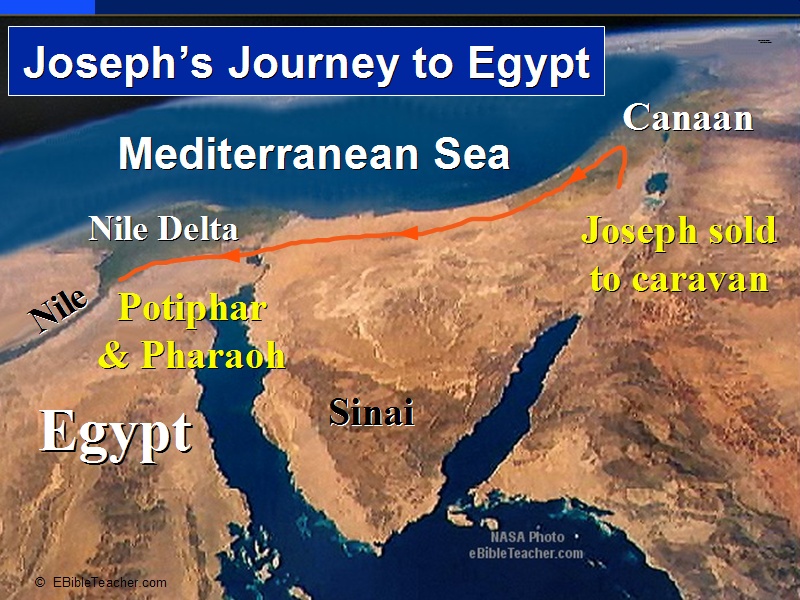
Joseph is sent to check on his brothers who were tending flocks. Shechem was about 50 miles north of Hebron.

Joseph is sent to check on his brothers who were tending flocks. Shechem was about 50 miles north of Hebron. . . . Bought as a piece of merchandise, Joseph would probably be chained and forced to walk the 30-day trek across the desert while being treated like baggage. Egypt would be a major culture shock for this young shepherd nomad. Although he would see gorgeous homes, grand pyramids, and witness the world’s most advanced civilization, he would also be thrust into a dark culture of countless gods.

In their jealousy, Joseph’s brothers conspire to kill Joseph. (This probably involves Dan, Naphtali, Gad, and Asher whom Joseph gives a bad report in verse 2.) But Reuben the first-born advocates for Joseph: “Why kill him? Let’s just throw him into a well!” (What a thoughtful guy!)

Although his plan was to rescue Joseph, Reuben’s concern appears to be more about himself if his brother is killed, rather than concerned for Joseph’s fate (vs. 29-30).

Judah also persuades the guys not to kill Joseph. Instead, why not make some money and let someone else do the dirty work?

So after ripping off Joseph’s robe and throwing him into a dry well, they drag him back out and sell him to some traveling Ishmaelite merchants. (Nice brothers!)

But God is in control of Joseph’s life.

Joseph ends up being sold to one of Pharoah’s officials, Potiphar, captain of the guard. And where most would fail, Joseph survives. When we continue his saga, we’ll see that with his knowledge of God—sculpted by pain—Joseph adds quiet wisdom to his confidence.

Meanwhile, Jacob (though blessed by God) meets up with his previous trail of deceit. But this time his sons deceive him into thinking that Joseph has been killed by a wild animal. In his grief, he refuses any comfort.

Reflect

Favoritism seems to be a theme in Jacob’s family history. Isaac favored Esau. Rebekah preferred Jacob. Jacob desired Rachel. And in Jacob’s old age, Joseph is the apple of his eye.

Favoritism breeds rivalry and division. Feelings about a child may be difficult to change. But as parents and grandparents, we can change our actions of giving special treatment to one over another.

The time to deal with jealousy is when we find ourselves keeping score with what others have.

Joseph’s brothers’ jealousy over a robe and anger over a couple of dreams grew into a blinding monstrous rage. Worried about carrying the guilt of Joseph’s death, they chose the lesser of two evils by selling him as a slave instead. Although they avoided murder, their action was still wrong.

When faced with problem solving, let’s first ask, “Is this right?”

Have a great weekend!


Esau’s Descendants, Genesis 36

Oholibamah. Try saying that 10 times fast! Who was Oholibamah? She was one of two Hittite women that Esau—Jacob’s twin brother—married according to Genesis 36.

Even though intermarriage with the Canaanites was strictly forbidden by his family, Esau defies his parents’ religious principles when he marries two idolatrous Hittites. Isaac and Rebekah are miserable with this arrangement (26:35). So Esau decides to add a third wife. But this time he’d marry Basemath, an Ishmael descendant (28:9).

You may read the list of Esau’s descendants here: Bible Gateway.

jordan

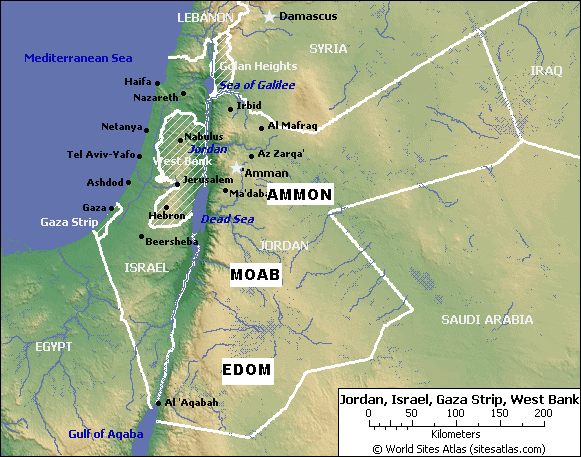
The Edomites’ territory featured both desolate desert and rugged mountains. Major roads allowed travelers access to the rich natural resources in this area. The city later called Petra—an ancient world marvel—was believed to be carved into Edom’s rock walls

Although the theme of infertility plagued Abraham’s line, it doesn’t seem an issue in Esau’s line. Esau’s descendants, however, would eventually vanish at God’s hand due to their hostile treatment toward their brothers, Israel, Jacob’s descendants.

Due to insufficient pasture and water for both brother’s herds, Esau moves his family south and east of the Dead Sea. This division of territory between Esau and Jacob sounds a lot like Abraham and Lot’s episode (13:1-13). However, Esau may have also moved with the acceptance that Canaan (the promised land) is to be passed on to Jacob.

The name Esau means “red.” Esau becomes known as Edom from his foolish decision to trade his birthright and father’s blessing for some red stew. So, the Edomites are his descendants.

Interesting Edomite Tidbits

  • Esau’s sons—who walk away from God—appear wise in worldly ways and reign as kings in Edom before any king reigns in Israel. And while Esau’s descendants become rulers, Jacob’s sons remain lowly shepherds for generations (47:3).
  • As Esau and Jacob grew up fighting, both of their descendants followed suit. Israel, (Jacob’s descendants), looked down on the Edomites because of their intermarriage with the Canaanites. God, however, commanded the Israelites during the exodus to give their “brothers,” special treatment despite the Edomites defiance and hostility (Deuteronomy 2:4-5).
  • Like their father, the Edomites were fierce and rugged. As warriors who prided themselves in their self-sufficiency, they mistakenly thought their rock cliffs were impregnable.
  • Edom—Israel’s neighbors and relatives—constantly harassed the Jews. They later looted Jerusalem and rejoiced at the misfortunes of Israel and Judah. God spoke strong words of judgment against them through the Old Testament prophet Obadiah in a dirge of doom format. You may read it here: Obadiah. (It’s only one chapter and the shortest book in the Old Testament!)
  • When Obadiah prophesied, Judah may have seemed less likely to survive than Edom. But—exactly as God foretold—the Edomite nation vanished. They were routed by Judas Maccabeus in 164 B.C. and were completely nonexistent by the first century A.D.

Reflect

Edom sets an example to allb69c87973c980aef46976f7f37e1e5f1  people and nations who live in hostility to God. Just as God will judge Edom for her evil actions toward His people, He will also destroy proud and wicked people.

As I wrap this up, a hail storm accompanied with loud thunder and lightning sweeps over our house. Thankfully I’m inside, safe from the hurling chunks of ice. What a great visual reminder of God’s protection for His children!

One day, God will judge and punish all who harm His people. I can’t think of a more terrifying scenario than being caught out in the storm of God’s wrath.

Those who rebel against God and take advantage of others’ misfortunes will someday answer to God.

Those who have trusted Christ for forgiveness and are faithful to Him, however, have hope for the future. Let’s be mindful of those around us and be willing to help in their time of need.

Enjoy your weekend!

Jacob Returns to Bethel, Genesis 35

Then God said to Jacob, ‘Go up to Bethel and settle there, and build an altar there to God, who appeared to you when you were fleeing from your brother Esau.’” –Genesis 35:1

Once again, God tells Jacob to settle in Bethel (and build an altar). Bethel is where Jacob first encountered God and built an altar to worship Him. It’s also where Jacob is first told about God’s plan to bless him.

You may read Genesis 35 here: Bible Gateway.

Jacob gives his clan a spiritual prep talk as he seeks a fresh start with God. Purification would involve the removal of all foreign gods, and be symbolized through the changing of their clothes.

Why did the people have idols in the first place? These were sometimes viewed more as good luck charms rather than gods. Their earrings were also viewed as good luck charms to buffer evil. But Jacob didn’t want anything—not even good luck trinkets—to distract his family’s spiritual focus.

As Jacob and his people set out to Bethel (in the land of Canaan), “the terror of God fell upon the towns all around them so that no one pursued them” (vs. 5).

Small wonder after what Jacob’s sons did to the people of Shechem! But God’s protective hand is also evident as Jacob obeys and sets up an altar in Bethel.

God renews His promise to give Jacob many descendants and the land (vs. 9-12), just as He first promised Abraham and Isaac. God also affirms Jacob’s new name, Israel, which means “he struggles with God”.

Jacob sets up a second pillar in Bethel as a memorial to God’s faithfulness. Similar to 30 years earlier, he sanctifies (sets apart) the stone and pours oil over it. By using the most expensive olive oil with the finest grade in purity, Jacob demonstrates his great respect where he meets with God. He also gives God an offering and reaffirms the name Bethel, which means “house of God”.

The Deaths of Rachel and Isaac

Rachel—who had desperately wanted a child—sadly dies while giving birth to her second son (vs. 16-19). She names him Ben-Oni, which means “son of my trouble”. But Jacob renames him Benjamin, which means “son of my right hand”.

Along with a list of Jacob’s sons, Isaac’s death is also recorded at the end of chapter 35. Isaac lives for 12 years after Jacob relocates to Hebron. He also grieves Joseph’s seeming death. He dies soon after Joseph’s promotion in Egypt—at the age of 180—and is buried near Hebron in the Machpelah Cave.

Reuben’s Ruse

Reuben—Jacob and Leah’s firstborn—is now an adult. He helps himself to Jacob’s concubine, Bilhah (vs. 22). (Although Bilhah held some privileges of a wife, she didn’t share in all of a wife’s benefits.)

Why would Reuben do such a foolish thing?

Layman’s Bible Commentary asserts: “Reuben’s relations with Bilhah are a power move as much as anything else. In that culture, a man who wanted to assert his superiority over another man might do so by having sexual relations with that man’s wife or concubine. It may have included a play for asserting his mother’s role as ‘first wife.’ With the death of Rachel, who had been Jacob’s favorite, Bilhah, Rachel’s servant, may have been able to move into a favored role. Reuben’s actions make Bilhah detestable to Jacob; thus Leah has a better chance for power in the household.”

Reuben may have thought he got away with his ruse. His actions, however, cost him in the end when Jacob gives his double portion to Joseph (1 Chronicles 5:1-2). The use of Israel instead of Jacob in verse 22 may indicate that the patriarch responds in a correct manner, instead of how the old Jacob might have responded.

Reflect

God desires and deserves our obedience. Compromise not only hinders our walk with God, but also hurts those around us.

God desires and deserves our obedience. Compromise not only hinders our walk with God, but also hurts those around us.

Sometimes—instead of a steady pace—my walk with God feels more like two steps forward and one step back. How about you?

Jacob the patriarch wasn’t perfect either. Setbacks marked his life. But I love that his new name characterized his desire to stay close to God. Despite life’s challenges and upsets, he learned to prevail with God.

If you’ve been a Christian for a while, you know that being a believer doesn’t make life easier. But we have a powerful God who is always ready to help us through life’s storms. Like Israel, let’s determine to prevail with God and cast aside all idols (anything that we put before God).

Have a great week!

Dinah and the Shechemites, Genesis 34

Now Dinah, the daughter Leah had borne to Jacob, went out to visit the women of the land. When Shechem son of Hamor the Hivite, the ruler of that area, saw her, he took her and violated her. His heart was drawn to Dinah daughter of Jacob, and he loved the girl and spoke tenderly to her. And Shechem said to his father Hamor, ‘Get me this girl as my wife.’” –Genesis 34:1-4

Shechem was not only the name of a place, but also the name of the man that Dinah encounters. Jacob probably didn’t foresee the immediate crisis looming. But the consequence of compromising God’s directive to go to Bethel (31:3, 13) would wreck havoc not only on his family, but also on the Shechemites.

You may read Genesis 34 here: Bible Gateway.

Dinah—Leah’s youngest child—must have been at least a teenager at this time. This suggests that Jacob and his family had been living in, or near, Shechem for several years.

Who could blame Dinah—living with 11 brothers—for wanting to get out and socialize with other girls her age? After all, a girl needs girlfriends!

Jacob, Leah, and Rachel must have been somewhat uncomfortable with their children living so close to pagan influence. Maybe they planned on moving to Bethel (as God had directed) in the near future to find mates for their growing kids. Maybe Jacob remained near Shechem in hopes of spreading a godly influence. Whatever their reasons, by-passing God’s command to return to Bethel put themselves in a tangled mess.

It wasn’t long before Shechem, the city’s chieftain, took notice of Dinah. This soon turned into an obsession. Beautiful Dinah, being of a different nationality, probably held a certain charm that the Canaanite girls lacked. For they were immersed in a culture of immorality and idol worship.

Henry Morris (The Genesis Record) writes: “Unattached women were considered fair game in cities of the time, in which promiscuity was not only common but, in fact, a part of the very religious system itself. It seems likely that Dinah must have been warned about such dangers by her parents, but perhaps she felt she could look out for herself and resented their overprotective attitude.”

Scripture doesn’t say if Dinah encouraged Shechem’s affection. But in light of her age, statutory rape would probably be applied in our times.

Even though Shechem violated Dinah, he pursues her as his bride. Since marriage was arranged by parents even in pagan cultures, he asks his dad to approach Jacob in the matter.

Jacob learns what happened, but waits until his sons come in from the fields. In the meanwhile, Hamor and Shechem show up. Without a hint of an apology, or indication that a wrong has been committed, Hamor suggests that Dinah be given to Shechem as his wife.

Jacob’s sons overhear their wild proposal and burst into the room. Jacob seems to fade into the background as his sons take charge.

The brothers are furious.

Not only has their only sister been violated, but Shechem has “done a disgraceful thing in Israel,” polluting their national purity that’s necessary for God’s continual blessing upon them.

(Side note: The name Israel in verse 7 refers to God’s chosen people for the first time.)

0c272b5765a8cec96a2947c5edfad9a1

Because of Simeon and Levi’s sins, their father cursed them with his dying breath (49:5-7). Their descendants (generations later) lost the part of the promised land allotted to them.

Adding insult to insult, Hamor suggests a general intermarrying between his people and Jacob’s clan. He also throws in a bonus: trade and land deals.

Jacob’s sons—following Jacob’s previous devious ways—devise a plan of revenge. (Never mind the defilement of God’s holy meaning of what they are about to propose!) They pretend to go along with Hamor’s proposal on one condition only: “That you become like us by circumcising all your males,” (vs. 15).

Why did Jacob’s sons include all the Shechemite men?

Maybe they felt they deserved punishment for their indifference to Shechem’s crime. Or perhaps they reasoned that they couldn’t carry out revenge on Shechem the Chieftan as the townsmen would surely kill them.

Surprisingly, the Shechemite men agree to circumcision. I guess the temporary inconvenience paled in light of the financial gain they would reap from this alliance.

So, on the third day—when the men are most debilitated—Simeon, Levi, and possibly their servants charge the city. Going from house to house, they slay all the men (including Shechem and Hamor) and rescue Dinah. Maybe the other brothers join in the looting and capture of the women, children, animals and possessions.

So where is Jacob during all of this?

His infuriation with his boys’ retaliation shows that he wasn’t in on this plan of vengeance. But his verbal response also indicates a selfish viewpoint: “You have brought trouble on me by making me a stench to the Canaanites and Perizzites,” (vs. 30).

Jacob’s silence—along with Simeon and Levi’s reference to Dinah as their sister (rather than Jacob’s daughter)—could infer that Jacob didn’t give her much attention. Maybe that’s why her protective blood brothers (Leah’s sons) felt justified in their actions.

Reflect

Simeon and Levi were right to be angry at both the injustice done to Dinah and Hamor’s proposal of mixing the chosen Israelite seed with the Canaanite seed. However, taking the law into their own hands was flat out wrong. Their arrogance led to the slaughter of innocent people.

This horrific account shows the high price of compromise. If Jacob had obeyed God’s command to return to Bethel, this tragedy wouldn’t have happened.

The following questions come to my mind: Am I settling for compromise? Am I putting off what God has asked me to do (or not do)? My consequences may not seem as huge, but do I really want to just coast in my relationship with God and miss His best for my life?

Thanks for staying the course! I appreciate you!