Jacob’s Children, Genesis 29:31-30:22

When Rachel saw that she was not bearing Jacob any children, she became jealous of her sister. So she said to Jacob, ‘Give me children, or I’ll die!’” –Genesis 30:1

With Jacob’s double marriage to Leah and Rachel, the sisters’ jealousy and rivalry isn’t a surprise. Each sister wants what the other has: Leah longs for Jacob’s love. She strives to earn his affection by bearing him children. Rachel already has Jacob’s love, but she envy’s Leah’s ability to bear children.

For all of Leah and Rachel’s efforts in their bitter childbearing race, it is God who opens the womb.

You may read Genesis 29:31-30:22 here: Bible Gateway.

All of the great patriarch’s (Abraham, Isaac, and Jacob) had wives who struggled conceiving. While Jacob followed Grandpa Abraham’s example of having relations with his maidservant in order to have his own child, Isaac chose another path. Instead of following the legal and culturally accepted practice of having children through his wife’s maidservant, he prayed to God when Rebekah was barren. God eventually answered his prayer and blessed Rebekah with twins.

Jacob’s children

The twelve tribes of Israel descend from a very blended and conflicted family. The following chart shows Jacob’s children in the order they were born.

12_sons_of_jacob-12_tribes_of_israel_chart

Names in the Old Testament

Names in the Old Testament were often given to reflect the situation at the time of birth. Sometimes a person’s name was later changed because his/her name and character didn’t match.

Six of Israel’s tribes descend from Leah. She birthed the following children.

  • Reuben means “see, a son”.
  • Simeon means “hear” or “listen”.
  • Levi means “attached” or “associated”. The royal priesthood descends from Levi’s tribe.
  • Judah means “praise”. The Messiah would come from this tribe.
  • Issachar sounds like the Hebrew word for “reward”.
  • Zebulun probably means “honor”.
  • Leah’s seventh baby was a girl (Dinah).

In Rachel’s frustration of infertility, she adopts her maidservant Bilbah’s babies. Rachel falsely assumes God is pleased with this move. Bilbah birthed two boys.

  • Dan means “He has vindicated me”.
  • Naphtali means “my struggle”.

When Leah isn’t pregnant, she also offers Jacob her maidservant, Zilpah, who births two boys.

  • Gad means “good fortune” or “a troop”.
  • Asher means “happy”.

After 14 years of infertility, Rachel births Joseph. She would also eventually birth Benjamin.

  • Joseph means “may he add”.
  • Benjamin means “son of my right hand”.

Reflect

Although Jacob was tricked into marrying Leah, he would have saved his family some grief if he would have considered the long term consequences of taking both Leah and Rachel’s maidservants as concubines. However, the most heated rivalry sparked between Leah and Rachel’s children (and descended tribes).

When Rachel couldn’t bear children she lost sight of Jacob’s commitment to her. Instead of accepting what he had already given her—devoted love—seeds of envy toward Leah took root. Heated competition of who could give Jacob the most children sprouted thorns of disunity among the family.

Rachel’s attempt to earn what Jacob had already given her, (love), paints a bigger picture. Perhaps the following question is what we should ask ourselves: Like Rachel, are we trying to earn God’s love?

Without God’s Word, it’s easy to believe these false ideas: 1) We’re good enough—at least better than many—to earn God’s love; 2) God’s love will never be ours because we can never attain it.

While it’s true that we can’t earn God’s love, we can know His love because He gives it freely. If the Bible only paints one picture, it’s this: God loves us! The vibrancy of His incredible mercy and patience are highlighted throughout His Word. He already took care of the problem that separates us from Him—our sin—when He sacrificed His Son on the cross.

When we accept and embrace God’s love, we are free from striving to earn His approval. We can walk with Him in joy and thankfulness.
Jacob Arrives in Paddan Aram, Genesis 29:1-30

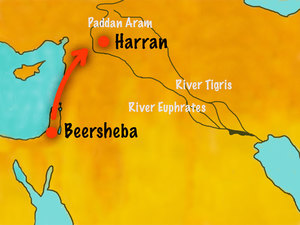
The plan was simple. Jacob would stay in Haran a few months, find a wife, and then return home to Beersheba. But unbeknownst to him, his stay would encompass 14 long years of labor after being fooled by uncle Laban. (This would not be a funny April Fool’s joke!) 🙂

You may read Genesis 29:1-30 here: Gateway Bible.

Now that Jacob has God’s promised blessing—which he previously strived to gain by his own efforts—Jacob is infused with purpose. After days of travel from Bethel, Jacob finally arrives in Haran. He stumbles across a field where three flocks of sheep lie near a well. He learns from the shepherds that they won’t remove the large stone from the well’s mouth to water their flocks until all the sheep have arrived.

But when Rachel draws near with her father’s flock, Jacob springs to action. Smitten by her beauty, he not only removes the big stone from the well’s mouth, but also plants a kiss on—or near—Rachel’s mouth.

Layman’s Bible Commentary notes: “Most likely, he [Jacob] kisses her on both cheeks, a traditional greeting. However, it is worth adding that this appears to be the only case in the Bible of a man kissing a woman who is not his mother or wife. So it is possible that this was more than just a ‘holy’ kiss.”

Laban Negotiates Wages with Jacob

freebibleimages.com

freebibleimages.com

Jacob is welcomed into the family. Even though Laban owns many sheep, he doesn’t negotiate payment for Jacob’s labor until Jacob has toiled a month for him. But Jacob is quick to respond to his wage inquiry: “I’ll work for you seven years in return for your younger daughter Rachel.”

Verse 17 says, “Leah had weak eyes, but Rachel was lovely in form, and beautiful.” Rachel in Hebrew means “ewe lamb,” while Leah (the oldest daughter) means “cow”.

Layman’s Bible Commentary suggests that verse 20 is often misunderstood to mean that time passed quickly for Jacob. “More likely it means that the price seems insignificant when compared to what he is getting in return.”

The Deceiver is Deceived

Finally! Seven years of toil have passed for Jacob. The wedding ceremony has arrived. But when Jacob opens his eyelids the next morning, he is astonished to find Leah next to him.

Jacob is enraged. “Why have you deceived me?”

“It is not our custom here to give the younger daughter in marriage before the older one.”

How could Laban fool Jacob? Layman’s Commentary notes: “The most likely explanation is that when Laban brings his daughter Leah to Jacob, it is late and dark, and she is veiled from head to toe. It seems that the wedding feast hosted by Laban is an intentional ploy to dull Jacob’s senses with wine (29:22).”

After Jacob’s marriage consummation to Leah, Jacob receives his true love, Rachel, in just eight short days. However, Laban has also conned Jacob into working another seven years as an exchange.

Reflect

1ffaa62d05c5a2528d8737195f2a0f42

When Peter asked Jesus: “How many times shall I forgive my brother or sister who sins against me? Up to seven times?” Jesus answered: “I tell you, not seven times, but seventy-seven times,” (Matthew 18:21-22). See Matthew 18:21-35 for “The Parable of the Unforgiving Debtor”.)

Ironically, Jacob meets his own sin of deception in uncle Laban. Jacob’s previous scam and dishonor of the firstborn’s birthright and blessing principle is now honored through the union of Laban’s firstborn daughter—Leah—to Jacob.

Although tricked by Laban, Jacob keeps his part of the bargain. Patient and diligent, he works another seven years without plotting revenge.

When we nurse a grudge and/or plot revenge, we are not only blind to God’s perspective, but also become imprisoned to bitterness. Offering forgiveness is never easy when offended or hurt. But God expects it, especially since He forgave us.


Jacob’s Dream at Bethel, Genesis 28:10-22

Surely the LORD is in this place, and I was not aware of it.” –Genesis 28:16

This passage tells of Jacob running for his life after his grand deception with Esau. Rebekah directed her ornery son to the safe haven of Haran—400 miles away—where her brother Laban lives. Jacob would retrace the steps of Grandpa Abraham who journeyed from Haran to the promised land many years before.

Disclaimer: Like other stories in Genesis, Scripture simply reports events that happened. In the following story, however, I have elaborated with some fictional details.

You may read Genesis 28:10-22 here: Bible Gateway.

Jacob sped north on his camel for hours, stopping only once for water at one of his father’s old wells. He lapped up the water before filling all his wineskins.

The lowering sun would soon give way to darkness. How far had he traveled, 50-60 miles? So far there were no signs of Esau in hot pursuit. But he would surely be on to him tomorrow. By then Jacob would have a good 60-80 mile advantage.

(freebibleimages.org)

(freebibleimages.org)

The plan was simple. Jacob would stay in Haran a few months, find a wife, and then return home to Beersheba. Plenty of time for Esau to simmer down.

Rank sweat mixed with dirt gave Jacob’s skin a leathered look. Any other day he would have made cleansing a priority. Today, however, was no ordinary day! He had secured his father’s blessing. But knowledge of his success didn’t lessen the lonely fear that kept creeping in. If only he could rid Esau’s bitter cry out of his throbbing head.

Jacob’s throat felt parched again. He would only drink a couple sips of water. Tomorrow he would have to ration the water and food carefully. Hopefully he would reach Haran by week’s end. Hopefully he would stumble across more wells. Be optimistic, he told himself. It will all work out.

Jacob stretched his aching muscles. He chose a spot sheltered by a cluster of trees—away from the dirt road—for his makeshift bed. The physical exertion of leveling the ground helped ease a little of his anxieties. At least the darkness would temporarily hide him from bandits. He willed himself to not think about hungry wild animals.

A smooth rock would have to work for a pillow. Jacob lay down on the hard ground. How will I find Uncle Laban . . . How will Father’s blessing look in my life? Jacob’s questions stilled as he surrendered to sleep.

A smooth rock would have to work for a pillow. Jacob lay down on the hard ground. How will I find Uncle Laban . . . How will Father’s blessing look in my life? Jacob’s questions stilled as he surrendered to sleep.

Jacob’s Dream

Jacob’s heartbeat boomed inside his head as his eyes opened. The words—God’s words—still ringing through his mind. His voice, majestic and rumbling like a wild river, filled him with awe and a sense of holiness.

“I am the LORD, the God of your father Abraham and the God of Isaac. I will give you and your descendants the land in which you are lying . . . . All peoples on earth will be blessed through you and your offspring. I am with you and will watch over you wherever you go, and I will bring you back to this land. I will not leave you until I have done what I have promised you.”

(freebibleimages.org)

(freebibleimages.org)

This is no ordinary dream . . . so vivid and real. Mighty angels were climbing up and down a staircase that stretched to the heavens. Although they glowed with a holy aura, their light brightened as they climbed upward. So much so, that even in his dream, Jacob had to shield his eyes.

Fear sprung up in him again. For he was unworthy of being in the presence of such a holy God. Yet, God promised him blessing and protection.

“How awesome is this place! . . . This is the gate of heaven!”

(freebibleimages.org)

(freebibleimages.org)

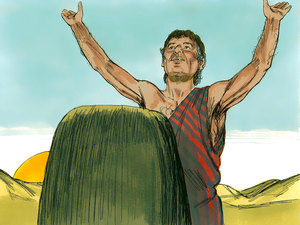
Early that morning Jacob took his stone pillow and set it up as a pillar to remind him of his experience. He poured oil over it. “This place shall be called Bethel.” He bowed his knee and vowed, “If God will be with me and will watch over me on this journey and will give me food and clothes so that I return safely to my father’s house, then the LORD will be my God and this stone that I have set up as a pillar will be God’s house, and of all that you give me I will give you a tenth.”

Reflect

God’s covenant promise given to Abraham and Isaac was also offered to Jacob. Although he was Abraham’s grandson, Jacob would have to establish his own personal relationship with God.

It’s not enough for us to just hear about wonderful Christian family or church members. God has no grandchildren, only children. He desires to be in a personal relationship with each of us. He makes this possible through the work of His son, Jesus Christ, on the cross.

“God made him who had no sin to be sin for us, so that in him we might become the righteousness of God.” –2 Corinthians 5:21

God was gracious with Jacob. He is also gracious with us.

With Easter around the corner, I encourage you to reflect on Christ’s sacrifice. He not only longs to save us from the consequences of our sin—eternal death—but also desires to fellowship with us daily (Rev. 3:20).

Jacob’s Blessing, Genesis 26:34-28:9

Although Jacob had been given the birthright by his older brother years before, he still needed his father’s blessing to make it binding.”                   –NIV Life Application Study Bible

This long chapter could be written as a play with five scenes. Two short passages of Esau’s pagan marriages (26:34-35 and 28:6-9) frame the main portion: Isaac giving his blessing to Jacob. The short Esau passages serve as a kind of prologue and epilogue.

You may read Genesis 26:34-28:9 here: Bible Gateway.

SCENE 1: Isaac Asks Esau for a Meal (27:1-4)

(freebibleimages.org)

(freebibleimages.org)

Despite the knowledge that Jacob was to get the blessing (25:23), Isaac in his old age determines to bless his favorite—Esau—in secrecy. Similar to Esau’s earlier insistence of Jacob’s stew (25:27-34), Isaac tells Esau to hunt some wild game and prepare his favorite dish before the blessing.

SCENE 2: Rebekah’s Scheme (27:5-15)

003-jacob-deceives

(freebibleimages.org)

This scene intensifies as Rebekah plays the role as spy and urgent initiator.

“The word used to describe Rebekah’s listening suggests that this is a habit, a pattern of behavior, not happenstance. Her behavior gives us an idea of the level of mistrust and poor communication in the family.” –Layman’s Bible Commentary

SCENE 3: Jacob Imitates Esau (27:18-29)

(freebibleimages.org) Rebekah's plan is carried out with skins and garments of goats. Jacob's deception would turn on him when his sons dip the garment of Joseph, his favorite son, in the blood of a goat to make him think Joseph has been killed by a wild animal (27:16; 37:31-33). “Although Jacob got the blessing he wanted, deceiving his father cost him dearly. These are some of the consequences of that deceit: 1) he never saw his mother again; 2) his brother wanted to kill him; 3) he was deceived by his uncle, Laban; 4) his family became torn by strife; 5) Esau became the founder of an enemy nation; 6) he was exiled from his family for years.” –NIV Life Application Study Bible

(freebibleimages.org)
Rebekah’s plan is carried out with skins and garments of goats. Jacob’s deception would turn on him when his sons dip the garment of Joseph, his favorite son, in the blood of a goat to make him think Joseph has been killed by a wild animal (27:16; 37:31-33).

Although Rebekah is the mastermind behind this scheme, Jacob joins in her ruse and manipulates Esau once again. Jacob had already secured the birthright with the promised land blessing. But now—duped into thinking Jacob is Esau—Isaac blesses Jacob with fruitfulness in the promised land (Deuteronomy 7:13) and dominion over the nations and his family.

In regards to the blessing, Layman’s Bible Commentary notes: “The dew of heaven provides irrigation. The fatness of the earth is rain. Grain and new wine evoke the image of a banquet, overflowing with joy (Psalm 4:7). . . . The curses and blessings equate to God’s protection and are particularly linked to dominion (Numbers 24:9).”

SCENE 4: Esau’s Horror and Revenge (27:30-45)

(freebibleimages.org)

(freebibleimages.org)

 Since a person’s word was binding in ancient times—much like a contract today—Isaac’s blessing was irrevocable.

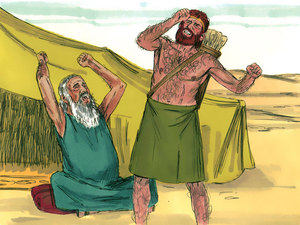
When Esau realizes Isaac’s ploy, he weeps aloud.

 SCENE 5: Jacob Leaves

In his fury, Esau determines to kill Jacob after their father dies. Rebekah once again manipulates Isaac in attempt to protect Jacob. She sends Jacob away to her brother Laban in Haran. Her cover story feeds from their frustration of Esau’s marriage to pagan women: “If Jacob takes a wife from the women of this land, from Hittite women like these, my life will not be worth living.”

(freebibleimages.org)

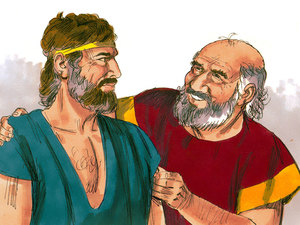
This time Isaac purposely blesses Jacob as he sends him off. But although Jacob receives the blessing, his deception costs him dearly. “These are some of the consequences of that deceit: 1) he never saw his mother again; 2) his brother wanted to kill him; 3) he was deceived by his uncle, Laban; 4) his family became torn by strife; 5) Esau became the founder of an enemy nation; 6) he was exiled from his family for years.” –NIV Life Application Study Bible.

Esau’s next move is to marry again—this time to an Ishmaelite. Perhaps his aim is to please his parents since his third bride isn’t a foreigner, (Ishmael was Isaac’s half-brother). But this arrangement only further disappointed his parents. Ever since Isaac received Abraham’s blessing, instead of Ishmael, family strife between Isaac and Ishmael’s descendants have sparked.

Reflect

  • Much heartache and division could have been avoided had Rebekah waited on God and His timing. For God had already clarified that Jacob would be the family leader (25:23-26). But Rebekah and Jacob became trapped in sin by resorting to lies and manipulation to achieve their goal.
  • No matter how worthy our goals may be, God never endorses wrong doing for desired results. It might be painful to correct ourselves in the middle of a mistake, but that will free us from being a prisoner to sin.
  • Where we see the shortcomings of the patriarchs, it’s clear that God is the real hero. Thankfully, He is the expert craftsman of all our human intentions and actions—for good or evil—weaving His purposes into His ongoing plan (Romans 8:28).

Have a wonderful week!


Isaac and Abimelech, Genesis 26:1-33

Blessed are the peacemakers, for they will be called children of God.” –Matthew 5:9

You may read Genesis 26:1-33 here: Bible Gateway.

Genesis 26 precedes Genesis 25:21-34 chronologically. Layman’s Bible Commentary points out: “If Isaac and Rebekah had Jacob and Esau by this point, the fact that they were husband and wife would have been obvious. Here, the promised seed is with Isaac and Rebekah, but no child has yet been born.”

Like Father, Like Son   fowl-language-comics-do-as-i-say-28bc8d56e19b08188b1883b1fc8deeb2

While Isaac is mentioned in other chapters, he is the main character in Genesis 26. The following parallels emerge between Isaac and his father, Abraham, in their life events:

  • Isaac travels to Gerar—the land of the Philistines—when famine strikes (vs. 1-6). This is the same area Abraham and Sarah journeyed after Sodom’s destruction (20:1).
  • Due to famine, Isaac plans on travelling to the same place that Abraham went: Egypt (12:10-20).
  • The Lord appears to Isaac—telling him not to go to Egypt—and uses the same covenant language that He used with Abraham (12:1-3; 13:14-17; 15:18-21; 17:6-8, 16; 22:17-18).
  • In fear of losing his life, Isaac lies about Rebekah’s identity just as Abraham withheld the truth of Sarah’s full identity. (The Abimelech in verse 8, however, is most likely the son or grandson of the Abimelech that ruled Gerar in Abraham’s day).
  • As Abraham and Isaac’s prosperity grew, both needed more space and water for their flocks. Abraham sought peace when disputes broke out between Lot’s herdsmen and his herdsmen. Likewise, Isaac avoids escalating conflicts when Gerar’s contentious herdsmen plug the first two wells he and his men dug.

The names of the wells in verses 20-22 reflect the situations. Esek means “argument” in Hebrew, a reminder of the conflict its discovery created. Sitnah comes from a Hebrew verbal root meaning “to oppose; to be an adversary,” and signals that the digging of this well causes opposition from the Philistines. Rehoboth comes from a verbal root meaning “to make room,” and reminds all how God has made room for them. Since he finally has a well that is uncontested, Isaac might logically have decided to stay there. Instead, he moves on to Beersheba (26:33).” –Layman’s Bible Commentary

Isaac’s second revelation from God is in Beersheba (vs. 23-25). God reviews the promises He gave earlier (vs. 2-5) and stills Isaac’s fears. In response, Isaac builds an altar and worships God. The fact that he settles in Beersheba seems to indicate God’s pleasure in his relocation from the Philistine region.

Verses 26-33 end on a sweet note. King Abimelech  approaches Isaac with a peace treaty as he acknowledges God’s blessings on Isaac. Not one to miss an opportunity to make peace, Isaac throws a celebration for him.

Reflect

Isaac followed Abraham’s life pattern. We should be intentional in what we model to our children. Do our words, attitudes, and actions reflect Christ?

The Philistines grew jealous of Isaac’s success. How can we guard ourselves from the misery of divisive jealousy? Consideration of the consequences of an angry reaction—perhaps loss of a relationship or job—and thankfulness for what we have is a great starting point.

By plugging up Isaac’s wells, Gerar’s herdsmen were declaring war. But Isaac compromised his father’s former wells and moved on. Would we be willing to compromise a valuable item or important position for the sake of peace?

Isaac’s pursuit of peace spread godly influence and won Abimelech’s respect. Are we willing to forgive and meet our enemy’s attempt to make amends?