Genealogy: Adam to Noah, Genesis 5:1-32

Although this second genealogy, (the first is Gen. 4:17-34), doesn’t appear inspiring at first glance, there are some cool findings here.

Genealogies show that people as individuals, not just nations, are important to God.

This fifth chapter in Genesis lists the ten descendants of Adam to Noah and spans at least 1,600 years—the longest period in world history. The development of the human race and showing the time lapse between these two major individuals seem to be the primary purpose for this genealogy. Of the ten people listed, the average age is about 900.

I would love to see that many candles on a birthday cake.

Come to think of it, I would love to visit with a 900 year-old!

How did our ancestors live so long?

The NIV Life Application Study Bible offers three explanations:

  1. The human race was more genetically pure in this early time period, so there was less disease to shorten life spans.
  2. No rain had yet fallen on the earth, and the expanse of water “above” (1:7) kept out harmful cosmic rays and shielded people from environmental factors that hasten aging.
  3. God gave people longer lives so they would have time to “fill the earth” (1:28).

Grace Trumps

Although the death theme rings loud in this chapter as a reminder of the consequence of sin, God’s grace trumps. References to fertility (sons and daughters), life, and other blessings illustrate God as a loving parent who provides an inherited blessing and insures the future well-being of His children, (Seth down to Noah’s family).

I find Enoch’s story mysterious and fff9ade3efebdb1f86636aed7f01af0aintriguing. Interestingly, Enoch and Lamech (Cain’s descendant) were both the seventh generation from Adam. They exemplified the contrasting positions toward God.
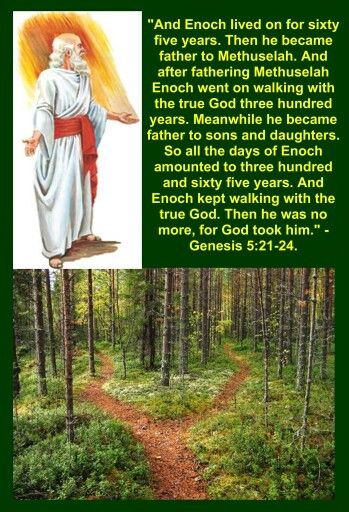
Only two men have been recorded as “walked with God” (NEV): Enoch and Noah (5:22; 6:9). Walk describes the closest communion with God—as if walking by His side—representing fellowship and obedience. Divine blessing are the results.

Enoch never experienced death. He was just 365 years when God took him to be with Him.
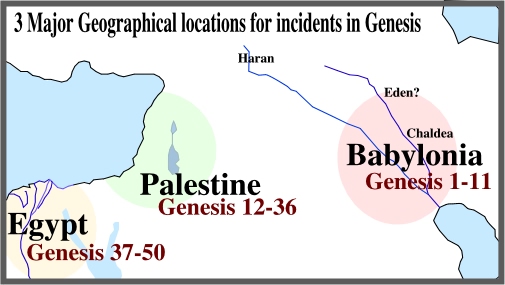
Our History: Two Distinct Groups Arise (Genesis 4:16-26)

So Cain went out from the LORD’s presence and lived in the land of Nod, east of Eden. Cain lay with his wife, and she became pregnant and gave birth to Enoch. Cain was then building a city, and he named it after his son Enoch.” – Genesis 4:16-17

Cain’s Descendants         

This account begins a history of Cain’s descendants. Since Nod means “wandering”, it’s likely that this was a figure of speech rather than an actual geographical area that Cain and his wife journeyed to after he murdered his brother, Abel.

GenesisOutlineMap

Cain may have tried to derail God’s prophecy of him becoming a wanderer by building a city. The Hebrew verb “was building”, however, is indefinite and suggests that he never finished. But Cain’s descendants did prosper by taking the lead in building cities, developing music, advancing agriculture, creating weapons, and spreading civilization.

Cain’s family record jumps down to Lamech, the seventh generation from Adam. His family not only epitomizes the variety of talent and ability God gives people, but also shows the rise of sin.

Lamech held a high view of himself and wore polygamy, murder, and revenge as a badge of honor. He defied God’s principle of monogamy (Gen. 2:23, 24) by taking two wives. He also killed a young man in self-defense, then arrogantly bragged to his wives: “If Cain is avenged seven times, then Lamech seventy-seven times.”

Henry M. Morris notes the significant elements that modern evolutionary archaeologists and anthropologists identify of evolving men from the stone age into true civilization—namely urbanization, agriculture, animal domestication, and metallurgy. These were all accomplished quickly by the early descendants of Adam. It did not take hundreds of thousands of years as evolutionists suggest.

Two Distinct Groups Arise

Another branch of Adam’s family tree takes shape. Seth—born to Adam and Eve—took Abel’s place as leader of God’s faithful people. Seth’s name means “appointed” or “substituted”.

Two distinct groups arise: 1) Those who are apathetic to sin and evil, (although the Cainites sought to exercise dominion over the earth as God commanded, their motivation stemmed from rebellion against God); and 2) those who call on the name of the Lord (the descendants of Seth, 4:26). This shows the probable shift from individuals personally meeting with God to the beginning of regular public worship and prayer. It also shows faith on the part of those who “called upon His name”.

Although Seth and his family line also inherited Adam and Eve’s sin nature, they would carry the “seed of the woman” (God’s prophecy to Eve) that would eventually defeat the Serpent: Jesus Christ through His death and resurrection.

Cain and Abel: Our History and More (Not So Great) Firsts, Part 2 (Genesis 4:3-15)

One’s attitude of heart toward this matter of approaching and knowing God actually determines his destiny in eternity. . . .”  – Henry M. Morris

Adam’s first two sons, Cain and Abel, show the first great division of humanity concerning their attitude toward God. Where Adam and Eve sinned only against God, sin quickly snowballed into tragedy through their firstborn son, Cain, who sinned against both God and man.

Adam’s first two sons, Cain and Abel, show the first great division of humanity concerning their attitude toward God. Where Adam and Eve sinned only against God, sin quickly snowballed into tragedy through their firstborn son, Cain, who sinned against both God and man.

Genesis 4:5 tells us that God rejected Cain’s offering, but accepted Abel’s. Beyond being the first shepherd, Abel is listed as the first member of the Hall of Faith in Hebrews 11. (For more on faith, see Abraham Justified By Faith, Faith Factor, Growing in Faith). Abel is also recorded as the first martyr for truth (Matthew 23:35).

Although the Bible doesn’t give specifics why God rejected Cain’s offering—fruits of the soil—both brothers knew God’s expectations. Maybe Cain resented Abel’s insistence of obeying God. (Abel was deemed the first prophet, Luke 11:49-51.) Maybe Cain determined to prove his self-sufficiency with his own produce, regardless of God’s curse from sin.

Whatever the reasons, God evaluates both the quality and motives of our offerings (Prov. 21:27). Cain’s offering failed God’s standards and specific instructions.

Instead of evaluating why God disapproved of his offering, Cain reacted in hot anger.

In response to Cain’s anger, God replied: “. . . . If you do what is right, will you not be accepted? But if you do not do what is right, sin is crouching at your door; it desires to have you, but you must master it,” (Genesis 4:6-7).

(This is the first time sin is mentioned in the Bible.)

God’s reply to Cain identifies his haughtiness, pride, and probable growing resentment toward his brother. Although God graciously gave Cain a second chance to right his wrong, Cain refused.

Seeds of jealousy, envy, and anger soon blossomed into hatred and eventually cold-blooded murder of his brother, Abel (Gen. 4:8).

God is patient and merciful, but He won’t always put up with sin. Although Cain stilled his brother’s prophesying voice, God’s voice had the final say: “Your brother’s blood cries out to me from the ground. Now you are under a curse and driven from the ground . . . . When you work the ground, it will no longer yield its crops for you. You will be a restless wanderer on the earth,” (Gen. 4:10-11).

(This is the first mention of blood in the Bible.)

Although God views human life as very sacred, He didn’t demand capital punishment as commanded later (Gen. 9:5). Instead, “He put a mark on Cain so that no one who found him would kill him,” (Gen. 4:15). Maybe Cain would still repent. Maybe Cain would remind others of sin’s consequence.

So What?

  • God deserves our best in time, talents, and money.
  • Satan is real and will do anything to get us to follow his deadly path. We may not think of ourselves as murderers, but as long as we live on earth: sin still “crouches at our doors”. Only through God’s Holy Spirit can we master sin.
  • Is there a small sin that needs to be uprooted in your life?

Our History of “Firsts”, Part 1 (Genesis 4:1-5)

There is a time for everything, and a season for everything under heaven: a time to be born and a time to die, a time to plant and a time to uproot . . .”  Ecclesiastes 3:1-2

The following “first times” are recorded in the short passage of Genesis 4:1-5.

First Sexual Intercourse

Genesis 4:1 records Adam and Eve in this intimate act.

God created sex not only to populate the earth, but also for our pleasure. His design for this act is modeled between one man and one woman, within the boundary of marriage. This sacred gift seals the spiritual, physical, and social relationship between husband and wife when exercised God’s way. (See also Gen. 2:18; Jer. 29:6; Isa. 62:5; 1 Cor. 11:11-12)

First Births

Although childbearing pain entered the picture, Eve acknowledged God’s help in conceiving her firstborn son, Cain. She later gave birth to Abel. Both sons occupied honorable occupations: Cain grew to become a farmer, while Abel became a shepherd.

First Struggle in Daily Living

Abel means “vapor” or “vanity.” At this point, Adam and Eve no doubt realized the full impact of God’s curse from their sin (Rom. 8:20). Food, clothing, and shelter would no longer be provided freely as in the Garden of Eve, but wrought with much struggle against the elements.

First Recorded Offerings to God

Although Adam and Eve had been driven out of the Garden away from God’s presence, God graciously still made Himself available for counsel under certain conditions. Although the Bible doesn’t record these first conditions to Adam and Eve in approaching Him, He probably instructed them in regards to sacrifices and offerings given to Him; possibly when God provided the first clothes—coats of animal skins—for them (Gen. 3:21).

It’s likely that Abel’s sheep were to be used for sacrifice since atonement (“covering”) required shedding of blood.

"In the course of time Cain brought some of the fruits of the soil as an offering to the LORD. But Abel brought fat portions from some of the firstborn of his flock. The LORD looked with favor on Abel and his offering, but on Cain and his offering he did not look with favor. So Cain was very angry, and his face was downcast."  - Genesis 4:3-5

“In the course of time Cain brought some of the fruits of the soil as an offering to the LORD. But Abel brought fat portions from some of the firstborn of his flock. The LORD looked with favor on Abel and his offering, but on Cain and his offering he did not look with favor. So Cain was very angry, and his face was downcast.” – Genesis 4:3-5

Cain and Abel may have made many offerings to God. But this was the first recorded time God rejected Cain’s offering. Why? Although we don’t know all of the reasons, my next post will explore some clues as we continue Cain and Abel’s sad saga.

I hope spring is treating you well. Thanks for dropping by!

Made In God’s Image

Then God said, ‘Let us make man in our image, in our likeness, and let them rule over the fish of the sea and the birds of the air, over the livestock, over all the earth, and over all the creatures that move along the ground.’ So He created man in his own image, in the image of God He created Him; male and female He created them.” – Genesis 1:26-27

In these verses God shifts from third person, “And God said, ‘Let there be . . .” to first person, “Let us make man in our image.” Although it’s difficult to comprehend, we see the triune Godhead at work (Father, Son, and Holy Spirit). One member is speaking to the other member(s).

It’s like God is holding a divine meeting on the sixth day of Creation and decides to “place the cherry (mankind) on top” of all He has created. After breathing life into them, He gives them charge over all the earth, fish, and animals.

“Man” is used here as a generic term, which includes female. (Genesis 2 details the first man, Adam, and the first woman, Eve.)

What Does “Made In God’s Image” Mean?

Although we probably can’t grasp the full significance of this truth now, we know that humans are the most complex and highly organized of all God’s earthly creatures. Besides physical bodies, other attributes that we don’t share with the animals include:

  • Moral consciousness
  • Understanding of emotion and beauty
  • Ability to think abstractly
  • The capacity to worship, fellowship, and love God. Henry M. Morris (The Genesis Record) writes, “This eternal and divine dimension of man’s being must be the essence of what is involved in the likeness of God.”

But if God is spirit (John 4:24) and omnipresent, how can we be made in His image?

Morris writes: “God designed and formed man’s body to enable it to function physically in ways in which He Himself could function, even without a body. God can see (Gen. 16:13), hear (Psalm 94:9), smell (Gen. 8:21), touch (Gen. 32:32), and speak (II Pt. 1:18), whether or not He has actual physical eyes, ears, nose, hands, mouth. Furthermore, whenever He has designed to appear visibly to men, He has done so in the form of a human body (Gen. 18:1-2).”

Christ Himself was the image of God (Heb. 1:3; Col. 1:15; II Cor. 4:4). Morris continues: “It does not seem too much to infer that God made man in the image of that body which He would Himself one day assume (Heb. 10:5; Luke.1:35; Phil. 2:7).”

Although we are marred by sin—and are not equal to God—His original, unique work of the human body manifests a part of God’s glory. When God redeems an individual, He begins to renew him/her in the original image of God. He creates a “new self, created to be like God in true righteousness and holiness” (Eph. 4:24). His redemption is made possible through faith in Jesus Christ as our Savior from the sin that separates us from Him (Eph. 2:8-9). We are made new creations—in the likeness of God—through Christ (2 Cor. 5:17).

If—or when—you feel insignificant, remember: You are uniquely crafted by the Master Creator of the universe. He has put much thought and pleasure into designing you. Not only does He have a special purpose specifically for you, but He also declares His work “very good!”

*This article is also posted in the Gospel Blog by FEBC at http://blog.febc.org/made-in-gods-image/