I, Jody, take you, John, to be my wedded husband. To have and to hold, from this day forward, for better, for worse . . . ‘Till death do us part.”
(stylegrace.com)
Sealed with a kiss, this vow—in the covenant of marriage—is valid as long as the husband is alive.
Paul’s readers understood that a violation of this law would disgrace Jody as an adulteress. If her husband dies, however, she is free to marry another man.
This is the picture Paul gives us to compare Christians and the Law. Not only do believers die to sin, but also to the Law, thus cancelling the Law’s “lordship” or claim over the believer (vs. 4).
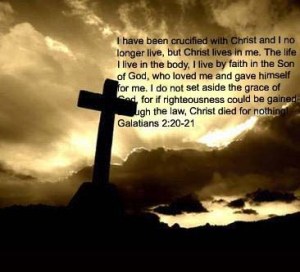
Similar to the picture of baptism, death to sin begins when the believer places his/her trust in Christ. By identifying with the crucified Christ and joining in union to Him, the resurrected Christ becomes the believer’s new “husband”. The Holy Spirit enables the believer to produce good fruit for God.
So What?
Because of Christ’s sacrifice, the way to God is open through faith. No longer trying to earn salvation through an external code of law keeping or following Christian customs, the believer is free to serve God with a new heart out of love and gratitude.
“Is the Law sin?” Paul asked as though repeating a reporter’s question. Given his previous replies, this one shouldn’t surprise: “certainly not!”
Romans 7 paints a small picture of Paul’s spiritual experience. He sets the stage here for the triumphant entry in chapter 8.
In verses 7-11 Paul seeks to explain a relationship he finds between the Law and sin. “I would not have known what sin was except through the Law . . . .” He reasons that apart from the Law sin can’t be labeled “sin,” even though it still exists.
Shepherd’s Notes gives this example and commentary: “There may be dangerous microbes in the air, but unless some instrument detects them, they will go unnoticed. The Law does more than show sin for what it is. It provokes sin. Sin seizes the opportunity and arouses within a person a desire to do evil.”
Question #2
Paul brings up another question: “Did that which is good—that is the Law—become death to me? By no means!” (vs. 13). Paul tells that through the Law he realized just how dark and enormous sin was, even achieving its evil end through something as good as God’s Law so death might be accomplished through it. The Law was never the culprit, just sin.
The Christian’s Struggle
As Paul furthers the relation between the Law and sin, he flips from past to present tenses: “We know that the Law is spiritual; but I am unspiritual, sold as a slave to sin.” The phrase “sold as a slave to sin” means bought and delivered to sin, as a slave to a master. This same verb was used in Matthew 18:25 to describe a debtor being sold into slavery (Shepherd’s Notes). Paul uses this analogy to show that no matter how much he loved God’s Law, he was enslaved to sin—powerless to completely obey it.
I do not understand what I do. For what I want to do I do not do, but what I hate I do.” -vs. 15
More than a tongue twister, Paul’s cry describes the Christian’s struggle against sin, or trying to please God by rule keeping apart from the Holy Spirit’s help.
Verses 21-24 remind me of the children’s book: Alexander and the Terrible, Horrible,No Good, Very Bad Day with struggling being the common denominator.
“What a wretched man I am! Who will rescue me from this body of death?” (vs. 24)
But Paul’s conclusion rings with sweet victory: “Thanks be to God—through Jesus Christ our Lord!” (vs. 25)
So What?
Law makes us aware of sin by defining it.
There is a two-sided reality of the Christian life. Although our acceptance with Christ is secure—making believers complete in Him—we still feel the pull of sin. Shepherd’s Notes observes: “Sanctification is a gradual process that repeatedly takes the believer through this recurring sequence of failure through dependency upon self to triumph through the indwelling Spirit.” Although conflict and struggle are part of our earthly journey, despair and defeat are not thanks to the death and resurrection of our Lord, Jesus Christ who provides power to live freely above sin’s lure and captivity.
“You may go free, not guilty!” What would these words mean to you if you were on death row?
The reality is, we are all on death row because we have broken God’s holy Law multiple times. But thankfully, God has made a way to clear our record, declare us not guilty, through faith in His Son, Jesus Christ.
Therefore, there is now no condemnation for those who are in Christ Jesus, because through Christ Jesus the law of the Spirit of life set me free from the law of sin and death.” – Romans 8:12
This verse, along with the rest of this chapter, is one of my favorite passages. In a world of condemning voices and pointing fingers, this verse gives reason to celebrate. Jesus liberates the believer from the old bondage to sin and death!
Two laws are cited in this passage:
The Law of Sin and Death. It lurks around every corner, challenging every good motive, enslaving the one who strives to fulfill the Law through self-determination. Romans 7:14-25 describes its havoc.
The Law of the Spirit. Through Jesus Christ, this law defeats the old law’s grip on sin and death, setting people free. Shepherd’s Notes observes: “Twenty-one times in Romans 8 the Greek word for Spirit or spirit occurs. At least 18 of these are references to the Holy Spirit . . . . We have in Romans 8 Paul’s fullest discussion of the new life of the Spirit.” (For more information on our sinful nature vs. our new life in Christ, see 6:6-8; Ephesians 4:22-24; Colossians 3:3-15.)
Verse 3 not only explains how the Law of the Spirit sets people free, but also contains the following two doctrines:
The Incarnation
God’s Son, Jesus Christ, became one of us. Paul describes Christ’s coming as “in the likeness of sinful man.”
The Atonement
God achieved our freedom from captivity to sin through Jesus’ sacrificial death (“sin offering”) on the cross. Jesus bore the brunt of the world’s sins. The NIV Study Bible notes: “In Old Testament times, animal sacrifices were continually offered at the temple. The sacrifices showed the Israelites the seriousness of sin: blood had to be shed before sins could be pardoned (see Leviticus 17:11). But animal blood could not really remove sins (Hebrews 10:4). The sacrifices could only point to Jesus’ sacrifice, which paid the penalty for all sins.”
In verse 9, Paul tells his readers that they are not controlled by their sinful nature, but their lives are guided by the indwelling Spirit (Holy Spirit). The Holy Spirit is also God’s guarantee of eternal life for the believer.
So What?
Christians can rise above sin and experience life through the empowerment of the indwelling Holy Spirit.
A Christian is anyone who has the Spirit of God (Holy Spirit) living in him/her. Jesus promised His Spirit to anyone who sincerely trusts Him for salvation and acknowledges Him as Lord.
Although our feelings come and go, we can stand confidently on God’s promises of living forever with Him. (See also Romans 8:23; 1 Corinthians 6:14; 2 Corinthians 4:14; 1 Thessalonians 4:14.)
“It’s personal!” Although this phrase is often stated negatively, Paul turns it into a positive.
Adoption or “sonship” is the theme used in this passage to illustrate the believers new relationship with God. The NIV Study Bible observes: “In Roman culture, the adopted person lost all rights in his old family and gained all the rights of a legitimate child in his new family. He became a full heir to his new father’s estate.”
Shepherd’s Notes classifies Paul’s discussion into three areas: the test of sonship, the privilege of sonship, and the assurance of sonship.
The Test of Sonship(vs. 14) “Those who are led by the Spirit of God are sons of God” (vs. 14). We follow the one to whom we belong. A daily response to the Spirit’s leading shows we are God’s child. This factor is more reliable than our emotional ups and downs. “Elation without obedience is a fraud,” (Shepherd’s Notes).
The Privilege of Sonship (vs. 15) Through the contrasting pictures of slavery and adoption, Paul reminds us that turning to Christ releases us from enslavement to fear. In fact, believers are now privileged to call God “Abba! Father!” Shepherd’s Notes observes that Abba is found only three times in the New Testament: Galatians 4:6; Mark 14:36; and in this passage. Abba is the Aramaic word for father. Used in the Jewish home, it expresses the intimacy between child and father. No term serves better than Abba or Father to show the warm, personal relationship to God that His grace has made possible.
The Assurance of Sonship (vs. 17) Paul connects being “heirs of God and co-heirs with Christ” to sharing in Christ’s sufferings. These sufferings come from following Christ, not from the common adversity of illness, loss of employment, or bereavement (Shepherd’s Notes). (See also Philippians 1:29; 3:10; Colossians 1:24). But Paul also emphasizes the result: “in order that we may also share in His glory.”
So What?
When a person becomes a Christian, he/she receives all the privileges and responsibilities of a child in God’s family.
God deserves obedience to His indwelling Spirit by following Him and “dieing” to sin.
The believer’s current suffering dims in comparison to the glory he/she will share with Christ.
Nothing we suffer compares to the suffering Jesus experienced to save us.
I hope you’ve had a great summer. The glory of summer is soon fading. I enjoy summer, but I really love the changing colors and weather fall brings. I’m thankful for the changing seasons.
Speaking of fading, my computer’s hard-drive died. I’ve told myself that I will never take my computer for granted again! 🙂
Since my hard-drive crashed last week I’ve been using the library’s computer. Unfortunately, I haven’t been able to post pictures. With limited time I will also be posting weekly for a while instead of twice a week.
Seasons
As I write about change and seasons I’m reminded of what my pastor said: “Knowing what season you’re in (spiritually) is important.” He suggested that our lives won’t be in perfect balance as we journey here on earth, but we usually have a rhythm in our spiritual growth. Knowing which season we’re in will determine how we respond.
On the tail of verse 17 in Romans 8, after writing about a season of sharing in Christ’s suffering, Paul sets up three reasons for encouragement: 1) the glory that will be revealed (vs. 18-25); 2) the Holy Spirit’s help (vs. 26-27); and 3) all things work together for good (vs. 28-30).
Hope of God’s Final Victory
I consider that our present sufferings are not worth comparing with the glory that will be revealed in us. The creation waits in eager expectation for the sons of God to be revealed. For the creation was subjected to frustration, not by its own choice, but by the will of the one who subjected it, in hope that the creation itself will be liberated from the bondage to decay and brought into the glorious freedom of the children of God. We know that the whole creation has been groaning as in the pains of childbirth right up to the present time.” –vs. 18-22
Genesis 3:17-19 sets the background for this passage. Paul makes three observations about creation:
It eagerly awaits the revelation of God’s children.
By God’s will, it was subjected to frustration.
It will be set free from decay’s bondage and share in transformation along with God’s children.
Paul ties the believer’s present trials to creation in verses 23-25. Similar to creation, we groan inwardly as we await the full adoption as God’s children that will happen at the resurrection. Our present hope is “the first-fruits of the Spirit”, God’s promise of our total victory with Christ in the end.
So What?
Through sin, all creation is subject to frustration and bondage to decay. But one day all creation will be set free and transformed. Because believers look forward to a new heaven and earth that God promised we can be filled with hope now.
Believers resurrected bodies will be glorified like the body Christ now has in heaven (1 Corinthians 15:25-58; 1 John 3:2). Believers have the down payment, “first-fruits”, of the Holy Spirit as a guarantee of being resurrected (2 Corinthians 1:22; 5:5; Eph. 1:14).
If you are a believer who is currently suffering, hold on to hope. Ultimate victory is your final resting place through Jesus Christ!

 is open through faith. No longer trying to earn salvation through an external code of law keeping or following Christian customs, the believer is free to serve God with a new heart out of love and gratitude.
 children’s book: Alexander and the Terrible, Horrible, No Good, Very Bad Day with struggling being the common denominator.
 kdmanestreet