Jonah and the Slippery Slope of Sin

So they said to him, ‘What should we do to you that the sea may become calm for us?’—for the sea was becoming increasingly stormy.” – Jonah 1:11

Jonah was the only prophet recorded in Scripture who ran away from God. Priscilla Shirer (Jonah, Navigating a Life Interrupted), writes: “When he first started running, Jonah in essence stepped down from his prophetic office and went down to Joppa—geographically down-hill. He found a ship and went down to it. His descent didn’t stop there. Once on board he went down into the hold to get some sleep (1:5).”
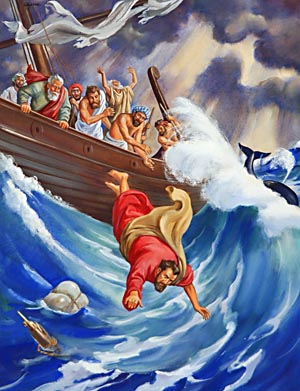
After getting stuck in a web of consequences—including being thrown overboard, swallowed by a big fish and tangled in slimy seaweed—Jonah learns it would have been much easier just to obey in the first place.

So how does a successful prophet/person spiral downward so quickly? The same way any of us spiral down the slippery slope of disobedience. It begins with a justified thought: I’ve worked hard all week, what’s a little flirting? . . .  Maybe I didn’t tell the whole story, what they don’t know can’t hurt . . . . If my boss knew that I barely make ends-meet he wouldn’t care that I pocket a donation now and then.

The justified thought followed by a justified action initiates the descent. It doesn’t take a rocket scientist to figure out sins’ negative ripples affect not only the one being disobedient, but also affects surrounding lives.

After Jonah finally told the sailors he was running from God, the sailors reeled not only from the storm, but also reeled for life saving answers. Shirer writes: “We easily become paralyzed by fear or guilt when our lives seem to whirl out of control. A glimpse at our lives with all of their spinning parts can make us dizzy with disgust at the mess we may have made. It’s easier to just sit, soak, and be sour. That’s what the enemy would like. He’d prefer we get lazy, complacent, and apathetic with distance between ourselves and God’s best. But if, like the sailors, we see the connection between our chaotic circumstances and our own decisions, we must ask, ‘Now what?’”

So what should we do when we find ourselves in the belly of our consequences? In last week’s post, Jonah’s Unhallowing of God’s Name, Jonah had finally answered the sailors’ questions about his identity. His answers, along with his actions, parallel important New Testament teachings for reconciliation with God.

Steps Toward Reconciliation with God

Acknowledge our sin (Jonah 1:12) – “I acknowledge my sin to You … I said, ‘I will confess my transgressions to the Lord’; and You forgave the guilt of my sin,” (Psalm 32:5).

Accept God’s discipline (Jonah 1:15) – “It was good for me that I was afflicted, that I may learn Your statutes . . . .  I know, O LORD, that Your judgments are righteous, and that in faithfulness You have afflicted me,” (Psalm 119:71, 75). God doesn’t discipline for sport. Rather, He wants to prepare us for His purposes by reviving and realigning us.

Ask for forgiveness (Jonah 2:2) – Repentance has two parts: 1) Confession means to agree with God about any rebellion or sin we harbor and ask Him to cleanse us; 2) Change means to change our attitude, mind, and actions . . . turn away from the sin and turn toward God. Although Jonah’s heart still didn’t align with God’s heart, his actions finally complied with God. Sometimes we just need to step out in faith and allow God to help us align our hearts and feelings in time. I love that no matter how far we have slipped, or how much time we’ve lost, God is faithful and completely forgives (1 John 1:9). He is the master of taking our messes and shaping it into something beautiful, replacing the old with fresh life in Him.

Act on God’s direction (Jonah 2:9; 3:3) – Many commentators believe Jonah 2:9 is the heart of the book of Jonah since he decides to obey God’s directives. After being spit out on dry land, Jonah realizes that Yahweh has preserved his life through a fish named “grace”. “But I will sacrifice to You with the voice of thanksgiving. That which I have vowed I will pay. Salvation is from the LORD.” Shirer writes: “True sacrificial obedience would cost Jonah something more than just a one-time decision to go to Nineveh. Likewise, we must be willing to obey the small details along the pathway to obedience to the Lord as well.”

Has God’s divine interruption revealed anything you are holding on to too tightly? Is there a goal, comfort, ambition, or sin He is asking you to release? If so, release it to the One who loves you and knows you best. Then go where He is leading.

While Jonah 1 records everyone praying except for Jonah, chapter 2 records a beautiful prayer of Jonah crying out to God. The bulk of his prayer highlights the depths he sunk both spiritually and physically.

For more on prayer, specifically unwrapping the Lord’s Prayer, you may listen to Pastor Cliff Purcell’s podcast here: A Family Conversation – Week 4 (Feb. 4, 2018). Blessings!


The Magi Visit the Messiah, Matthew 2

After Jesus was born in Bethlehem in Judea, during the time of King Herod, Magi from the east came to Jerusalem and asked, ‘Where is the one who has been born king of the Jews? We saw his star when it rose and have come to worship him.’” –Matthew 2:1-2

I realize most of us have heard this story many times. But I thought I’d share a short summary of what stands out the most to me at this time. You may read Matthew 2 here: Bible Gateway.

The wise men—after traveling thousands of miles to see the king of the Jews—responded with worship and costly gifts. They gave of their best. Bible students see their gifts as a symbol of Christ’s identity and what He would accomplish:

  • Gold – a gift for a king
  • Incense – a gift for deity
  • Myrrh – a spice for a person who was going to die

The Magi’s approach to simply worship God for who He is stands in stark contrast to many people’s approach today. Our culture tends to breed expectations of God that center around us: our comfort and convenience. How often do we expect God to seek us, explain and prove Himself, and then bless us with gifts?

Joseph received divine guidance to take Mary and Jesus to Egypt so Herod couldn’t kill Jesus. Like Joseph, are we receptive to God’s guidance? Are we preparing our hearts to discern God’s leading by spending daily time in His Word and in prayer?

The following music video is for all my drummer friends (and those of you who just like drums) Merry Christmas!


Does Jesus’ Genealogy Matter? (Matthew 1:1-17)

“Thus there were fourteen generations in all from Abraham to David, fourteen from David to the exile to Babylon, and fourteen from the exile to the Christ.” – Matthew 1:17

I’m beginning the book of Matthew during my devotional times, which seems appropriate with Christmas around the corner. This Gospel book links the Old and New Testaments by referencing many links to Jesus as the fulfillment of Old Testament prophecy. While 400 years had passed since the last Old Testament prophecies, faithful Jews were still waiting for the Messiah.

Because a Jewish family line proved whether or not a man or woman was chosen as God’s own, Matthew’s opening presentation of Jesus’ genealogy would have held a fascination for his Jewish readers. The first of many proofs to connect Jesus as the Messiah is evidenced with Jesus Christ being a descendant of both King David and Abraham, as the Old Testament had predicted. But Matthew takes it a step further by writing that God did not send His Son to be an earthly king—as the Jews hoped—but a heavenly king. Unlike King David’s kingdom, Christ’s kingdom would never end (Isaiah 11:1-5).

Forty-six people whose lifetimes span 2,000 years—all ancestors of Jesus—are listed in the first 17 verses of Matthew, chapter one. Here is the record of Jesus’ Genealogy: Matthew 1:1-17.

What I love about this record is the fact that all of Jesus’ ancestors were different in their experience, spirituality, and personality. The Life Application Study Bible notes: “Some were heroes of faith—like Abraham, Isaac, Ruth, and David. Some had shady reputations—like Rahab and Tamar. Many were very ordinary—like Hezron, Ram, Nahshon, and Akim. And others were evil— like Manasseh and Abijah.”

Reflect

God is not limited by human sin and failures. Just as He used a variety of people to bring His Son into the world, He continues to work out His purposes through all kinds of people. How has God used you in the past? How does He want to use you now?

God’s Glory Dwelling, Exodus 39:32-40:38

Never underestimate the spiritual power of a dedicated man or woman who knows how to intercede with God. One of our greatest needs today is for intercessors who can lay hold of God’s promises and trust God to work in mighty power (Isa. 59:16; 62:1; 64:1-7).” –Warren Wiersbe

I wonder if the Israelites had a clue about Moses’ experience of interceding for them on Mt. Sinai. Maybe they would have been more appreciative of him had they known. For Moses had “wrestled” with God in prayer, resulting in God’s decision to not reject or destroy Israel.

Tabernacle Dedication

Along with the building dedication, chapter 40 summarizes the priests’ dedication (also described in Exodus 28-29). The tabernacle and its furnishings were now complete so Moses could inspect everything. His job not only included making sure that every utensil was anointed and put in the right spot, but also inspecting every piece of furniture. For unless everything was done according to the pattern God showed him on the mountain, God would not dwell in the tabernacle (25:8-9, 40; Heb. 8:5; 9:9). Warren Wierbe (Be Delivered) makes an interesting observation: “Too many sincere people have tried to do God’s work their own way and then have asked God to bless it. But ministry doesn’t work that way. First we find out what God wants us to do, and we do it to glorify Him. If we obey His will and seek to honor His name, then He will come and bless the work with His powerful presence.”

The word commanded is used 18 times in Exodus 39 and 40, reminding us that the workers did exactly what God told them to do. Moses is also cited as being a faithful servant (Heb. 3:1-6). The work is given a thumb’s up and construction is a go (Ex. 40:1-8, 17-19, 33). Next, the tabernacle—along with everyone associated with it—is dedicated to the Lord.

God’s Glory Fills the Tabernacle

Now God’s glory can fill the tabernacle and abode. Wiersbe writes: “The Hebrew word translated “abode” in Exodus 40:35 (“settled,” NIV) is transliterated shekinah in English, “the abiding presence of God.” (See 24:16 and 25:8). So powerful was the presence of God’s glory that Moses wasn’t able to enter the tabernacle!”

Sadly, Jewish history teaches us that the tabernacle glory left when the people and priests sinned against the Lord (1 Sam. 4:21-22). Ichabod means “the glory is gone.” But God’s glory returned again and dwelt with the people when Solomon dedicated the temple (1 Kings 8:10-11). Unfortunately, their sins also drove God’s glory away (Ezek. 8:4; 9:3; 10:4, 18; 11:23).

“The Word became flesh and made his dwelling among us. We have seen his glory, the glory of the one and only Son, who came from the Father, full of grace and truth.” -John 1:14

When and where did God’s glory appear next? Wiersbe writes: “. . . . in the person of Jesus Christ. In the Greek translation of the Old Testament (the Septuagint), the word abode in Exodus 40:35 is the Greek word used in Luke 1:35 and translated “overshadow.” Mary’s virgin womb was a Holy of Holies where the glory of God dwelt in the person of God’s Son. What did the world do with this glory? Nailed it to a cross!”

Reflect

Where is God’s glory today? Every true believer houses the temple of God (1 Cor. 6:19-20), along with the local church (3:10-23) and the universal church (Eph. 2:20-22). Buildings are dedicated to God as tools for God’s work, but God doesn’t dwell in buildings today (Acts 7:48-50). He dwells in believers. It’s our privilege and responsibility to glorify Him both individually (1 Cor. 6:20) and collectively (14:23-25).

Wiersbe writes: “What a tragedy it would be if the glory departed and we had to write “Ichabod” on [us]. How much better it would be if, like Moses, we did everything according to the heavenly pattern so that God’s glory would feel at home in our midst. . . . When Solomon finished the temple, the glory of God moved in, but when God finishes building His church, He will move the church out! Then we will share God’s glory in heaven for all eternity! ‘And the city had no need of the sun or of the moon to shine in it, for the glory of God illuminated it. The Lamb is its light’ (Rev. 21:23 NKJV).’”

How have you glimpsed God’s glory? I see His glory in a person’s countenance when they are pouring themselves into worship, or have just spent quality time in God’s presence, or exhibit His characteristics.

This is my last post in Exodus. Thank you for visiting, reading, and all of your encouragement! I hope you had a wonderful Thanksgiving! I certainly did. I have much to be thankful for!

God’s Presence and Glory Dwells with the People, Exodus 34:29-35

At last, God blesses Israel’s tabernacle with the glory of His presence. Exodus begins with Moses witnessing God’s glory in the burning bush (3:1-5) and ends with God’s glory descending in the camp and filling the tabernacle. Warren Wiersbe (Be Delivered) writes: “The presence of the glory of God in the camp of Israel was not a luxury; it was a necessity. It identified Israel as the people of God and set them apart from the other nations, for the tabernacle was consecrated by the glory of God (29:43-44). Other nations had sacred buildings, but they were empty.”

God’s Glory Reflected (34:29-35; 2 Cor. 3)

Did Moses realize his face glowed? He apparently “absorbed” some of God’s glory when he soaked in God’s presence the past 80 days while fasting and praying. He had also caught a glimpse of God’s glory. According to this passage, however, Moses was clueless about his radiant face. But it didn’t take long for him to figure out why the people were afraid of him when he came down the mountain. Moses soon persuaded them to come and converse as before. He eventually covered his face with a veil as the glory faded (2 Cor. 3:13). Why? Weren’t the people afraid this strange phenomenon? Wiersbe observes: “The Jews saw this glory as something wonderful and exciting, but what would they say if they knew it was fading away? Who wants to follow a leader who is losing his glory?”

So Moses continued the pattern: Talk to God inside the tent of meeting; God’s glory illuminates his face; Moses covers face with a veil as the glory fades. The Apostle Paul—when answering legalists who taught that God’s way to salvation involves not only faith in Christ, but also obedience to the law (Acts 15:1)—made the following applications about this amazing event (2 Corinthians 3):

  1. The glory of the Mosaic legal system was fading away, but the glory of God’s grace in the gospel is more glorious (vv. 7-11).
  2. The lost Jews during Paul’s day had a veil covering their hearts due to unbelief, blocking their view of God’s glory (2 Cor. 3:14-16). The only remedy for the removal of the veil was to trust Jesus and believe the Word.
  3. Paul also related Moses’ experience to Christians, who through faith experience a spiritual transformation by seeing Christ’s glory in the Word (vv. 17-18). Wiersbe writes: “This is why Christians read the Bible and meditate on it, because when the child of God looks into the Word of God and sees the Son of God, he or she is transformed by the Spirit of God into the image of God for the glory of God.”

    (Credit: elleandcompanydesign.com)

REFLECT (Or should I say “RADIATE”?) 🙂

I’ll close with two more Wiersbe quotes (because they’re really interesting!): “The Greek word for ‘transformed’ in 2 Corinthians 3:18 is “transfigured,” as in Matthew 17:2. It describes the glory on the inside being revealed on the outside. Moses only reflected the glory of God; the dedicated believer radiates the glory of God. Unlike Moses, we don’t wear a veil when we come to God’s Word because we have nothing to hide.”

“Truly spiritual people don’t recognize their own godliness but usually feel as though they’re failures and far from what they ought to be. At Pentecost (Acts 2), each believer could see the tongues of fire above the other believers’ heads, but not over their own heads.”

Next week will be my last post on Exodus. Have a great week!