Jacob’s and Joseph’s Final Days, Genesis 49:29-33; 50:1-26

I am about to be gathered to my people. Bury me with my fathers in the cave in the field of Ephron the Hittite, the cave in the field of Machpelah, near Mamre in Canaan, which Abraham bought as a burial place from Ephron the Hittite . . .” -Genesis 49:29-30

Jacob’s instructions for his sons to bury him where his fathers are buried in Canaan reveals his faith that God’s covenant promises to give them the land will come to pass. (Related: The Death of Sarah)

You may read Genesis 49:29-33; 50:1-26 here: Bible Gateway.

Interesting Facts and Observations

  • Jacob dies at the age of 147. Although he claimed his years to be “few and difficult” (Gen. 47:9), his relationship with God became a priority. God changed his name to Israel, meaning “he struggles with God.”
  • Joseph never appears to shed tears for himself, but rather tears for his brothers’ plight. He also mourns his father’s death for months.
  • The Egyptians show Joseph great respect when they mourn 70 days for Jacob after his death. This is just two days shy of the mourning period given for a pharaoh’s death. Also, all of Egypt’s elders—including Pharaoh’s elders and servants—accompany Joseph to bury his father.
  • Joseph hadn’t stepped foot in his homeland since he was 17 years old. Although Canaan is the land connected to God’s promises, Joseph keeps his word to Pharaoh and returns to Egypt, the place God called him.
  • Joseph dies at the age of 110. Even though he prevailed through much adversity, he also received great blessing from God.

Joseph’s Brothers Devise a False Claim

With Jacob’s (Israel’s) death, Joseph’s brothers are terrified that Joseph will punish them for wronging him. So they devise a false claim, stating that Jacob admonishes Joseph to forgive them after Jacob dies.

On the positive side—though the brothers scheme up a lie—they own up to their sin against Joseph. The brothers throw themselves down before him and beg for his forgiveness. God’s heart of grace is mirrored in Joseph’s response.

Don’t be afraid . . . You intended to harm me, but God intended it for good to accomplish what is now being done, the saving of many lives.” – vs. 19-20

Joseph had already forgiven his brothers. He not only reassures them, but also pledges to care for them and their families.

Joseph’s Death
These verses set the groundwork for the Israelites plight in Exodus; the book of Joshua brings it to completion. The Israelites would have to rely on God's promises to make them into a great nation, lead them out of Egypt and bring them into Canaan, the promised land.

These verses set the groundwork for the Israelites plight in Exodus; the book of Joshua brings it to completion. The Israelites would have to rely on God’s promises to make them into a great nation, lead them out of Egypt, and bring them into the promised land.

More than 50 years lapse between verses 21 and 22. Joseph—an extraordinary man of faith and integrity—is blessed with a long life and is honored to see his great-great-grandchildren.

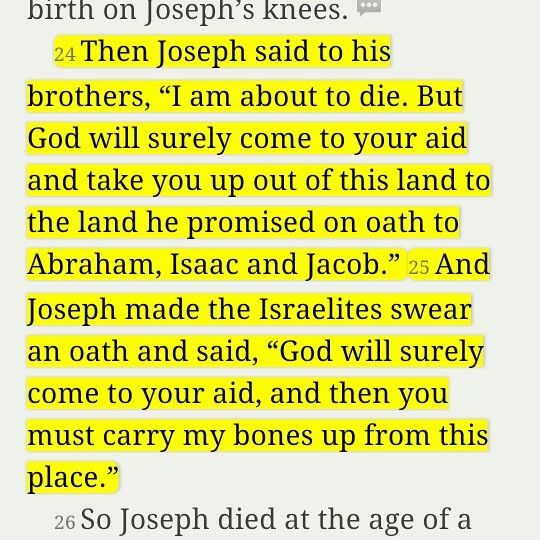
With the confidence that God would carry out His covenant promises, Joseph also requests that he be buried in the promised land. Although his coffin would lay above the ground for over 400 years as God’s people are enslaved in Egypt, the Israelites carry it back to Canaan under Moses’ leadership (Exodus 13:19).

Joseph’s faith is the perfect climax to the end of Genesis.

Reflect

Pharaoh didn’t doubt Joseph’s return to Egypt after burying Jacob. Because Joseph’s past record as Pharaoh’s advisor proved him responsible, Pharaoh trusted his word. Are we reliable even in the little things? Over time, privileges and freedom usually reward those who demonstrate trustworthiness.

Joseph gave complete forgiveness to his brothers. God also forgives us even though we don’t deserve it. Because God graciously accepts and forgives us, we should also graciously offer forgiveness to others.

God bringing good from evil is the theme in Joseph’s story. Like Joseph, do we trust God enough to work good out of our difficult situations?

Next week will be my last post in Genesis. Exhale. 🙂 I’ll give a brief summary of the parallels between Joseph and Jesus. Thanks for your visit!

Jacob Blesses His Sons, Genesis 49:1-28

Then Jacob called for his sons and said: “Gather around so I can tell you what will happen to you in days to come. Assemble and listen, sons of Jacob; listen to your father Israel.” –Genesis 49:1-2

Jacob’s final words to his twelve sons are recorded here in Genesis 49. Layman’s Bible Commentary notes: “Jacob’s prophecies refer to the distant future (49:1). The double exhortation to give attention to Jacob’s words stresses the importance of what he is about to say (49:2). The prophecies included here are not the spontaneous thoughts of a dying man, but the carefully prepared words of a prophetic poet.”

You may read Genesis 49:1-28 here: Bible Gateway.

Although the oldest son was supposed to receive a double inheritance, Reuben would not be granted this privilege. Jacob asserts: “Turbulent as the waters, you will no longer excel, for you went up onto your father’s bed, onto my couch and defiled it,” (vs. 4). Reuben’s former dishonorable ways cost him in the end (Genesis 35:21).

True to Jacob’s prophecy, Reuben’s descendants never produce a significant leader or inherit the promised land.

The next two oldest sons—Simeon and Levi—also disinherit the land due to their unfaithfulness and unwillingness to repent (vs. 5-7). Jacob characterizes these two as remaining angry: “Cursed be their anger, so fierce, and their fury, so cruel! I will scatter them in Jacob and disperse them in Israel,” (vs. 7).

This prophecy is fulfilled as Simeon’s tribe later inherits land scattered throughout Judah’s territory (Joshua 19:1-9; 1 Chronicles 4:28-33, 39). Although the Levites become priests, they are scattered throughout the rest of the tribal lands. Notable descendants of Levi include: Aaron, Moses, Eli and John the Baptist.

These first three tribes disqualify from their reward for unrepentant sin (Ezekiel 18:30). However, Jacob’s prophecies about them are still a blessing as they remain in the chosen family and reap God’s promises as Jacob’s heirs.

Greater Responsibility Given to the Faithful

The principle of God giving more responsibility to those who use their gifts and resources for His kingdom purposes (Luke 19:26) is seen with Jacob’s nine acceptable sons. Jacob uses poetic images along with word-plays for most of his sons’ names to describe their tribes’ destiny.

Prophecies of Jacob’s Sons Who Inherit the Land

"All these are the twelve tribes of Israel, and this is what their father said to them when he blessed them, giving each the blessing appropriate to him." -Genesis 49:28

“All these are the twelve tribes of Israel, and this is what their father said to them when he blessed them, giving each the blessing appropriate to him.” -Genesis 49:28

  • Judah – His brothers will bow down to him as “his hand will be on the neck of [his] enemies,” (vs. 8). “The scepter will not depart from Judah,” (vs. 10) means God chose Judah to be the ancestor of Israel’s line of kings, including Jesus, the promised Messiah. Leadership of Judah’s descendants, however, wouldn’t come until 640 years later under King David.
  • Zebulun“Zebulun will live by the seashore and become a haven for ships,” (vs. 13). His promised territory would be between the Mediterranean Sea and the Sea of Galilee.
  • Issachar – Rather than political pursuits, Issachar will settle around agriculture (vs 14-15). “When he sees how good is his resting place and how pleasant his land, he will bend his shoulder to the burden and submit to forced labor,” (vs.15). This suggests Issachar is capable, but lazy. Unlike lion-like Judah who subdues his enemies, Issachar submits to the Canaanites.
  • Dan – His prophecy of “providing justice for his people” partially comes to light during Samson’s era (Judges 13). Dan’s victories help Israel, but his people also lead Israel into idolatry (Judges 18:30-31; 1 Kings 12:26-30). His territory later becomes known as Israel’s center of idolatry (Amos 8:14).
  • Gad – His tribe becomes known as victorious fighters over every foreign army they battle (vs. 19; Jeremiah 49).
  • Ashar“Ashar’s food will be rich” (vs. 20). Some of Canaan’s most fertile ground will be given to this tribe (Deut. 33:24-25; Joshua 19:24-31).
  • Naphtali – Articulate speakers and gifted literature would arise from this tribe. Deborah, who composes a song of military victory, is an example (Judges 5:1-31). Naphtali’s land, located around the Sea of Galilee, is where much of Jesus’ ministry happens (Matthew 4:15-16). Other notable descendants include Barak, and possibly Elijah.
  • Joseph“Joseph is a fruitful vine . . . .” (vs. 22). Although Judah is given leadership of the tribes, Joseph is blessed with the double portion of the birthright (1 Chronicles 5:2). The tribes from Joseph’s two sons—Ephraim and Manasseh—will see this prophecy’s fulfillment. Joseph, who faced much adversity, is credited with his “bow remaining steady, his strong arms staying limber, because of the hand of the Mighty One of Jacob” (vs. 24). God enabled Joseph to draw closer to Him when trials mounted. Therefore, “let all these [blessings] rest on the head of Joseph, on the brow of the prince among his brothers,” (vs.26). Notable descendants of Joseph include: Joshua, Gideon and Samuel.
  • Benjamin“Benjamin is a ravenous wolf . . . .” (vs. 27) This tribe would be known for their fierceness (Judges 19-21) who demonstrates warlike character (Judges 5:14; 20:16; 1 Chronicles 8:40; 2 Chronicles 14:8; 17:17). Notable aggressive descendants include: Ehud (Judges 3:15-23), King Saul (1 Samuel 9:1; 14:47-52), and the Apostle Paul, previously known as Saul (Acts 8:1-3).
Reflect

Regardless of their faithfulness, all of Jacob’s 12 sons have a future and a blessing. However, only the faithful sons would inherit the land.

Likewise, although believers can’t earn forgiveness and salvation, our attitudes and actions matter. How we live determines our future blessings in God’s program.

Leaving a Legacy, Genesis 48

The following post is by Pastor Norm from “Called Within the Storm.” Enjoy.

The story of Jacob and his ‘favourite’ son Joseph is an interesting glimpse into what it could mean to live a life of obedience to the will of God. Like all of our life stories, we didn’t simply arrive at where we are today by chance. As we take the time to reflect back on […]

via Leaving a Legacy — Called within the Storm

Jacob’s Family Moves to Egypt, Genesis 46:5-34; 47:1-27

So that your faith might not rest on human wisdom, but on God’s power.”    -1 Corinthians 2:5

After Jacob sought God’s direction and heard directly from Him to “not be afraid” he travels with his family from Beersheba to Egypt (46:5-7). In 46:28-30, Jacob and Judah appear to have reconciled their past as Jacob chooses Judah to be their guide. Rising above his past failures, Judah proves himself trustworthy. His descendants are eventually gifted as the royal tribe (49:8-12) and the Messiah would come from his line.

Finding Joseph alive and well gives Jacob’s tormented heart some much-needed peace. As his family’s knotted past finally untangles, he is able to see God’s sovereign hand at work.

You may read Genesis 46:5-34; 47:1-27 here: Bible Gateway.

Israel’s Heritage

The names listed in Genesis 46:8-27 list every tribe that would eventually form the nation of Israel. This would have been especially important to Genesis’ first readers. For they were not only reminded that God chose them for a special purpose, but duties and allotments were also given according to tribe: the parceling of land, the division of labor, the army’s organization.

Joseph’s Family Meets Pharaoh

Before Joseph’s family meets Pharaoh, Joseph encourages them to be honest when asked about their work as shepherds. He hopes Pharaoh will allow them to live in Goshen. Layman’s Bible Commentary notes: “Goshen had some of the best pastureland in all of Egypt. It would be a place to keep the Hebrews isolated and insulated from the culture and religion of Egypt, since the Egyptians considered sheep unclean and Hebrews detestable (43:32).”

After Joseph introduces five of his brothers to Pharaoh and explains his family needs, Pharaoh grants the brothers’ request to live in Goshen. As an added bonus he also offers any capable brothers the job of tending his own livestock.

Next, Joseph introduces his father, Jacob, to Pharaoh. After Jacob blesses him, Pharaoh asks his age. Jacob responds, “The years of my pilgrimage are a hundred and thirty. My years have been few and difficult, and they do not equal the years of the pilgrimage of my fathers,” (47:9).

Joseph’s Family Settles in Goshen

So Joseph settles his father and brothers in the district of Rameses. Not only have they acquired the best part of the land, but Joseph also provides the entire clan with plenty of food.

Over the next 400 years in Egypt, the Israelite population would explode from seventy to over two million!

Joseph and the Famine d66cf8ce067e05b7e3d08433f2e1661f

In 47:13-26 we not only see God using Joseph to save Egypt and its surrounding neighbors from starvation, but also the fulfillment of Jacob’s blessing to Pharaoh. Because Pharaoh blessed the Israelites with Egypt’s best, God blesses him in return.

Reflect

Joseph’s faithfulness not only affected his entire family, but also Egypt and the surrounding people. Joseph had plenty of opportunities to wonder about his future: being thrown into a pit; sold into slavery; falsely accused; imprisoned. But in the midst of his trying circumstances, he chose to do what is right and yielded to God’s plan.

We may not see the exciting results of faithfulness as Joseph did, but we can be sure that God will honor our faithfulness. What area(s) is God calling you to be faithful in?

Enjoy your weekend!

Charles Spurgeon Devotion, Genesis 46:3-4

Hello! This week I bring  you a post from PassionSchmitz blog. I love that God’s truth is timeless and that both He and His message remain constant in the midst of our changing times. Charles Haddon Spurgeon was England’s best known preacher for most of the second half of the nineteenth century. I hope you are encouraged as I am after reflecting on his message.

***

Below is a devotion by Charles Spurgeon (1834-1892) from the May 12th evening entry of Morning and Evening. I’ve bolded a few quotes that stood out to me. ‘Fear not to go down into Egypt; for I will there make of thee a great nation: I will go down with thee into Egypt; and I […]

via Charles Spurgeon Devotion: Genesis 46:3-4 — PassionSchmitz