Submission to Authorities, Romans 13:1-7

Everyone must submit himself to the governing authorities, for there is no authority except that which God has established. The authorities that exist have been established by God.”  Romans 13:1

In the wake of recent uproar against police officers, this isn’t a popular passage, at least by the world’s standards. But Paul sets the bar high for believers concerning divinely sanctioned government offices and our response to them. For to rebel against authorities is rebelling against what God has instituted and will incur God’s judgment (vs. 2). God’s purpose of rulers and their use of force is to keep order in society by rewarding good conduct and punishing wrongdoers (vs 3).

Paul doesn’t expand on his remarks—such as duties of rulers to those under them, or limits of Christian obedience—and many modern believers struggle with this. But the context implies that the officials are just and are “God’s servants” (verse 4).

a768ddbb3c7b02b824dd07dda279da99

Are there times when believers should not submit to the government? The NIV Life Application Study Bible comments: “We should never allow the government to force us to disobey God. Jesus and His apostles never disobeyed the government for personal reasons; when they disobeyed, it was in order to follow their higher loyalty to God. Their disobedience was not cheap: they were threatened, beaten, thrown into jail, tortured, and executed for their convictions. Like them, if we are compelled to disobey, we must be ready to accept the consequences.”

So What?

Although interpretations may differ on verse one, Paul makes it clear that we are to strive for peace with the authorities. Allegiance to God does not dismiss our responsibility to secular authority. We are expected to respectfully abide by accepted regulations, including paying taxes.


The Primacy of Love, Romans 13:8-14

Let no debt remain outstanding, except the continuing debt to love one another, for he who loves his fellowman has fulfilled the law . . . . Love is the fulfillment of the law.” – Romans 13:8-10

Is Paul being extreme in calling “love for others” a debt? Especially when we feel slighted, or our love isn’t returned?

Maybe.

But all the best rationalizations for not loving others—even the most difficult people—drown in the outpouring of Christ’s lavish love upon us.

God’s Unconditional Love

In this section, Paul reminds believers of the following:

  • We are to follow Christ’s example of loving others.
  • No limit can be placed on this obligation to love since Christ’s love is infinitely greater than our love.
  • We will always be indebted to Christ.
  • Imitating God’s love fulfills the Law because it does no harm to neighbors, and goes beyond human legal requirements (James 2:8-9; 4:11; 1 Peter 2:16-17).
9f681511dd5d447e88d20b163263d788

Believers conduct is rooted in the hope of Christ’s return and our ultimate makeover (transformation).

Paul also reminds us of the following in verses 11-14:

  • “Understand the present time . . . . Wake up . . . because our salvation is nearer than when we first believed.”
  • “Put away the deeds of darkness and put on the armor of light.”
  • Behave respectably.
  • Clothe ourselves with the Lord Jesus Christ.
  • Abstain from thinking about how to gratify the sinful nature.
How do we clothe ourselves with the Lord Jesus Christ?

The NIV Life Application Study Bible suggests: c72ece94c71ad68e781622546700b81f“First we identify with Christ by being baptized (Galatians 3:27). This shows our solidarity with other Christians and with the death, burial, and resurrection of Jesus Christ. Second, we exemplify the qualities Jesus showed while He was here on earth (love, humility, truth, service . . . . see Ephesians 4:24-32; Colossians 3:10-17).”

So What?

We have nothing to lose and everything to gain when we choose to love others. So let’s go ahead and walk in God’s light!


Guidelines for Church Issues, Romans 14:1-15:13

Accept him whose faith is weak, without passing judgment on disputable matters.” – Romans 14:1

The Problem

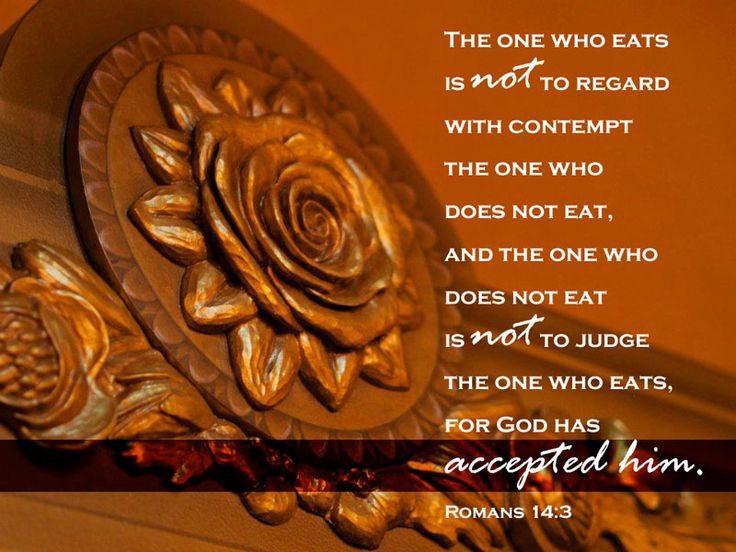
Strong differences of opinion sparked tension in the early church. These areas included: (1) eating of meat (vs. 2); (2) observing special days (vs. 5); and (3) drinking wine (vs. 21).

Paul’s objective in writing this section was to bring unity in an atmosphere of difference. He wrote of two groups of believers whom he identifies as “weak” and “strong”. He described the “weak” Christian in a figurative way: by his lingering legalism and tendency to criticize other believers with differing opinions—perhaps viewing them as morally lax. They were uncertain how this new faith in Christ affected the Old Testament rules. The “strong” were those who recognized their boundaries within Christ’s freedom. Paul warned them to not put down believers who felt compelled to follow parts of the Mosaic Law, or have a condemning attitude.

2727286392ecc62f1b5c4fe6dc98b4cf

Jewish food laws forbid the Jews to eat the flesh of certain animals, or drink their blood (Leviticus 11). Jewish observances not only set the Jews apart from other people, but also made them feel clean before God.

Although Jesus declared all foods “clean” in Mark 7:17-19, it’s no wonder many of the Jews still struggled with sharing a meal with Gentiles. (Acts 10:9-29 also shows God removing the cultural restrictions with food.)

Paul offered three guidelines to address these divisive issues. His letter is more pastoral than abstract theology. My next three posts will explore each principle.

So What?

Paul didn’t say to stop making judgments on sin. Rather, he urged us to stop launching hurtful and prideful judgments against one another. Loving other believers who differ from our opinions challenges the boundaries of our faith. But God gives us freedom to decide many nonessential issues that are not clear in His Word. He also convicts committed believers differently. As believers, it’s important to know when correct doctrine is at stake and when to be tolerant of others’ strong convictions.

Happy Thanksgiving

I'm thankful for you!

I’m thankful for you!

Paul’s Personal Notes, Romans 15:14-33

I have written you quite boldly on some points, as if to remind you of them again, because of the grace God gave me to be a minister of Christ Jesus to the Gentiles . . . .” – Romans 15:15, 16

Paul’s tone is warm as he closes his letter by stating his role as a minister to the Gentiles and his travel plans.

Paul’s Goal of Ministry (vs. 14-21)

When affirming the Roman church’s goodness, knowledge, and competent instruction, He also admits his boldness on some points. Why? “. . . . so that the Gentiles might become an offering acceptable to God, sanctified by the Holy Spirit” (vs. 16).

Paul exerted all of his energy in encouraging and exhorting Gentiles to follow and obey Christ. He sought to preach the gospel in areas where no one had heard it. From Jerusalem to Illyricum—a province bordering the Adriatic Sea—Paul endured much and persevered with the work God gave him.

Plans to Visit Rome (vs. 22-29)

Many scholars believe Paul was writing this letter from Corinth when he declared that his work was finished in the eastern regions. For a second time, he expressed his desire and delayed plans to visit the Roman church (1:10-15). But this time he added his current desire: to evangelize Spain. First, however, he would go with the Gentile church delegates to Jerusalem with the relief offering for the poor (vs. 25-28; Acts 20:3-6; 24:17). He encouraged his readers to financially support both the Jews and his mission to Spain. Paul hoped to visit them on his trip to Spain.

Prayer Requests (vs. 30-33)

Paul shared his concerns about his upcoming mission to Jerusalem. He urged his readers to join in his struggle through prayer: 1) that he would be rescued from unbelievers in Judea; 2) that his service in Jerusalem would be acceptable to them; and 3) that God would allow him his long awaited visit to Rome.

Acts 21:15-28:31 gives insights to God’s answers to these requests. Paul’s dream of visiting Rome was finally realized, but probably not in the way he had hoped. He arrived as a prisoner.

194532973483522da6d6f9c5138db442

The book of Acts does not record Paul journeying further westward to Spain.

So What?
  • Although not everyone is called to preach or serve in a foreign country, all of us can support foreign missionaries through our prayers. Some can give financially.
  • We, “who have shared in the Jews’ spiritual blessings” (vs.27), are called to support Jewish believers.
  • Although prayer is often known as a means of comfort and making our requests known to God, it is also a weapon in the Christian’s arsenal when interceding for others in our spiritual battle.
  • God’s ways are higher than our ways (Is. 55:9). He’s always at work, for the good, even when we don’t discern it.