Guidelines for Church Issues, Romans 14:1-15:13

Accept him whose faith is weak, without passing judgment on disputable matters.” – Romans 14:1

The Problem

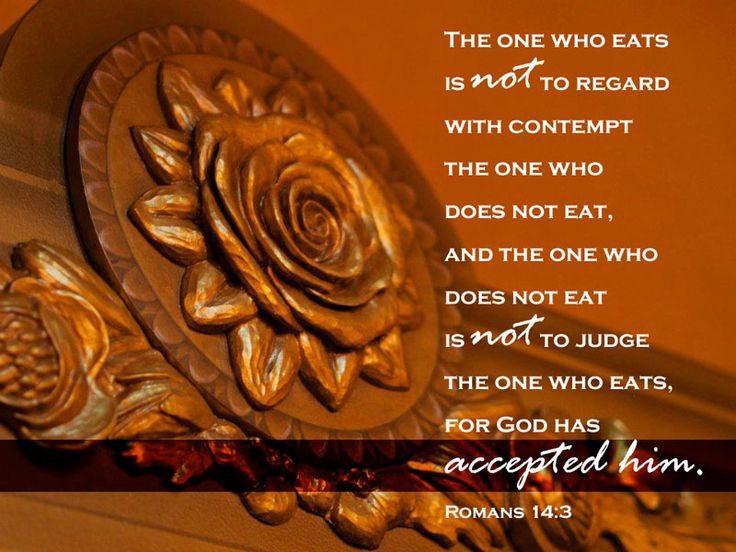
Strong differences of opinion sparked tension in the early church. These areas included: (1) eating of meat (vs. 2); (2) observing special days (vs. 5); and (3) drinking wine (vs. 21).

Paul’s objective in writing this section was to bring unity in an atmosphere of difference. He wrote of two groups of believers whom he identifies as “weak” and “strong”. He described the “weak” Christian in a figurative way: by his lingering legalism and tendency to criticize other believers with differing opinions—perhaps viewing them as morally lax. They were uncertain how this new faith in Christ affected the Old Testament rules. The “strong” were those who recognized their boundaries within Christ’s freedom. Paul warned them to not put down believers who felt compelled to follow parts of the Mosaic Law, or have a condemning attitude.
2727286392ecc62f1b5c4fe6dc98b4cf

Jewish food laws forbid the Jews to eat the flesh of certain animals, or drink their blood (Leviticus 11). Jewish observances not only set the Jews apart from other people, but also made them feel clean before God.

Although Jesus declared all foods “clean” in Mark 7:17-19, it’s no wonder many of the Jews still struggled with sharing a meal with Gentiles. (Acts 10:9-29 also shows God removing the cultural restrictions with food.)

Paul offered three guidelines to address these divisive issues. His letter is more pastoral than abstract theology. My next three posts will explore each principle.

So What?

Paul didn’t say to stop making judgments on sin. Rather, he urged us to stop launching hurtful and prideful judgments against one another. Loving other believers who differ from our opinions challenges the boundaries of our faith. But God gives us freedom to decide many nonessential issues that are not clear in His Word. He also convicts committed believers differently. As believers, it’s important to know when correct doctrine is at stake and when to be tolerant of others’ strong convictions.

Paul’s Personal Notes, Romans 15:14-33

I have written you quite boldly on some points, as if to remind you of them again, because of the grace God gave me to be a minister of Christ Jesus to the Gentiles . . . .” – Romans 15:15, 16

Paul’s tone is warm as he closes his letter by stating his role as a minister to the Gentiles and his travel plans.

Paul’s Goal of Ministry (vs. 14-21)

When affirming the Roman church’s goodness, knowledge, and competent instruction, He also admits his boldness on some points. Why? “. . . . so that the Gentiles might become an offering acceptable to God, sanctified by the Holy Spirit” (vs. 16).

Paul exerted all of his energy in encouraging and exhorting Gentiles to follow and obey Christ. He sought to preach the gospel in areas where no one had heard it. From Jerusalem to Illyricum—a province bordering the Adriatic Sea—Paul endured much and persevered with the work God gave him.

Plans to Visit Rome (vs. 22-29)

Many scholars believe Paul was writing this letter from Corinth when he declared that his work was finished in the eastern regions. For a second time, he expressed his desire and delayed plans to visit the Roman church (1:10-15). But this time he added his current desire: to evangelize Spain. First, however, he would go with the Gentile church delegates to Jerusalem with the relief offering for the poor (vs. 25-28; Acts 20:3-6; 24:17). He encouraged his readers to financially support both the Jews and his mission to Spain. Paul hoped to visit them on his trip to Spain.

Prayer Requests (vs. 30-33)

Paul shared his concerns about his upcoming mission to Jerusalem. He urged his readers to join in his struggle through prayer: 1) that he would be rescued from unbelievers in Judea; 2) that his service in Jerusalem would be acceptable to them; and 3) that God would allow him his long awaited visit to Rome.

Acts 21:15-28:31 gives insights to God’s answers to these requests. Paul’s dream of visiting Rome was finally realized, but probably not in the way he had hoped. He arrived as a prisoner.

194532973483522da6d6f9c5138db442

The book of Acts does not record Paul journeying further westward to Spain.

So What?
  • Although not everyone is called to preach or serve in a foreign country, all of us can support foreign missionaries through our prayers. Some can give financially.
  • We, “who have shared in the Jews’ spiritual blessings” (vs.27), are called to support Jewish believers.
  • Although prayer is often known as a means of comfort and making our requests known to God, it is also a weapon in the Christian’s arsenal when interceding for others in our spiritual battle.
  • God’s ways are higher than our ways (Is. 55:9). He’s always at work, for the good, even when we don’t discern it.

Paul’s Personal Greetings & Warning, Romans 16:1-23

Paul usually closed his letters with greetings and commendations (recommendations), which were well known in the ancient world. He wanted Roman believers to welcome and help Phoebe, a deaconess of the Cenchreae church. She had faithfully helped Paul and many others in the gospel work (vs. 1-2). She may well have been Paul’s letter carrier to the Roman church.

(marelletaylor.com)

(marelletaylor.com)

Paul’s Greetings (vs. 3-16, 21-23)

Beyond a challenging tongue twister, or finding a unique baby name, this section also reflects Paul’s lengthy list of close relationships within a broad church base. From Andronicus to Philologus, Paul listed a whopping twenty-six people in his greetings to the Roman church. These were people with various backgrounds—men, women, Jews, Gentiles, Greeks, Romans—whom Paul had met in his travels. Paul knew much about these people: their family relationships and ministries.

Paul also sent greetings from his companions, including Timothy, who traveled with Paul on his second missionary trip. Timothy held a special place in Paul’s ministry.

Paul’s Warning (vs. 17-19)

“I urge you, brothers, to watch out for those who cause divisions and put obstacles in your way that are contrary to the teaching you have learned. Keep away from them. For such people are not serving our Lord Christ, but their own appetites. By smooth talk and flattery they deceive the minds of naive people.”

So What?
  • Although Paul was singular in his commitment to God’s call, he also sought ministry partnership and fellowship with the believers that God placed in his path. Likewise, we should extend our fellowship and hospitality to believers outside our circle of church small groups and denominations.
  • By studying God’s Word we can keep from being duped by smooth talkers and/or literature that strays from God’s truth (Acts 17:10-12).

Doxology, Romans 16:25-27

c0538841d329284f0d84d31a968f2919

Paul’s final verses to the Roman church ring with praise. For God not only used him to help spread the gospel, but also share His plan for the Gentiles: God’s inclusion of them/us into His church.

Major Themes

Paul weaved major themes from Romans into these last three verses:

  • God alone establishes and strengthens the believer.
  • God alone has given direct revelation of the gospel through Jesus Christ through His life, death, and resurrection.
  • God has purposed His plan of salvation to everyone who chooses to receive it.
So What?

We should never write someone off as impossible for God to save. Paul was a prime example. From a zealous Christian persecutor to a zealous gospel preacher, God moved mightily in his life: saving, transforming, and strengthening his faith.

We too can trust God to work powerfully in our lives. He’s not limited by our backgrounds, weaknesses, and/or failures.

God used Paul to reach the ends of his world through the cosmopolitan power house of Rome. We would do well to heed God’s inspired words from Paul in Romans as we also take the gospel to the ends of our world through words, prayer, technology, and missionary support.

Have you received God’s gift of salvation?

How has God strengthened your faith?

I love the following scripture/song. It’s a great reminder that God is not only able to work for the good in our  circumstances, but also work for the good in our hearts’ invisible arena.

Holy Spirit’s Filling—Part 3

If anyone is thirsty, let him come to me and drink. Whoever believes in me, as the Scripture has said, streams of living water will flow from within him.”  – Jesus (John 7:37-38)

Jesus used the term living water in John 4:10 to symbolize eternal life. Living water in 7:38 (above) refers to the Holy Spirit. Wherever the Holy Spirit is accepted, Jesus brings eternal life. (Related post: Thirsty?)

This summary caps my final review of the Spirit’s filling, taken from the following key verse:

Do not get drunk on wine, which leads to debauchery [wickedness]. Instead be filled with the Spirit.”   – Ephesians 5:18

The Apostle Paul contrasts the effects of alcohol here—associated with selfish desires and the old way of life—as a temporary high to being controlled by The Holy Spirit, which results in lasting joy.

Although I’ve sensed the Holy Spirit’s presence and power in church services and in my own life, I haven’t dwelt on the following question until recently.

How Does The Holy Spirit Fill Us?

God’s ways can’t be pinned down to formulas, but He doesn’t leave us clueless either. Tony Evans suggests that Paul’s following remarks in Ephesians 5:19-21 explain the process of the Spirit’s filling:

Speaking to one another in psalms and hymns and spiritual songs, singing and making melody with your heart to the Lord: always giving thanks for all things in the name of our Lord Jesus Christ to God, even the Father; and be subject to one another in the fear of Christ.”

(Paul also urges us to hold our own private worship services, Romans 12:1.)

Practical Application

How does this practically relate to Christians?

  1. Communicate with one another: Christians should regularly reinforce—and be reinforced by others—to keep our focus on Christ and stay on track spiritually (Hebrews 10:24-25)
  2. Communicate with the Lord: Pray . . . . Pray . . . . Pray (John 16:24; 1 Thessalonians 5:18)
  3. Give thanks: for everything in Jesus’ name (Ephesians 5:20; I Thessalonians 5:17)
  4. Be subject to one another: This doesn’t mean the demeaning, subservient thing defined in many circles. But rather, reflecting the servant spirit Jesus beautifully demonstrated.

I don’t know about you, but in comparison to an inflated balloon when filled by the Holy Spirit, I admit—I rapidly deflate at times—spinning wildly before crashing to the ground (especially before my morning cup of coffee, or after too many cups!) 68b9b998e8bfb984213c7a440b36ceedMaybe that’s why we’re told to consistently meet together and encourage one another (Hebrews 10:25). I for one need this!

Results of The Holy Spirit’s Filling

In Christ—when controlled by the Holy Spirit—we have a higher and longer lasting remedy to depression, tension, or boredom. When filled, we benefit from the following results:

  • Christlikeness: (Romans 8:5; Galations 5:22, 23)
  • Help: in daily problems and in our praying (Romans 8:26, 27)
  • Empowerment: to freely serve God and carry out His will (2 Corinthians 3:17; Acts 1:8; Romans 12:6)

The Spirit’s filling brings peace and life (Galations 5:16-23). The quantity and frequency of submitting ourselves to the Spirit’s control directly relates to our spiritual growth. (Related post: Training or Trying)

God loves you! Come to Him right where you are . . . . I was blessed by Steve Rebus’ testimony. Here is a link to his page: http://steverebus.com/about/.