‘Honor and majesty are before Him,’ wrote the psalmist; ‘strength and beauty are in His sanctuary’ (Ps. 96:6). The strength of His sanctuary is revealed in its construction, and the beauty is revealed in its adornment.” –Warren Wiersbe, Be Delivered
I didn’t realize that more space is devoted to the tabernacle, more than any other topic, in all of scripture. I also wasn’t aware just how much the tabernacle is steeped in symbolism that points to our Savior, Jesus Christ.
So far in this study, we’ve explored the significance of the following tabernacle furniture: ark of the covenant, the table of “presence bread”, the golden lampstand, the incense altar, the lavar, and the brazen altar. Now onward to the framework of the tabernacle.
 Strength

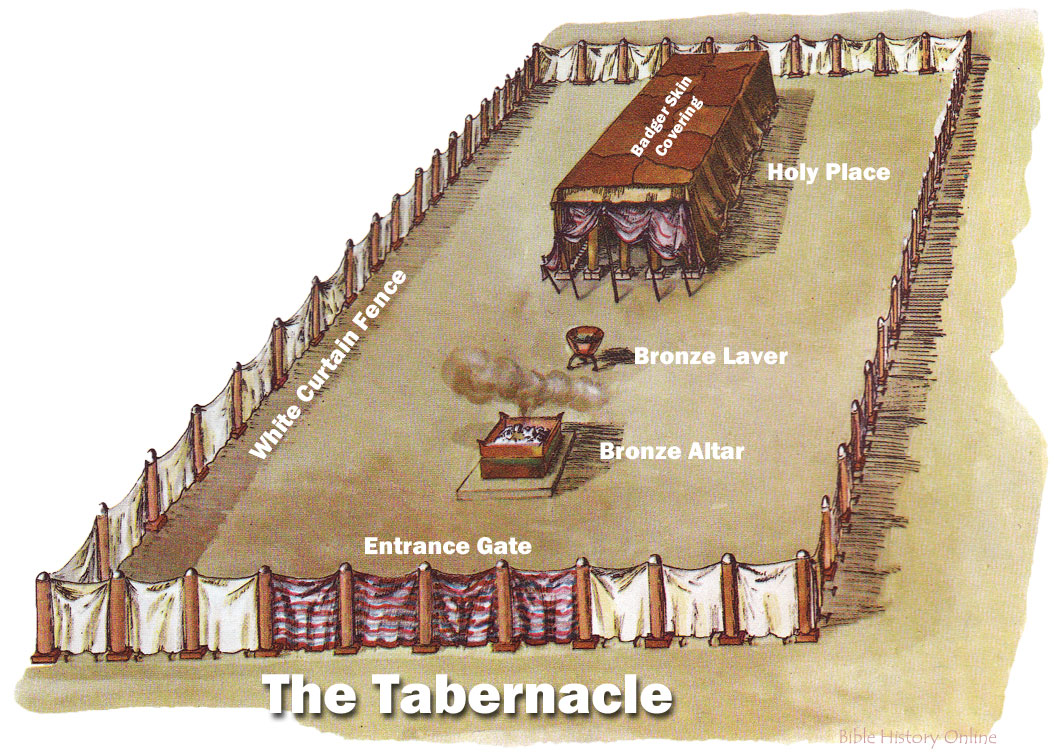
Elegant curtains were draped over the solid structure of the tabernacle proper. Forming the north and south walls were twenty boards of acacia wood overlaid with gold. These stood fifteen feet high and twenty-seven inches wide. Eight similar boards fashioned the west wall.
God instructed Jewish men of military age to give silver shekels (“redemption money”) to be made into two silver bases for each board. This provided needed stability and security on the uneven ground. Wiersbe writes: “God’s sanctuary didn’t rest on the shifting sands of this world but on the solid foundation of redemption.” Further strengthening the 48 boards were four rods (crossbars) which ran through golden rings on every board.  The door into the Holy Place stood on the east end of the tabernacle. A linen curtain—beautifully embroidered with blue, purple and scarlet yarn—hung on the five posts stationed there. Some scholars believe that the boards on the north and south walls were connected to the end pillars by an additional rod to give even more stability to the framework.
Beauty
The hangings and coverings of the tabernacle were cloaked in gold, blue, purple, scarlet, and white; major colors representing spiritual themes. The white linen fence surrounding the sacred area points to God’s holiness. At the east end stood the 30 foot gate embroidered in blue, purple, and scarlet. These brilliant colors stood out against the white linen fence. Blue, the color of the sky, reminds us of heaven and the God of heaven. Purple represents royalty, which points to the King. Scarlet signifies our Savior’s blood sacrifice.
 Covered with four different curtains in the Holy Place and Holy of Holies, these curtains graced the walls and hung down to the ground. The leatherlike outmost covering consisted of badgers’ skins (“sea cows,” NIV). These not only protected the other coverings, but also the tabernacle proper and its furnishings. Below this protective covering lie a curtain of rams’ skins dyed red. The next layer consisted of a woven fabric made from goats hair, which might have been black. Fine linen embroidered with cherubim in blue, purple, and scarlet made up the last curtain.
The veil between the Holy Place and the Holy of Holies hung from golden clasps supported by four pillars. The veil was also embroidered with cherubim in white, scarlet, blue, and purple. Hebrews 10:20 tells us that this veil typifies Christ’s body. When His body was offered on the cross, the veil in the temple tore from top to bottom (Mark 15:38).
Wiersbe notes: “Some students see a parallel between the four gospels and the four pillars that supported the veil with the four colors. Purple speaks of royalty—the gospel of Matthew, the gospel of the King. Scarlet reminds us of sacrifice—the gospel of Mark, the gospel of the Suffering Servant. White speaks of the perfect Son of Man—the gospel of Luke, and blue points to heaven—the gospel of John, the gospel of the Son of God who came from heaven to die for our sins.”
Next week we’ll explore how the treasures that the Old Testament believers possessed in God’s house translates to modern believers. Have a great week!

 kdmanestreet