Victory In Jesus

“For the joy set before Him He endured the cross, scorning its shame, and sat down at the right hand of the throne of God.”  – Hebrews 12:2
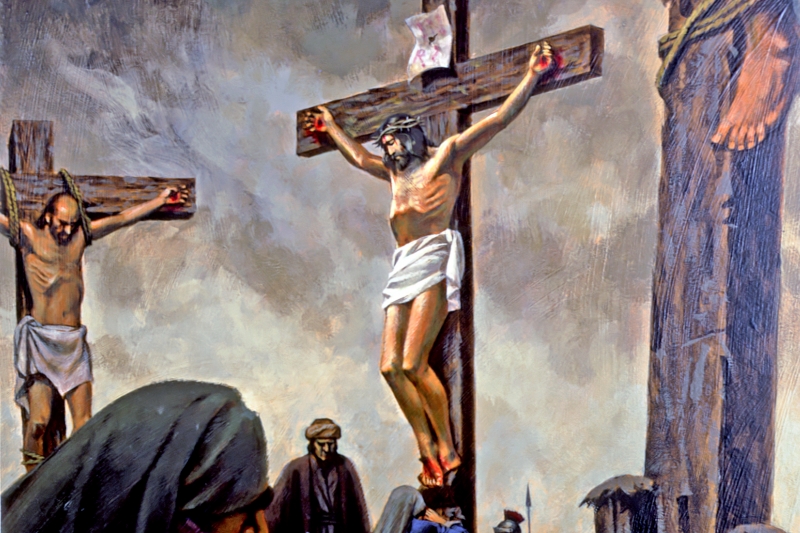
110_04_0217_BiblePaintings

I find it interesting that there are hundreds of messianic prophecies in the Old Testament of the Bible―God’s revelation predicting the coming Messiah. These 39 books were written between 1450 B.C. and 430 B.C. God chose to reveal His plan to redeem mankind, and each of His proclamations about the coming Messiah has been revealed in Jesus.

God revealed to the prophet Amos, who lived 700 years before Jesus was crucified, that “on that day” the sun will set at noon and darkness will cover the earth (Amos 8:9). And then Matthew, one of many eyewitnesses, confirms that the entire land became dark for three hours (Matthew 27:45). This darkness at Jesus’ crucifixion is Matthew’s first supernatural sign before God’s salvation of the world.

When darkness swallowed the sun, Jesus swallowed death in victory.

The Psalmist in Psalm 118:15b-17 (HCSB) predicts Christ’s rising from the grave:

“The Lord’s right hand performs valiantly! 16 The Lord’s right hand is raised. The Lord’s right hand performs valiantly!” 17 I will not die, but I will live and proclaim what the Lord has done.

Mark 16:6 (NIV) records an angel saying,

 Don’t be alarmed. You are looking for Jesus the Nazarene, who was crucified. He has risen! He is not here. See the place where they laid him.”

The Father raised Jesus up in the power of His Holy Spirit, seating Him at His right hand―to His original position before Jesus took on flesh (John 1:1-5). Jesus  reigns victoriously (Philippians 2:9-11) and will one day reign in justice over His new earth (Revelation 21). The question I must ask myself: Does Jesus reign victoriously in my heart, or am I harboring sin?

I love that the apostle Paul gives the image of God’s children sitting victoriously with Christ in the “heavenly realms,” replacing the image of us as being objects of God’s wrath due to our sin (Ephesians 2:1-9). This is made possible only because our sinless Lord took our deserved punishment upon Himself (Isaiah 53:4-12). Our eternal life is secured only through Jesus Christ (1 John 5:11-12).

As God’s children, do we embrace God’s grace and extend it to others?

Maybe you’re unsure whether or not you are God’s child. This is a decision only you can make. The church can’t save you. Your good works or parents’ faith can’t save you.

There are no guarantees for tomorrow. Isaiah 55:6-7 says,

Seek the Lord while He may be found; call on Him while He is near.Let the wicked forsake their ways and the unrighteous their thoughts. Let them turn to the Lord, and He will have mercy on them, and to our God, for He will freely pardon.”

If God is knocking on your heart’s door, please don’t ignore Him. I encourage you to call out to Christ, seek His forgiveness, and ask Him to save you. He loves you!

Me, A Saint?

When I think of “saints,” the following thoughts surface: 1) the song, When the Saints Go Marching In; 2) Saint Patrick’s Day; 3) Mother Teresa; 4) martyrs who have died for their faith, (and last, but not least); 5) I know I’m saved and am trying to become more Christ-like, but I am not a saint.

ab692e80a27a61d88a94dd01b78447c3

I admit, the fact that God calls His children “saints” causes me to squirm. I’m well aware of my shortcomings. Maybe that’s why God prods me to explore this topic more in depth.

“Saints” appear 95 times in the Bible. The Greek word for saints is hagios, which signifies being separated from sin and consecrated to God. It is used of people and things concerning their devotion to God―divine demands upon the conduct of believers who are called hagioi, “saints,” “sanctified,” or “holy” ones.

This sainthood is not by achievement or attainment, but is rather a state into which God in grace calls people (2 Timothy 1:9); yet believers are called to confess sin, become cleansed, and forsake sin. We are admonished to live a holy life so we might experience fellowship with our holy God (1 Peter 1:15; 2 Peter 3:11).

When a person is spiritually reborn into God’s family he/she has the greatest experience of love and the greatest inheritance. Those who become Christians are purposed to be His holy children―saints―that are set apart for His service.

God views us as righteous only through our union and identification with His Son, Jesus (1 Corinthians 1:30).

God made Him who had no sin to be sin for us, so that in Him we might become the righteousness of God.”  – 2 Corinthians 5:21

Thankfully, holiness is God’s master intrinsic work … phew!

Jesus is the fulfillment and culmination of God’s revelation through the centuries. When we know Him, we have all we need to be saved from our sin and to have a perfect relationship with God (Hebrews 1:1-2). If we are in Christ, God looks upon us as saints … I know, mind boggling, but exciting just the same! So, the question arises, are we saints in Christ? Or, are we trying to be saints by our own efforts? When I’ve strived apart from Christ, I’ve always wound up frustrated. How about you?

Below is Chris Tomlin’s song, Jesus Messiah. The corresponding video is graphic, but a good reminder of the extent Jesus suffered that we might have life.

http://www.youtube.com/watch?v=_YqHGFtnMOI

God Bless,

K. D.

*This article is also posted in the Gospel Blog by FEBC at http://bit.ly/19BNQF0

Sank-a-what?

Sanc·ti·fi·ca·tion: noun, sounds like “saŋ(k)-tə-fə-ˈkā-shən” … not to be confused with “sank·a·va·ca·tion,” which sounds more like my daughter’s interpretation.

(This post article is also posted in the Gospel Blog by FEBC at http://bit.ly/13vG5Iy.)

I don’t pretend to be a theologian or philosopher. But I am a curious learner who wants―needs―to know how God’s truths work in daily, practical matters. So to make this concept clearer, I consulted Strong’s Greek Dictionary of the New Testament.

The translated Greek word Hagiasmos is associated with purity and holiness. It signifies (1) separation to God (1 Corinthians 1:30; 2 Thessalonians 2:13; 1 Peter 1:2), and (2) the resultant state, the conduct befitting those so separated (1 Thessalonians 4:3-4, 7), (3) it is translated “holiness” in Romans 6:19, 22; 1 Thessalonians 4:7; 1 Timothy 2:15; Hebrews 12:14, (4) Sanctification is thus the state predetermined by God for believers, into which in grace He calls them, and in which they begin their Christian course and so pursue it. (5) Hence they are called “saints.”

“Saints”―really? Now that’s a difficult concept for me to wrap my head around. I’m very aware of the times I mess up and sin. How can a holy God view someone like me as a saint?

God reminds me: I can’t live the Christian life by my own efforts. Sanctification/holiness results solely from His Holy Spirit working in my life. I do have a choice, however, whether I grow or regress in my Christian journey.

For my next five posts, under the category Sanctification, I plan to dig deeper into the five areas listed above. Will you join me? I hope we can learn together.

What are your views and/or experiences on sanctification?

Don’t Forget Your Helmet

IMG_0427_3

“Take the helmet of salvation and the sword of the Spirit, which is the word of God,” Ephesians 6:17.

Satan wants us to doubt God, Jesus, and our salvation. The helmet protects our minds from doubting God’s saving work for us through His Son, Jesus.

My boys often think they are invincible. With only a skiff of snow and being near their school, they think gym shorts are suitable for watching basketball games. “All the kids do it, Mom. Besides, the gym’s hot.”

“It’s below freezing. And if you get stuck outside you’re asking for frostbite!” My reasoning settles in their minds like snow flurries in the wind. Time to switch tactics. This time I put on my Commander hat.

“You will wear your jeans and your coat. NO shorts.” My battle ready stance tells them I’m not backing down. After a few grunts and rolling eyes, they comply.

God often uses my children to drive home a point. How many times do I react like my kids to God’s instruction? How often do I skim over a Bible passage while my mind is distracted with daily tasks? Or I’ll read, ponder it, but then fail to apply it throughout the day. Like my boys, do I wave it off by reasoning: I’ll be fine … everyone else does it (or isn’t doing it)?

Ephesians 6:10-18 commands us to put on God’s armor. Like a parent who knows what’s best, Paul illustrates how we can be strong in the Lord so we won’t get knocked over by the devil’s schemes. Four times, he writes “stand firm.” Why? God shows us our struggle is not against people, but against the spiritual forces of evil, (vs. 12).

Don’t neglect wearing your helmet of belief, for “whoever does not believe stands condemned already because he has not believed in the name of God’s one and only Son,” John 3:18b.

Do you have any additional thoughts about God’s armor, (Ephesians 6:13-17)?

Bad News, Good News

Care to join me for a steaming latte? It’s 12 degrees fahrenheit in my neck of the woods. Brrr. Reason enough to enjoy the crackling fire with a hot drink within reach.

As I mentioned in my earlier post, God’s first call in our lives deals with salvation. In fact, most of the Bible centers around John 3:16 (NIV), “For God so loved the world that He gave His one and only Son, that whoever believes in Him shall not perish but have eternal life.”

The word salvation appears 164 times in the Bible. According to Strong’s Concordance, salvation is “mattâth” in Hebrew and Aramaic, which means “a present: ― gift; reward.” The Greek translation “soteria” means “rescue or safety.”

Salvation can be summarized as follows: deliverance from the power or penalty of sin.

Whose sin? Both yours and mine. We’ve all done wrong things and failed to obey God’s laws (Romans 3:23; 5:12).

The result? Separation from holy God, our Creator. This separation―the penalty of our sin―is eternal death (Romans 6:23; Revelation 20:10-15). Our best efforts–moralism–fall short in our attempts to unite with God (Isaiah 64:6). That’s the bad news.

The good news: Jesus–God’s unique Son–never sinned (Hebrews 5:9). He alone bridged the gap between sinless God and sinful mankind when He freely died on the cross (1 Timothy 2:5-6; 1 John 5:9-12). He took our place in order to save us from sin’s consequences―including God’s judgment and death (2 Corinthians 5:21; 1 Peter 2:24; Romans 5:8-11).

The result? We can have new life because Jesus took our past, present, and future sins upon Himself, forgiving all our wrongdoing (Hebrews 10:5-18). Thus, He reconciles us to God (1 Peter 3:18; Hebrews 10:19-22). Jesus’ resurrection from the dead is the proof that His substitutionary sacrifice on the cross was acceptable to God. His resurrection has become the source of new life for whoever believes Jesus is the Son of God (John 11:25; Romans 10:9). He grants eternal life, giving union with God to those who believe and receive Him (Ephesians 2:4-7; John 1:12).

Do you believe Jesus is God’s Son? If so, have you confessed your sins to Him and asked Him for the gift of eternal life and forgiveness?

*This article is also posted in the Gospel Blog by FEBC at http://bit.ly/17RG5UK.