 “The light of the righteous rejoices” (Proverbs 13:9). We thank You, Lord, that Jesus is our Light. He’s “the Light of the world” (John 8:12). In Him, we rejoice (Romans 5:11) – “the blood Of Jesus, Your Son, cleanses us from all sin” (1 John 1:7). We thank You that, through Jesus, You have “called […]
Tag Archives: Christianity
God’s Glory Dwelling, Exodus 39:32-40:38
Never underestimate the spiritual power of a dedicated man or woman who knows how to intercede with God. One of our greatest needs today is for intercessors who can lay hold of God’s promises and trust God to work in mighty power (Isa. 59:16; 62:1; 64:1-7).” –Warren Wiersbe
I wonder if the Israelites had a clue about Moses’ experience of interceding for them on Mt. Sinai. Maybe they would have been more appreciative of him had they known. For Moses had “wrestled” with God in prayer, resulting in God’s decision to not reject or destroy Israel.
Tabernacle Dedication
Along with the building dedication, chapter 40 summarizes the priests’ dedication (also described in Exodus 28-29). The tabernacle and its furnishings were now complete so Moses could inspect everything. His job not only included making sure that every utensil was anointed and put in the right spot, but also inspecting every piece of furniture. For unless everything was done according to the pattern God showed him on the mountain, God would not dwell in the tabernacle (25:8-9, 40; Heb. 8:5; 9:9). Warren Wierbe (Be Delivered) makes an interesting observation: “Too many sincere people have tried to do God’s work their own way and then have asked God to bless it. But ministry doesn’t work that way. First we find out what God wants us to do, and we do it to glorify Him. If we obey His will and seek to honor His name, then He will come and bless the work with His powerful presence.”
The word commanded is used 18 times in Exodus 39 and 40, reminding us that the workers did exactly what God told them to do. Moses is also cited as being a faithful servant (Heb. 3:1-6). The work is given a thumb’s up and construction is a go (Ex. 40:1-8, 17-19, 33). Next, the tabernacle—along with everyone associated with it—is dedicated to the Lord.
God’s Glory Fills the Tabernacle
Now God’s glory can fill the tabernacle and abode. Wiersbe writes: “The Hebrew word translated “abode” in Exodus 40:35 (“settled,” NIV) is transliterated shekinah in English, “the abiding presence of God.” (See 24:16 and 25:8). So powerful was the presence of God’s glory that Moses wasn’t able to enter the tabernacle!”
Sadly, Jewish history teaches us that the tabernacle glory left when the people and priests sinned against the Lord (1 Sam. 4:21-22). Ichabod means “the glory is gone.” But God’s glory returned again and dwelt with the people when Solomon dedicated the temple (1 Kings 8:10-11). Unfortunately, their sins also drove God’s glory away (Ezek. 8:4; 9:3; 10:4, 18; 11:23).

“The Word became flesh and made his dwelling among us. We have seen his glory, the glory of the one and only Son, who came from the Father, full of grace and truth.” -John 1:14
When and where did God’s glory appear next? Wiersbe writes: “. . . . in the person of Jesus Christ. In the Greek translation of the Old Testament (the Septuagint), the word abode in Exodus 40:35 is the Greek word used in Luke 1:35 and translated “overshadow.” Mary’s virgin womb was a Holy of Holies where the glory of God dwelt in the person of God’s Son. What did the world do with this glory? Nailed it to a cross!”
Reflect
Where is God’s glory today? Every true believer houses the temple of God (1 Cor. 6:19-20), along with the local church (3:10-23) and the universal church (Eph. 2:20-22). Buildings are dedicated to God as tools for God’s work, but God doesn’t dwell in buildings today (Acts 7:48-50). He dwells in believers. It’s our privilege and responsibility to glorify Him both individually (1 Cor. 6:20) and collectively (14:23-25).
Wiersbe writes: “What a tragedy it would be if the glory departed and we had to write “Ichabod” on [us]. How much better it would be if, like Moses, we did everything according to the heavenly pattern so that God’s glory would feel at home in our midst. . . . When Solomon finished the temple, the glory of God moved in, but when God finishes building His church, He will move the church out! Then we will share God’s glory in heaven for all eternity! ‘And the city had no need of the sun or of the moon to shine in it, for the glory of God illuminated it. The Lamb is its light’ (Rev. 21:23 NKJV).’”
How have you glimpsed God’s glory? I see His glory in a person’s countenance when they are pouring themselves into worship, or have just spent quality time in God’s presence, or exhibit His characteristics.
This is my last post in Exodus. Thank you for visiting, reading, and all of your encouragement! I hope you had a wonderful Thanksgiving! I certainly did. I have much to be thankful for!
God’s Presence and Glory Dwells with the People, Exodus 34:29-35
At last, God blesses Israel’s tabernacle with the glory of His presence. Exodus begins with Moses witnessing God’s glory in the burning bush (3:1-5) and ends with God’s glory descending in the camp and filling the tabernacle. Warren Wiersbe (Be Delivered) writes: “The presence of the glory of God in the camp of Israel was not a luxury; it was a necessity. It identified Israel as the people of God and set them apart from the other nations, for the tabernacle was consecrated by the glory of God (29:43-44). Other nations had sacred buildings, but they were empty.”
God’s Glory Reflected (34:29-35; 2 Cor. 3)
Did Moses realize his face glowed? He apparently “absorbed” some of God’s glory when he soaked in God’s presence the past 80 days while fasting and praying. He had also caught a glimpse of God’s glory. According to this passage, however, Moses was clueless about his radiant face. But it didn’t take long for him to figure out why the people were afraid of him when he came down the mountain. Moses soon persuaded them to come and converse as before. He eventually covered his face with a veil as the glory faded (2 Cor. 3:13). Why? Weren’t the people afraid this strange phenomenon? Wiersbe observes: “The Jews saw this glory as something wonderful and exciting, but what would they say if they knew it was fading away? Who wants to follow a leader who is losing his glory?”
So Moses continued the pattern: Talk to God inside the tent of meeting; God’s glory illuminates his face; Moses covers face with a veil as the glory fades. The Apostle Paul—when answering legalists who taught that God’s way to salvation involves not only faith in Christ, but also obedience to the law (Acts 15:1)—made the following applications about this amazing event (2 Corinthians 3):
- The glory of the Mosaic legal system was fading away, but the glory of God’s grace in the gospel is more glorious (vv. 7-11).
- The lost Jews during Paul’s day had a veil covering their hearts due to unbelief, blocking their view of God’s glory (2 Cor. 3:14-16). The only remedy for the removal of the veil was to trust Jesus and believe the Word.
- Paul also related Moses’ experience to Christians, who through faith experience a spiritual transformation by seeing Christ’s glory in the Word (vv. 17-18). Wiersbe writes: “This is why Christians read the Bible and meditate on it, because when the child of God looks into the Word of God and sees the Son of God, he or she is transformed by the Spirit of God into the image of God for the glory of God.”

(Credit: elleandcompanydesign.com)

REFLECT (Or should I say “RADIATE”?) 🙂
I’ll close with two more Wiersbe quotes (because they’re really interesting!): “The Greek word for ‘transformed’ in 2 Corinthians 3:18 is “transfigured,” as in Matthew 17:2. It describes the glory on the inside being revealed on the outside. Moses only reflected the glory of God; the dedicated believer radiates the glory of God. Unlike Moses, we don’t wear a veil when we come to God’s Word because we have nothing to hide.”
“Truly spiritual people don’t recognize their own godliness but usually feel as though they’re failures and far from what they ought to be. At Pentecost (Acts 2), each believer could see the tongues of fire above the other believers’ heads, but not over their own heads.”
Next week will be my last post on Exodus. Have a great week!
Nepal Campus Crusade for Christ: Krishna Chaudhary
I haven’t posted in the “Service” category for some time, but I hope to add more stories and service opportunities here.
Introducing Krishna Chaudhary
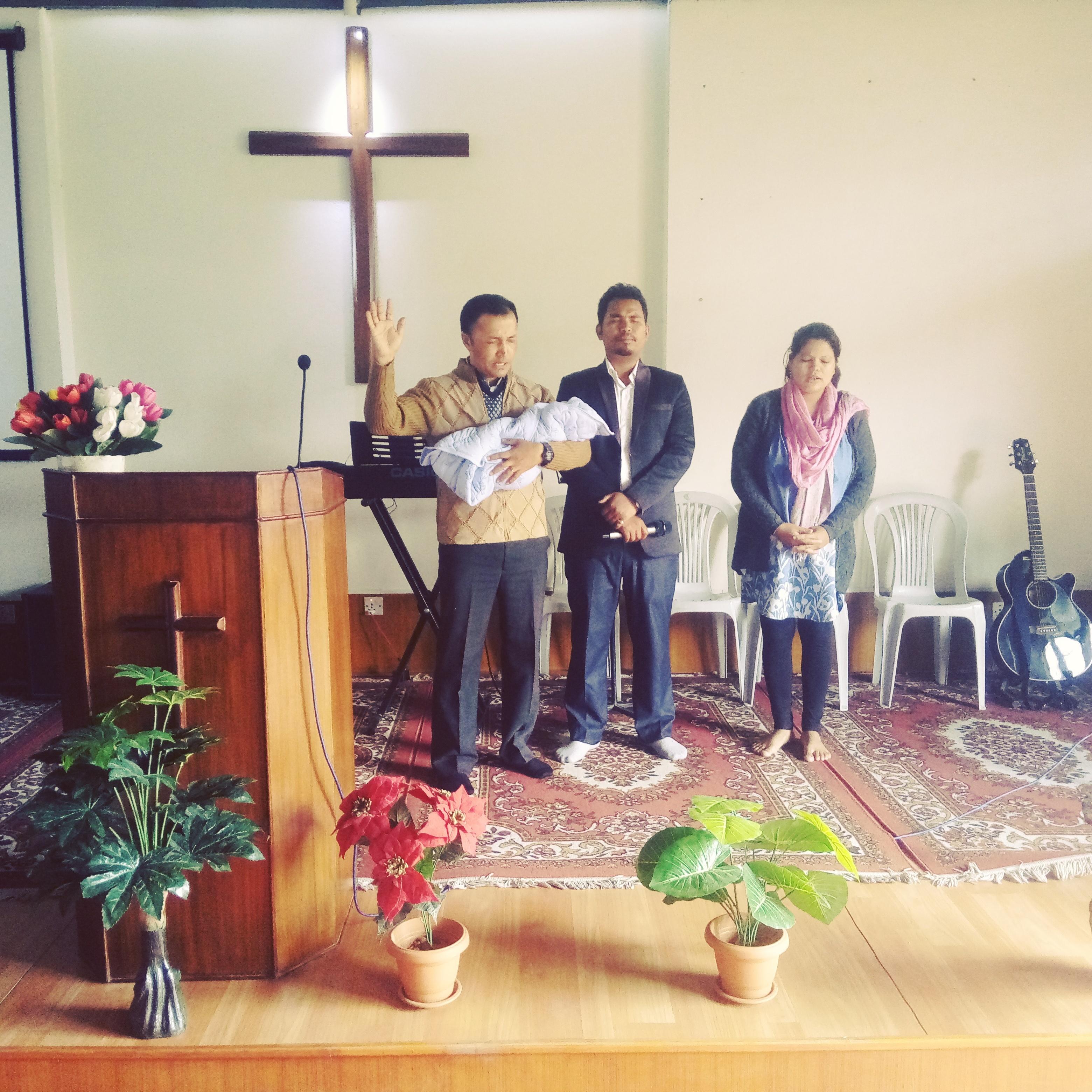
Krishna and his wife recently dedicated their beautiful baby, Jason, to God.
Krishna Chaudhary is a missionary at Campus Crusade for Christ in Kathmandu, Nepal where he has served as full time staff and Finance Manager from 2011 to the present. Krishna received his education from Tribhuvan University. There are six members in his KaV South City Team. His coverage area includes Birjung, Hetuda and Lalitpur.
Our Vision: Movements everywhere in Nepal so that everyone will know someone who truly follow Jesus
Our Mission: Launching spiritual movements everywhere in Nepal through winning, building, training and sending Christ Centered Multiplying Disciples
Despite great persecution and availability of few faithful kingdom leaders, God began to build a spiritual movement everywhere in Nepal since Campus Crusade for Christ began ministry in 1976. Below is an update from the ministry’s national director, Tara Singh Kathayat. As you read, would you prayerfully consider supporting Krishna through prayer and/or being a financial partner?
“Now, religious freedom has definitely given us more opportunity to reach unreached people of the country. But on the other hand nominalism is increasing immensely in Nepal. We have greater technology, resources, kingdom leaders and workers than ever before for proclaiming the gospel to every person, tribe and tongue. Yet many unreached peoples still await a fair opportunity to know and follow Jesus.
Lately, Nepal Campus Crusade for Christ has been identifying the systemic problems and obstacles that hinder us from bringing the gospel to every segment of the society. So we have set the Mission Critical Components-MCC as Student-led Movement, Leader-led Movement, Global Church Movement, Virtual-led Movement and Prayer Movement to highlight the mission strategies that can help us overcome the barriers and bring the love of Christ to every person regardless of their location, language or culture—building spiritual movement everywhere in Nepal by making disciples who makes disciples. We as a team are focused and dedicated to building and equipping followers of Christ.”
To receive Krishna’s current Ministry Partner Letter, view specific prayer requests, and/or financial partnership information contact Krishna Chaudhary at: krish.chudhary@gmail.com. Nepal Campus Crusade for Christ website may be found here: http://www.nepalccc.org/. Thank you for your prayerful consideration!
The Great Discipline, Exodus 32:15-33:11
God never permits His people to sin successfully.” –Charles Spurgeon
Warren Wiersbe (Be Delivered) writes: “God in His grace forgives our sins, but God in His government allows sin to work out its terrible consequences in human life. We reap what we sow (Gal. 6:7-8). . . . What a tragedy it is to reap the consequences of forgiven sin!”
King David—a man after God’s heart (Acts 13:22)—was one example of not only experiencing God’s forgiveness, but also having to face the consequence of his sins. God told him that the sword would not depart from his family, and it didn’t (2 Sam. 12:1-14).
With Moses’ absence for 40 days on Mt. Sinai, Israel impatiently grumbles against Moses and demands that Aaron set up an idol to lead them in place of God. Aaron complies and the people say: “These are your gods, Israel, who brought you up out of Egypt,” (32:4).
Moses Disciplines the people (32:15-29)
Moses asks Joshua to join him as he treks down Mt. Sinai. For one day Joshua would replace Moses and take up his leadership role. As Moses sees the golden calf idol, he throws down the stone tablets—that God had inscribed with His finger—in righteous anger. This act of breaking the tablets symbolizes Israel’s breaking the covenant with God. Now they would face the consequences.
After Moses confronts Aaron, he obeys God’s order and asks the people: “Who is on the Lord’s side? (see Josh. 24:15). The people are given opportunity to repent of their sin and return to God, but only the Levites respond. Setting aside the bonds of family and friendship, these men obediently follow through with the gut wrenching task of killing all involved in the orgy (about three thousand). Paul uses this event—among others—centuries later to warn believers about rebelling against God (1 Cor. 10:1-12).
Next, Moses destroys the idol calf by burning it, grinding the gold to powder, then throwing the powder into a stream. As he makes the people drink from this stream (Deut. 9:21), he forces them to identify with their sins.
Although Moses is angry with the people, God is angrier. When Moses returns to Mt. Sinai again for forty days and nights fasting and praying, he petitions God for an exchange: Spare the Israelites and kill him instead. But God rejects his offer. Maybe if the Israelites knew the anguish Moses experienced because of them they might have been more supportive of him. The Lord, however, comforts Moses with the assurance that His angel would go before them and Moses would once again lead them. But punishment would be certain, in God’s own way and in His own time.
God Disciplines the People (32:35-33:11)

“Grace is simply not just leniency when we sin, grace is the enabling gift of God not to sin. Grace is power, not just pardon.” –John Piper
After the Levites kill three thousand men, God’s first discipline comes in the form of a plague among the people. Wiersbe writes: “God knew who all the guilty people were. Sometimes God passes the sentence of judgment immediately but then delays executing the penalty. However, whether in the Old Testament or the New, ‘there is sin leading to death’ (1 John 5:16-17 NKJV).”
In God’s second judgment, He withdraws His presence leading Israel in their march to the Promised Land (33:1-6). Although He would still keep His covenant promises He made with the patriarchs earlier, He would send an angel to accompany them instead of in the person of His Son—“the Angel of the Lord”—going before Israel (23:20-23).
God’s third judgment involves moving Moses’ “tent of meeting” outside the camp where he could personally meet with God. Moses used this as a special tent to consult God since the tabernacle hadn’t been erected or dedicated yet. The cloud of pillar that led Israel thus far would hover at the tent door as God graciously granted Moses the privilege of talking to Him face-to-face (Num. 12:1-8; Deut. 34:10).
Reflect
The brief pleasure of sin isn’t worth its cost. Not only did Israel’s sin lead to thousands of deaths, but it also robbed the nation of God’s presence in both their camp and in their journey to the Promised Land. Although God punishes sin, He also shows His love to a thousand generations to those who love Him and keep His commandments (Exodus 20:6).
If you are experiencing God’s discipline, know that He loves you. Turn away from the sin and turn to Him. “If we confess our sins, He is faithful and just and will forgive us our sins and purify us from all unrighteousness” (1 John 1:9).
Wishing you a wonderful week!
 kdmanestreet