God Hears the Prayers of His People

In prayer it is better to have a heart without words, than words without a heart.” – John Bunyan, The Pilgrim’s Progress

I am enjoying this study in Exodus and hope you are as well. So far in studying the tabernacle, we’ve covered the ark of the covenant, the table of “presence bread”, and the golden lampstand. The remainder of the tabernacle furniture includes: the incense altar (covered in this post), the lavar, and the brazen altar. We’ll explore the tabernacle framework, coverings, and the veils last.

The Altar of Incense
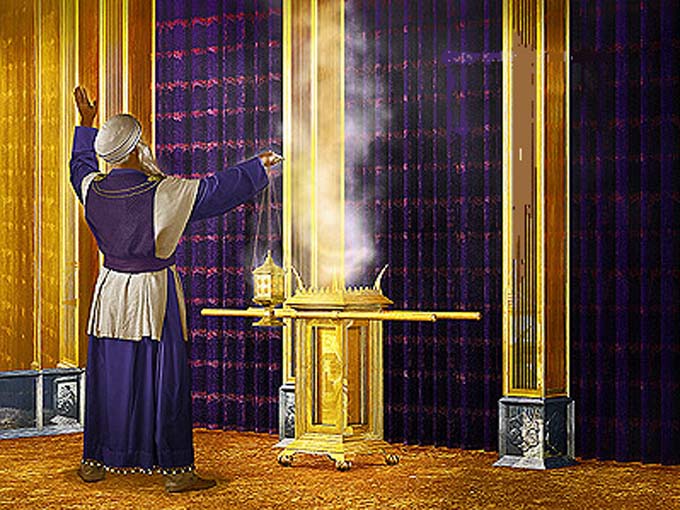
The priests were warned not to use the golden altar for anything except for burning incense (Ex. 30:9). God’s people were also called to pray whenever the priest burned incense (Luke 1:8-10). Today we are called to “pray continually” (1 Th. 5:16-18).

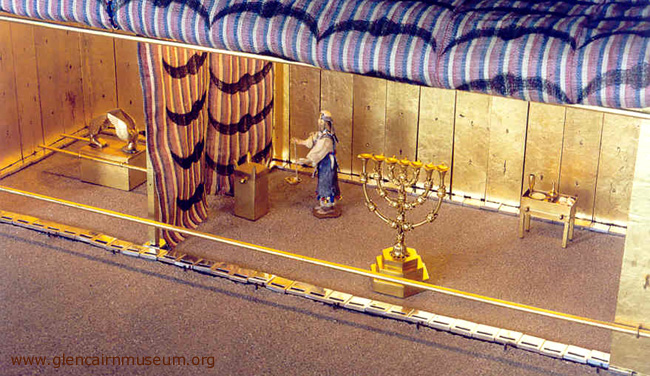
Made out of acacia wood and overlaid with gold, the altar of incense stood the tallest of all the furniture in the Holy Place (a foot and a half square and three feet high). An ornamental gold rim like a crown circled the top with golden “horns” on each corner. The altar stood before the veil that separated the Holy of Holies from the Holy Place. The priest burned incense here, morning and evening, as he trimmed the lamps.

Prayer 

The Bible often paints a picture of prayer whenever incense is mentioned. John wrote about his experience in seeing the elders in heaven with “golden bowls full of incense, which are the prayers of the saints” (Rev. 5:8; also see 8:3-4).

God not only gave specific instructions to the priest for a prescribed mix of spices in the incense, but also the correct fire on the altar (Ex. 30:34-38). The brazen altar, where sacrifices were offered to God, supplied the fire for burning the incense (Lev. 16:12-13; Num. 16:46). The priest that risked disobedience also risked his life, as was the case with Nadab and Abihu. Both were killed when they tried to worship God with “false fire” (Lev. 10). Likewise, any Israelite trying to copy this special incense for personal use would be cut off, possibly leading to his death.

Warren Wiersbe (Be Delivered) writes: “This suggests that true prayer must be based on the work of Christ on the cross and on our complete dedication to God. A true fervency in prayer isn’t a religious emotion we work up ourselves; rather, it’s a blessing that God sends down as we yield ourselves to Him.”

There are no substitutes for prayer. Contrary to some views, prayer isn’t just mumbling words with the hope that the “Big Guy in the sky” hears and answers. The golden altar also wasn’t intended as a bargaining table with God, but rather a place to adore Him and pray that His will be done. Some of the ingredients the Bible lists for prayer include: adoration, confession, thanksgiving, petition, submission (1 Tim. 2:1; Phil. 4:6). Jesus even  gives us a pattern for our prayers (Matt. 6:5-15).

Believers today don’t have the veil that separates ourselves from God, but rather have direct access to His throne because of Jesus’ work on the cross. What an awesome privilege! God extends His grace to us under the new covenant and welcomes our worship and petitions in Jesus’ name (Heb. 10:19-25). And, not only does the Holy Spirit intercede in our hearts (Rom. 8:26-27), but Jesus—our living, reigning Priest-King—continually intercedes for us in heaven as well (Rom. 8:33-34; Heb. 4:14-16; 7:19-28). What an amazing blessing!

Now for the convicting part, at least for me. The priest didn’t rush into the tabernacle, burn the incense and then rush out so he could check off one more item on his “to do” list. Rather, he reverently drew near the altar after preparing himself to be in the presence of the holy God.

Reflect

Although we are privileged to draw near to God because of Christ, He deserves our utmost respect.

Interestingly, the priest had to apply blood to the incense altar once a year—on the Day of Atonement— to make it ceremonially clean before God (Ex. 30:10). Why? Wiersbe writes: “Even in our praying we can sin!” How? He continues: “. . . . special incense had to be ‘salted’ (Ex. 30:35), for salt is a symbol of purity and of a covenant relationship (Lev. 2:13). ‘If I regard iniquity in my heart, the LORD will not hear’ (Ps. 66:18 NKJV). . . . We’re commanded to remove ‘anger or disputing’ from our hearts (1 Tim. 2:8). If God killed every believer today who didn’t pray as He has ordered, how many of us would survive a prayer meeting?”

Ouch. I’ll stop here. If I come across “preachy”, please know that any finger pointing is aimed at myself. . . . Alrighty then, wishing you a wonderful week!

Significance of the Lampstand in the Bible

“A talent of pure gold is to be used for the lampstand and all these accessories.” -Exodus 25:39

I hope you are enjoying summer. The months seem to fly by faster and faster. . . . Continuing our study in Exodus, we come to another significant piece of tabernacle furniture: the lampstand.

The candlestick was hammered from about seventy-five pounds of gold. Although the lampstand is laced with symbolism, it primarily points to Jesus Christ.

“Command the Israelites to bring you clear oil of pressed olives for the light so that the lamps may be kept burning. In the tent of meeting, outside the curtain that shields the ark of the covenant law, Aaron and his sons are to keep the lamps burning before the Lord from evening till morning. This is to be a lasting ordinance among the Israelites for the generations to come.” -Exodus 27:20-21

Without the lampstand, the priests couldn’t carry out their ministries in the Holy Place for lack of light. Warren Wiersbe (Be Delivered) observes: “God wants us to offer Him intelligent worship, not ignorant worship (John 4:19-24; Acts 17:22-31; Rom. 1:18:25), and to do that, we need the light of the Word of God to guide us (Ps. 119:105, 130; Prov. 6:23). . . Prayer is enlightened by the Word (John 15:7), and the Word is opened up to us as we pray (Ps. 119:18; Eph. 1:15-23). Both the study of the Word and the exercise of prayer must be energized by the Holy Spirit, who is symbolized by oil (the lampstand, Zech. 4:1-7) and fire (the altar, Acts 2:3-4).

For more on the lampstand’s symbolism, I found the following post from gotquestions.org both interesting and informative. Writing of light, may you enjoy the rest of your summer as daylight lingers longer.

What is the Significance of the Lampstand?


The Place Where God Dwells, Part 2

When the Israelites traveled from place to place in their wilderness journey, the pillar of cloud and the ark of the Lord led the way. Out of the six special pieces of tabernacle furniture, the ark is mentioned first. Why? The ark represented God’s power and authority in Israel’s camp.

God Must Be First in Everything (Exodus 25:10-22; 37:1-9)

The New Testament’s version of putting God first.

The ark consisted of a wooden chest measuring forty-five inches long, twenty-seven inches wide, and twenty-seven inches high. God’s “shekinah” presence rested with the ark in the Holy of Holies. God’s throne—represented in the golden mercy seat—sat upon the ark with a cherub at each end; their wings overshadowing the ark.

The Ark Points to Jesus Christ

God designed the ark to symbolize His Son, Jesus, with the wood representing His humanity. The gold—which completely covered the wood—represents His deity.

The contents within the ark included: the tablets of the law (Ex. 25:16), a pot of manna (16:32-34), and Aaron’s rod that budded (Num. 16-17). Of these items, Warren Wiersbe (Be Delivered) writes: “These objects tell us that the law of God was in Christ’s heart and He perfectly obeyed and fulfilled it (Ps. 40:6-8; Heb. 10:5-9); He is the Bread of Life, who gives eternal life to all who receive Him (John 6:32); and He lives by the power of an endless life so we can be fruitful for God (Heb. 7:16).”

Only the high priest could enter the Holy of Holies once a year on the Day of Atonement. Israel’s sins were covered for another year when he sprinkled blood from the sacrifices on the mercy seat (Lev. 16). Christ fulfilled this type when He died once for all the world’s sins. Jesus, the “Bread of Life”, clothed Himself in humanity that He might enter our world and sacrificially die in our place.

God’s Presence Nourishes His People (Exodus 25:23-29; 37:10-16)

When the priest walked from the outer court into the Holy Place, he would see the table of “presence bread,” on the right. The golden lampstand would be on his left, and the golden altar of incense ahead, which stood before the veil that separated the Holy Place from the Holy of Holies.

Like the ark, the table—three feet long, a foot and a half wide, and twenty-seven inches high—reminds us of Jesus’ humanity and deity from the acacia wood overlaid with gold.

Each week, twelve loaves of bread were baked, (see recipe in Lev. 24:5-9). The old loaves were removed and eaten each Sabbath by the priests in the Holy Place while new loaves replaced the old. Wiersbe writes: “The loaves are called “showbread” (Ex. 25:30 NKJV) or “Presence bread (NIV), literally ‘bread of faces’. The presence of twelve loaves of bread in the Holy Place couldn’t help but remind the priests that they were serving the twelve tribes of Israel, God’s chosen people. Through these loaves, the twelve tribes were presented before God and God was present with them in their camp, beholding their worship and their daily walk. The tribes were also represented by the jewels on the breastplate and the shoulders of the high priest (28:6-21). When you combine the images of the jewels and the loaves, you learn that the Lord feeds His people, bears them on His shoulders, and carries them in His heart.”

The loaves of bread were considered a meal offering so no leaven would be in the dough (Lev. 2:1-11). The priests were to eat the bread in a thoughtful manner. The act of a defiled priest eating the bread or sacrificial meat belonging to the priests was punishable by death (Lev. 22:3-9).

Reflect

Ancient Israelites followed the ark of the Lord and pillar of cloud. God’s children today are also led by God from His throne: communicated through His Word, the Bible, and through His indwelling Holy Spirit.

Although Moses was permitted to enter the Holy of Holies to receive God’s will for the Israelites when God spoke to him from the golden mercy seat  (Ex. 25:21-22; 29:42; 30:6, 36; Num. 7:89), God’s people today may enter into His presence through the “mercy seat” of Jesus Christ (Heb. 10:19-25).

God’s throne is no longer reserved for a high priest making atonement for sins once a year. Rather, God’s children may fellowship at the foot of God’s throne any where, any time, because Jesus’ sacrifice makes us right before God by cleansing us from our sin when we place our trust in Him and ask for His forgiveness (Heb. 9:11-10:14).

Paul used the comparison of the church to a loaf of unleavened bread (1 Cor. 5:1-8; 10:16-17) to emphasize that God’s people must keep themselves free from impurity. Jesus, the “Bread of Life”, not only offers eternal life, but also comforts and nourishes His children.

How are Christians called to act as priests today? What qualifies Jesus to be our mediator and Great High Priest under the new covenant? How is the church to “feed” the world?


The Place Where God Dwells—Part I

See that you make them according to the pattern shown you on the mountain.” -Exodus 25:40

The last section of Exodus (ch. 25-40) describes God’s plans for the tabernacle and the priesthood. God gave Moses the tabernacle pattern on Mt. Sinai and warned him to make everything accordingly.

So far, God has fulfilled His promises in Exodus 6:6-8 by delivering His people from Egypt (Ex. 1-18) and adopting them as His special treasure (Ex. 19-24; Rom. 9:4). Now He’s about to fulfill the remainder of His promise by coming into the camp so He might dwell with His people. Not only would this be a great privilege for the Israelites, but also a huge responsibility as the camp would need to be holy for the holy God to dwell there.

After giving Moses the law, God gives detailed instructions for the tabernacle He wants the Israelites to build. This would not only be a place of worship, but also a mobile building designed for the people to set up and take down during their wilderness journey. God also designates the tribe of Levi to be set apart that they might serve Him as priests.

The remainder of Exodus not only relays historical events, but is also steeped in spiritual truths. This book isn’t arranged topically. The tabernacle and priesthood is also sprinkled throughout Leviticus, Numbers, and Deuteronomy. Perhaps God did this so we wouldn’t just read one book, but study all the books He has authorized in the Bible. I’m following Warren Wiersbe’s outline from his book, Be Delivered, and hope to highlight how this section relates to us today.

God Designs the Plan (25:9, 40; 26:30)

God’s design for the earthly tabernacle was a copy of the heavenly tabernacle (Heb. 8:1-5; 9:1). The book of Revelation parallels the heavenly tabernacle with the earthly tabernacle: an altar (6:9-11), an altar of incense (8:3-5), a throne (4:2), elders/priests (vv. 4-5), lamps (v. 5), a “sea” (v. 6), and cherubim (vv. 6-7).

God always has a plan when He does a work, whether it’s building a tabernacle, local church, or individual Christian life (Eph. 2:10). We are told to follow His pattern, not the pattern of this world.

God Provides the Materials (25:1-9; 30:11-16; 35:4-29)

Precious metals, fabrics, wood, skins, olive oil, spices and precious stones were collected. Over three tons of silver and a ton of gold have been estimated in the tabernacle construction.

“Everything comes from you,” King David prayed, “and we have given you only what comes from your hand” (1 Chron. 29:14). God not only supplied the materials, but also stirred the people’s hearts to give. They were so generous, in fact, that Moses actually told them to stop (Ex. 36:6-7)!

Everything we have to give has been given to us first by our Maker.

God Equips the Workers (31:11; 35:30-36:7)

God not only appointed Bezalel and Oholiab to lead the workers, but also gave them wisdom and the ability to succeed. The tabernacle and furniture were crafted by assistants that God also enabled (Ex. 35:10).

God is still in the business of calling people who differ in abilities and spiritual gifts to be used for His glory and the good of His church (1 Cor. 12:1-13; Eph. 4:1-16; Rom. 12). (For more on this topic see Spiritual Gifts, Romans 12:3-8).

Wiersbe writes: “The Jews built a tent that long ago turned to dust, but we’re helping to build ‘a habitation of God in the Spirit’ (Eph 2:22) that will glorify God eternally.”

Reflect

What spiritual gifts and abilities has God given you? Where is God prompting you to join in His work?

God’s Call to Moses, God’s Call to Us, Exodus 24:9-18

Then they climbed the mountain—Moses and Aaron, Nadab and Abihu, and seventy of the elders of Israel—and saw the God of Israel. He was standing on a pavement of something like sapphires—pure, clear sky-blue. He didn’t hurt these pillar-leaders of the Israelites: They saw God; and they ate and drank. God said to Moses, ‘Climb higher up the mountain and wait there for me; I’ll give you tablets of stone, the teachings and commandments that I’ve written to instruct them.’ So Moses got up, accompanied by Joshua his aide. And Moses climbed up the mountain of God.” –Exodus 24:9-13 (The Message)

You may read Exodus 24:9-18 here: Bible Gateway.

After Moses followed God’s instruction to ratify the covenant with Israel, as spelled out in the Ten Commandments, the final act of this process ends with the covenant meal. Eating together denotes friendship. Seventy-five leaders who teach, interpret law, and act on Israel’s behalf receive God’s blessing and agreement as they eat together in the glory of His presence.

God Summons us to Worship Him

(www.bloglovin.com) Today, God calls us to enter into His presence through “the new and living way” (Hebrews 10:19-25). We don’t have to be fearful when our names are written down as citizens of heaven (Heb. 12:18-24). Only we can decide how “high” we will go in our worship and fellowship with God.

Although only a handful of witnesses behold God’s partial glory from a distance in the old covenant, God invites all of us to draw near Him under the new covenant. God longs to fellowship with us and invites us into His presence. He seeks people who will worship Him in “spirit and in truth” (John 4:23-24).

Worship of God is the greatest responsibility and highest privilege. One day we will give an account to our Almighty Creator who is the highest Being in the universe. As believers, our very being and actions should flow from our relationship with the Lord.

The Tablets of Stone

God calls Moses even higher, to the top of Mt. Sinai, to give him the commandments (along with the tabernacle’s blueprints). The commandments are inscribed in stone by God’s own finger.

Moses stays on the mountain for forty days and nights as God uses that time to give him the plans for the tabernacle and priesthood. Wiersbe writes: “The glory cloud ‘abode’ on Mount Sinai, and the Hebrew word translated “abode” is shekinah, a word that both Jewish and Christian theologians use to describe the presence of God. It’s translated “dwell” in Exodus 25:8 and 29:45-46. The blazing fire on the mount reminds us that “our God is a consuming fire (Heb. 12:29).”

Reflect

The elders of Israel are amazed that God doesn’t strike them dead from their revelation, but interestingly, Moses’ revelation of God is only described from their perspective at the camp’s base, rather from Moses himself. Perhaps Moses didn’t want to showcase his experience since he is recorded as being very humble (Numbers 12:3). Or maybe the experience was too special and overwhelming to adequately put into words. For the Israelites couldn’t even look steadily at Moses face because of God’s glory. But interestingly, this glory faded. Of the glory of the new covenant, the Apostle Paul writes: “Will not the ministry of the Spirit be even more glorious? If the ministry that condemns men is glorious, how much more glorious is the ministry that brings righteousness!” (2 Cor. 4:8-9).

The expression “finger of God” not only relates to the Ten Commandments (Ex. 31:18), but also points to God’s creative power  and authority over His creation (Ps. 8:3), writing judgment (Da. 5:5, 24-28) and executing miracles. He also inscribed revelation to us through the Bible, communicating the old and new covenants. (For more on covenants see The Covenant Confirmed, Exodus 24:1-8 ).

For believers under the new covenant, God has marked us with His seal “the promised Holy Spirit, who is a deposit guaranteeing our inheritance until the redemption of those who are God’s possession—to the praise of His glory,” (Ephesians 1:13). The Apostle Paul wrote in 2 Corinthians 3:3: “You show that you are a letter from Christ . . . written not with ink but with the Spirit of the living God, not on tablets of stone but on tablets of human hearts.”

The thought that God wants to dwell with us—in us—through His Holy Spirit is mind-blowing. His “finger” not only pursues us in love, but also works powerfully in us and around us (2 Cor. 3:17-18, Rom. 8:28). His beloved Son endured ridicule and suffering before laying down His life—dying a criminal’s death—to become the once for all perfect sacrifice. Through the sprinkling of Christ’s blood, God provides a means of forgiveness and relating to people. With open hand, He extends an invitation to everyone to participate in this incredible gift of abundant, eternal life.

Have you entered into a relationship with God through means of His new covenant? There is nothing more important, or life altering, than this decision. Eternal life and death hang in the balance. (For more on this topic, please click on the Salvation tab in the menu bar.)