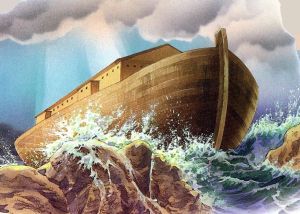
The Ark: A True Type of Christ, (Genesis 8)

But God remembered Noah and all the wild animals and the livestock that were with him in the ark, and He sent a wind over the earth, and the waters receded. Now the springs of the deep and the floodgates of the heavens had been closed, and the rain had stopped falling from the sky.”    Genesis 8:1-2
4579512f32989497f93af3e45690edf4

Read Genesis 8 here: Bible Gateway

The Hebrew term for remember means “began again to act on their behalf”.

After 150 days of reeling on the water the ark finally came to rest, most likely on Mount Ararat since it was the highest mountain in the region, Gen. 8:5.

After another seven months—totaling 371 days—Noah, his family, and the animals finally exited the ark.

The Ark: A true type of Christ

The Bible is full of parallels or “types.” We can see God arranging the affairs of several Old Testament people and events to show us similarities to Jesus Christ, the focal point of the Gospel. Consider the following parallels:

  • After five months of providing refuge and laboring to accomplish its work of saving its occupants from judgment of sin, the ark finished its mission. After Christ came to earth and provided refuge and healing for many, He died on the cross and finished His mission: the work of salvation (John 19:30).
  • The ark’s construction was made to be waterproof and resistant to decay by sealing it with “pitch” inside and out. The Hebrew word for pitch—kopher—means a “covering”. But it’s also the Hebrew word for atonement. This is the Bible’s first mention of atonement. Henry Morris writes: “It sufficed as a perfect covering for the ark, to keep out the waters of judgment, just as the blood of the Lamb (Christ) provides a perfect atonement for the soul.”
  • The Jewish date that the ark rested (Gen. 8:4) and the date Jesus Christ rose from the dead are the same: “the seventeenth day of the seventh month”.
  • The ark became the bridge from the old evil world to the present one (Gen. 7:7, 2 Peter 3:6-7). God would help Noah and his family with their new life in their new world. God also graciously provides deliverance from spiritual death to us through His Son, Jesus. This is symbolized through water baptism (1 Peter 3:21). He saves us from God’s judgment of sin. He not only gives us the opportunity for a new beginning, but also offers help in our daily walk.
  • Although Noah wasn’t perfect, he is described as a “righteous man who walked with God” (Gen. 6:9). Jesus was the perfect, blameless man who consistently obeyed His Father (Heb. 4:15).
  • Noah was like a “second Adam” since all people come from him (Gen. 8:15-9:17). Christ is called “the second man (Adam)” since He is the only source of eternal life (1 Cor. 15:47; Acts 4:12).
  • Human evil had reached a deplorable high, so God decided to undo his creation with a flood (Gen. 6:6-7). In God’s timing, He will undo His creation again; this time by fire (2 Peter 3:12-13) and then re-create it (Rev. 21:1).

Questions

Each of us share some similarities with Noah as we look forward to the removal of sin and its curse.

  • How is Jesus like a bridge for us to God the Father and new life?
  • Have you accepted God’s gracious invitation of new life through Jesus Christ?
  • How should we be living today? (2 Peter 3:12-14)

*For scientific evidence of the worldwide flood, read Starling Evidence for Noah’s Flood. Also, The Genesis Flood by Henry Morris is a comprehensive geological book that includes Biblical commentary.

Conditions Before Christ’s Return (Genesis 6-8; Mt. 24)

No one knows about that day or hour, not even the angels in heaven, nor the Son, but only the Father. As it was in the days of Noah, so it will be at the coming of the Son of Man. For in the days before the flood, people were eating and drinking, marrying and giving in marriage, up to the day Noah entered the ark; and they knew nothing about what would happen until the flood came and took them all away. That is how it will be at the coming of the Son of Man. Two men will be in the field; one will be taken and the other left.” – Matthew 24:36-41

The door to Noah’s ark represents salvation. As the door to the ark was the only way to preserve life, so Jesus is the only way to eternal life with God (Jn. 14:6).

(Source: alittleperspective.com)

(Source: alittleperspective.com)

Although we don’t know the exact time Christ will return, Jesus tells us to be watchful (Matthew 24; Mark 13:32-37; Luke 21:34-38). As the pre-flood days of violence and evil foreshadowed the coming world-wide flood, so will conditions in the last days foretell an even greater destruction for those who have rejected God’s son, Jesus Christ.

What Are these Conditions?

Henry Morris summarizes some similar characteristics of the pre-flood era to conditions in these last days preceding Christ’s return:

  1. Preoccupation with physical appetites (Luke 17:27)
  2. Rapid advances in technology (Genesis 4:22)
  3. Grossly materialistic attitudes and interests (Luke 17:28)
  4. Uniformitarian philosophies (Hebrews 11:7)
  5. Inordinate devotion to pleasure and comfort (Genesis 4:21)
  6. No concern for God in either belief or conduct (2 Peter 2:5; Jude 15)
  7. Disregard for the sacredness of the marriage relation (Matthew 34:38)
  8. Rejection of the inspired Word of God (1 Peter 3:19)
  9. Population explosion (Genesis 6:1, 11)
  10. Widespread violence (Genesis 6:11, 13)
  11. Corruption throughout society (Genesis 6:12)
  12. Preoccupation with illicit sex activity (Genesis 4:19; 6:2)
  13. Widespread words and thoughts of blasphemy (Jude 15)
  14. Organized Satanic activity (Genesis 6:1-4)
  15. Promulgation of systems and movements of abnormal depravity (Genesis 6:5, 12)

Sound familiar?

As the flood in Noah’s day was swift and sudden, so will the return of Christ be. This should motivate us to obey Him every day. Jesus’ warns us to be ready for His return (Mt. 24).

Like Noah, are we in right standing with God?

Will Christ find faith and obedience in us when He returns?

Next week I’ll explore more of Noah’s life and why he found favor (grace) in God’s eyes.

Have a great week!

Paul’s Salutation, Romans 1:1-7

While our “Dear John” letters usually include minimal details about ourselves, the ancient letter writers wrote differently. The writer placed his name first, the identity of the reader next, then a greeting.

Romans begins with the author, Paul, following this format. He identifies himself in three ways:

1) A “servant of Jesus Christ”

  • Although Paul was a Roman citizen, he no longer embraced the average Roman’s attitude that being a servant was uncool. Instead, Paul threw his energy into dependence and obedience to his new found Master. Paul’s former zeal for his ancestral tradition had garnered him honor and high ranking in Judaism. As a religious Pharisee, Paul’s fierce intensity targeted killing Christians because he thought they endangered Judaism (Acts 9:1-25). But after his conversion from Jesus’ confrontation, Paul declared himself Christ’s bondslave (Gal. 1:1-14).

2) “Called to be an apostle”

  • God chose Paul’s role. Paul responded by preaching Christ throughout the Roman Empire on three missionary journeys.

3) “Set apart”

  • God set Paul (formerly Saul) apart to serve Him by sharing and spreading the gospel.
Paul’s Purpose for Writing (vv. 2-6)

Paul declares his purpose for writing to verify his apostolic message. God had promised His gospel earlier “through the prophets in the holy Scriptures.” Some of these prophecies about Jesus Christ and the Good News are Genesis 12:3; Psalm 16:10; 40:6-10; 118:22; Isaiah 11:1; Zechariah 9:9-11; 12:10; Malachi 4:1-6.

In verses 3-4, Paul presents Jesus Christ as the center of the gospel. Jesus, descendant of King David, fulfilled Old Testament Scriptures predicting the Messiah coming from David’s line. Several New Testament passages also verify the Davidic descent of Jesus: Matthew 1:1; Luke 1:31-33; Acts 2:29-30; Revelation 5:5.

In relation to Jesus’ present exaltation, Paul cites “Jesus Christ our Lord” as “the Son of God by His resurrection from the dead”.

Grace & Peace

“Grace and Peace” combined a Christianized form of the Greek and Hebrew greetings (Shepherd’s Notes).

After receiving unlimited, undeserved forgiveness (grace) when meeting Christ on the Damascus road, Paul’s heart received a transformation. Upon following a new leader, Paul strove to fulfill his calling of sharing the Good News of Christ by aligning himself with God’s directives.

So What?

The same Jesus Christ who “set Paul apart” also invites us to be “saints”—set apart, holy, dedicated for His service; whether through formal or informal ministry. It is a great privilege and responsibility to share our Father’s Good News: Forgiveness and eternal life are a gift of God’s grace—received through faith in Christ—available to all.

I like the following excerpt from my NIV Study Bible: “God did not waste any part of Paul—his background, his training, his citizenship, his mind, or even his weaknesses. Are you willing to let God do the same for you? You will never know all He can do with you until you allow him to have all that you are!”

God’s Righteous Judgment, Romans 2:1-16

High-fives echo in response to the judge’s verdict on the Gentiles: “Guilty as charged.”

166163e41e3c9ac70768869d063e6d8bLike the last passage, I feel like I’m in a courtroom, but this time slinking down in my seat to avoid apostle-attorney Paul’s piercing gaze as his focus shifts from the Gentiles toward the Jews. No, I’m not Jewish, but Paul didn’t let anyone slide. Probably some Jewish heads nodded their approval when Paul pronounced God’s judgment on the pagan Gentiles. Paul lights into their condemning attitude like a firecracker (verses 1-10).

You, therefore, have no excuse, you who pass judgment on someone else, for at whatever point you judge the other, you are condemning yourself, because you who pass judgment do the same things.” –vs. 1

Despite knowing God’s laws, the Jews failed to live up to it. Their sin may have been hidden in more socially acceptable forms. But Paul faults them for having a stubborn and unrepentant heart, treating God’s great kindness, tolerance, and patience with contempt.

Those who patiently and persistently do God’s will, however, will find eternal life (vs. 7). This may sound like a contradiction to his statement that salvation comes by faith alone (1:16-17), but he is stressing that our deeds follow in grateful response for what God has done.

Again, Paul warns of God’s wrath toward: self-seekers, those who reject the truth, and those who follow evil.

Judgment With or Without the Law

All who sin apart from the Law will also perish apart from the Law, and all who sin under the Law will be judged by the Law.” – vs. 12

Paul weaves his case: Can the religiously privileged Jews expect special treatment because they’ve been given the Mosaic Law? This gave the Jews greater responsibility for following it.

Or could the Gentiles receive an easier verdict for not having God’s Law? Certainly God’s revelation through the Law made His will more fully known. But God made Himself known to the Gentiles through nature and the inner law of conscience.

Conclusion

Paul concludes that all—Jew and Gentile—are guilty of violating God’s Laws. People are condemned for what they do with what they know, not for what they don’t know. God doesn’t play favorites. God patiently waits for our repentance. But a time is appointed when He will judge everyone’s secrets when we stand before His throne. No one will stand apart from the saving grace found in His son, Jesus Christ. (For more on God’s judgment, see John 12:48 and Revelation 20:11-15.)

So what?

The sins we’re tempted to point out in others are often the sins we struggle with the most. Like King David, we need to consistently ask God to search our hearts and show us our sin so we can seek His forgiveness.

Ps. 51Those of us who have grown up in Christian families could be considered today’s religiously privileged. Are we focused on living according to what we know? Or are we passing judgment on those around us?

Assurance in Judgment, Romans 5:6-11

I received my gold crown today. Yes, really . . . I did! However, I almost bailed halfway through the process.

I nearly jumped out of the chair when my dentist began prepping my exposed tooth. The unnerving sensation—akin to finger nails on a chalkboard—caused me to impulsively grab my dentist’s hand. That’s when he asked, “Shall I numb the area?”

“Yes, please!”

I’ll be okay now, I thought when my tongue felt fat and tingly after the shot. Yea, I won’t feel a thing now! But one poke of his instrument stole my breath with those unnerving shock waves. So I opted for another numbing shot. While waiting for the novocaine to set in, my thoughts shifted like the wind: This shot isn’t going to do the job either! And when it doesn’t, how am I going to hold still? Should I just up and leave? No, I can’t do that! Do they ever strap their patients hands down? Dear Lord, please help me not feel this, or at least distract me from this pain . . . . And so my thoughts flickered.

4b46e1d2a0b5d21411a561214b020414

Uncertainty

Everyone struggles with uncertainty at times: decisions, jobs, relationships, etc.

Do you ever feel uncertain of God’s love for you? If so, spend some time soaking in these amazing words:

But God demonstrates His own love for us in this: While we were still sinners. Christ died for us. Since we have now been justified [declared not guilty for our sins] by His blood, how much more shall we be saved from God’s wrath through Him! For if, when we were God’s enemies, we were reconciled to Him through the death of his Son, how much more, having been reconciled, shall we be saved through His life!”  – Romans 5:8-10

At the perfect time, God orchestrated the unthinkable: sending His sinless Son to die for the atonement of our sins. We don’t—and can’t—get our act together before coming to Christ. 2 Corinthians 5:21 says, “God made Him who had no sin to be sin for us, so that in Him we might become the righteousness of God.” Our sin was poured into Christ at His crucifixion. His righteousness is poured into us when we place our trust in Christ at our conversion.

So What?

God’s love is bigger than our doubts and sin. Because His generous act has provided reconciliation, Christians “rejoice in God through our Lord Jesus Christ” (vs.11). We can rest and have complete confidence, knowing we will be saved from God’s wrath at the final judgment because Jesus paid our sins in full.

The same love that caused Christ to die is also the same love that equips believers with the indwelling Holy Spirit to guide, teach, and comfort (John 14:26).

If you haven’t asked Jesus for forgiveness and placed your trust in Him, there is no time like now. Don’t let anything hold you back from coming to Christ.