The Tabernacle Framework (Exodus 26:1-37; 27:9-19; 36:8-38; 38:9-20)

‘Honor and majesty are before Him,’ wrote the psalmist; ‘strength and beauty are in His sanctuary’ (Ps. 96:6). The strength of His sanctuary is revealed in its construction, and the beauty is revealed in its adornment.” –Warren Wiersbe, Be Delivered

I didn’t realize that more space is devoted to the tabernacle, more than any other topic, in all of scripture. I also wasn’t aware just how much the tabernacle is steeped in symbolism that points to our Savior, Jesus Christ.

So far in this study, we’ve explored the significance of the following tabernacle furniture: ark of the covenant, the table of “presence bread”, the golden lampstand, the incense altar, the lavar, and the brazen altar. Now onward to the framework of the tabernacle.

Strength

Elegant curtains were draped over the solid structure of the tabernacle proper. Forming the north and south walls were twenty boards of acacia wood overlaid with gold. These stood fifteen feet high and twenty-seven inches wide. Eight similar boards fashioned the west wall.

God instructed Jewish men of military age to give silver shekels (“redemption money”) to be made into two silver bases for each board. This provided needed stability and security on the uneven ground. Wiersbe writes: “God’s sanctuary didn’t rest on the shifting sands of this world but on the solid foundation of redemption.” Further strengthening the 48 boards were four rods (crossbars) which ran through golden rings on every board. The door into the Holy Place stood on the east end of the tabernacle.  A linen curtain—beautifully embroidered with blue, purple and scarlet yarn—hung on the five posts stationed there. Some scholars believe that the boards on the north and south walls were connected to the end pillars by an additional rod to give even more stability to the framework.

Beauty

The hangings and coverings of the tabernacle were cloaked in gold, blue, purple, scarlet, and white; major colors representing spiritual themes. The white linen fence surrounding the sacred area points to God’s holiness. At the east end stood the 30 foot gate embroidered in blue, purple, and scarlet. These brilliant colors stood out against the white linen fence. Blue, the color of the sky, reminds us of heaven and the God of heaven. Purple represents royalty, which points to the King. Scarlet signifies our Savior’s blood sacrifice.

Covered with four different curtains in the Holy Place and Holy of Holies, these curtains graced the walls and hung down to the ground. The leatherlike outmost covering consisted of badgers’ skins (“sea cows,” NIV). These not only protected the other coverings, but also the tabernacle proper and its furnishings. Below this protective covering lie a curtain of rams’ skins dyed red. The next layer consisted of a woven fabric made from goats hair, which might have been black. Fine linen embroidered with cherubim in blue, purple, and scarlet made up the last curtain.

The veil between the Holy Place and the Holy of Holies hung from golden clasps supported by four pillars. The veil was also embroidered with cherubim in white, scarlet, blue, and purple. Hebrews 10:20 tells us that this veil typifies Christ’s body. When His body was offered on the cross, the veil in the temple tore from top to bottom (Mark 15:38).

Wiersbe notes: “Some students see a parallel between the four gospels and the four pillars that supported the veil with the four colors. Purple speaks of royalty—the gospel of Matthew, the gospel of the King. Scarlet reminds us of sacrifice—the gospel of Mark, the gospel of the Suffering Servant. White speaks of the perfect Son of Man—the gospel of Luke, and blue points to heaven—the gospel of John, the gospel of the Son of God who came from heaven to die for our sins.”

Next week we’ll explore how the treasures that the Old Testament believers possessed in God’s house translates to modern believers. Have a great week!
God Hears the Prayers of His People

In prayer it is better to have a heart without words, than words without a heart.” – John Bunyan, The Pilgrim’s Progress

I am enjoying this study in Exodus and hope you are as well. So far in studying the tabernacle, we’ve covered the ark of the covenant, the table of “presence bread”, and the golden lampstand. The remainder of the tabernacle furniture includes: the incense altar (covered in this post), the lavar, and the brazen altar. We’ll explore the tabernacle framework, coverings, and the veils last.

The Altar of Incense

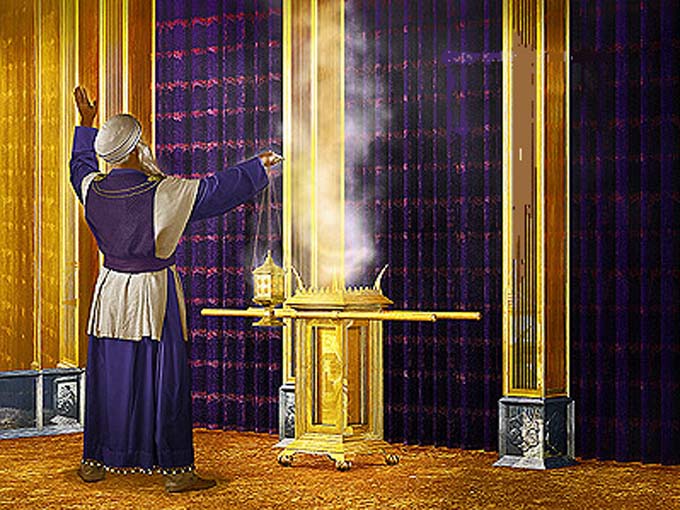
The priests were warned not to use the golden altar for anything except for burning incense (Ex. 30:9). God’s people were also called to pray whenever the priest burned incense (Luke 1:8-10). Today we are called to “pray continually” (1 Th. 5:16-18).

Made out of acacia wood and overlaid with gold, the altar of incense stood the tallest of all the furniture in the Holy Place (a foot and a half square and three feet high). An ornamental gold rim like a crown circled the top with golden “horns” on each corner. The altar stood before the veil that separated the Holy of Holies from the Holy Place. The priest burned incense here, morning and evening, as he trimmed the lamps.

Prayer 

The Bible often paints a picture of prayer whenever incense is mentioned. John wrote about his experience in seeing the elders in heaven with “golden bowls full of incense, which are the prayers of the saints” (Rev. 5:8; also see 8:3-4).

God not only gave specific instructions to the priest for a prescribed mix of spices in the incense, but also the correct fire on the altar (Ex. 30:34-38). The brazen altar, where sacrifices were offered to God, supplied the fire for burning the incense (Lev. 16:12-13; Num. 16:46). The priest that risked disobedience also risked his life, as was the case with Nadab and Abihu. Both were killed when they tried to worship God with “false fire” (Lev. 10). Likewise, any Israelite trying to copy this special incense for personal use would be cut off, possibly leading to his death.

Warren Wiersbe (Be Delivered) writes: “This suggests that true prayer must be based on the work of Christ on the cross and on our complete dedication to God. A true fervency in prayer isn’t a religious emotion we work up ourselves; rather, it’s a blessing that God sends down as we yield ourselves to Him.”

There are no substitutes for prayer. Contrary to some views, prayer isn’t just mumbling words with the hope that the “Big Guy in the sky” hears and answers. The golden altar also wasn’t intended as a bargaining table with God, but rather a place to adore Him and pray that His will be done. Some of the ingredients the Bible lists for prayer include: adoration, confession, thanksgiving, petition, submission (1 Tim. 2:1; Phil. 4:6). Jesus even  gives us a pattern for our prayers (Matt. 6:5-15).

Believers today don’t have the veil that separates ourselves from God, but rather have direct access to His throne because of Jesus’ work on the cross. What an awesome privilege! God extends His grace to us under the new covenant and welcomes our worship and petitions in Jesus’ name (Heb. 10:19-25). And, not only does the Holy Spirit intercede in our hearts (Rom. 8:26-27), but Jesus—our living, reigning Priest-King—continually intercedes for us in heaven as well (Rom. 8:33-34; Heb. 4:14-16; 7:19-28). What an amazing blessing!

Now for the convicting part, at least for me. The priest didn’t rush into the tabernacle, burn the incense and then rush out so he could check off one more item on his “to do” list. Rather, he reverently drew near the altar after preparing himself to be in the presence of the holy God.

Reflect

Although we are privileged to draw near to God because of Christ, He deserves our utmost respect.

Interestingly, the priest had to apply blood to the incense altar once a year—on the Day of Atonement— to make it ceremonially clean before God (Ex. 30:10). Why? Wiersbe writes: “Even in our praying we can sin!” How? He continues: “. . . . special incense had to be ‘salted’ (Ex. 30:35), for salt is a symbol of purity and of a covenant relationship (Lev. 2:13). ‘If I regard iniquity in my heart, the LORD will not hear’ (Ps. 66:18 NKJV). . . . We’re commanded to remove ‘anger or disputing’ from our hearts (1 Tim. 2:8). If God killed every believer today who didn’t pray as He has ordered, how many of us would survive a prayer meeting?”

Ouch. I’ll stop here. If I come across “preachy”, please know that any finger pointing is aimed at myself. . . . Alrighty then, wishing you a wonderful week!

The Place Where God Dwells—Part I

See that you make them according to the pattern shown you on the mountain.” -Exodus 25:40

The last section of Exodus (ch. 25-40) describes God’s plans for the tabernacle and the priesthood. God gave Moses the tabernacle pattern on Mt. Sinai and warned him to make everything accordingly.

So far, God has fulfilled His promises in Exodus 6:6-8 by delivering His people from Egypt (Ex. 1-18) and adopting them as His special treasure (Ex. 19-24; Rom. 9:4). Now He’s about to fulfill the remainder of His promise by coming into the camp so He might dwell with His people. Not only would this be a great privilege for the Israelites, but also a huge responsibility as the camp would need to be holy for the holy God to dwell there.

After giving Moses the law, God gives detailed instructions for the tabernacle He wants the Israelites to build. This would not only be a place of worship, but also a mobile building designed for the people to set up and take down during their wilderness journey. God also designates the tribe of Levi to be set apart that they might serve Him as priests.

The remainder of Exodus not only relays historical events, but is also steeped in spiritual truths. This book isn’t arranged topically. The tabernacle and priesthood is also sprinkled throughout Leviticus, Numbers, and Deuteronomy. Perhaps God did this so we wouldn’t just read one book, but study all the books He has authorized in the Bible. I’m following Warren Wiersbe’s outline from his book, Be Delivered, and hope to highlight how this section relates to us today.

God Designs the Plan (25:9, 40; 26:30)

God’s design for the earthly tabernacle was a copy of the heavenly tabernacle (Heb. 8:1-5; 9:1). The book of Revelation parallels the heavenly tabernacle with the earthly tabernacle: an altar (6:9-11), an altar of incense (8:3-5), a throne (4:2), elders/priests (vv. 4-5), lamps (v. 5), a “sea” (v. 6), and cherubim (vv. 6-7).

God always has a plan when He does a work, whether it’s building a tabernacle, local church, or individual Christian life (Eph. 2:10). We are told to follow His pattern, not the pattern of this world.

God Provides the Materials (25:1-9; 30:11-16; 35:4-29)

Precious metals, fabrics, wood, skins, olive oil, spices and precious stones were collected. Over three tons of silver and a ton of gold have been estimated in the tabernacle construction.

“Everything comes from you,” King David prayed, “and we have given you only what comes from your hand” (1 Chron. 29:14). God not only supplied the materials, but also stirred the people’s hearts to give. They were so generous, in fact, that Moses actually told them to stop (Ex. 36:6-7)!

Everything we have to give has been given to us first by our Maker.

God Equips the Workers (31:11; 35:30-36:7)

God not only appointed Bezalel and Oholiab to lead the workers, but also gave them wisdom and the ability to succeed. The tabernacle and furniture were crafted by assistants that God also enabled (Ex. 35:10).

God is still in the business of calling people who differ in abilities and spiritual gifts to be used for His glory and the good of His church (1 Cor. 12:1-13; Eph. 4:1-16; Rom. 12). (For more on this topic see Spiritual Gifts, Romans 12:3-8).

Wiersbe writes: “The Jews built a tent that long ago turned to dust, but we’re helping to build ‘a habitation of God in the Spirit’ (Eph 2:22) that will glorify God eternally.”

Reflect

What spiritual gifts and abilities has God given you? Where is God prompting you to join in His work?

Prepping for God’s Appearance, Exodus 19:9-15

“Are you prepared for what’s coming?” This is the question Prepper Journal inquires on their website. A quick Google search on prepping brings up about 38,500,000 results ranging from emergency food, water, lighting, heating, shelter, gear, etc.

But what about prepping to meet God?

Up to this point, God has shown the Israelites the importance of keeping their part of the covenant by obeying the laws He’s about to reveal. And the people have eagerly agreed to follow God’s laws. Now God has some specific prepping instructions for Moses and the Israelites.

The LORD said to Moses, ‘I am going to come to you in a dense cloud, so that the people will hear me speaking with you and will always put their trust in you. . . . Go to the people and consecrate them today and tomorrow. Have them wash their clothes and be ready by the third day, because on that day the LORD will come down on Mount Sinai in the sight of all the people. Put limits for the people around the mountain and tell them, ‘Be careful that you do not go up the mountain or touch the foot of it. Whoever touches the mountain shall surely be put to death.’” –Exodus 19:9-12

You may read Exodus 19:9-15 here: Bible Gateway. Verses 10-15 outline God’s expectations for the people as they prepare to physically and spiritually meet with Him. In order to dedicate themselves to God, Moses is instructed to consecrate the people by setting themselves apart from sin and ordinary daily routine.

Warren Wiersbe, (Be Delivered), writes: “The act of washing their clothes helped the Israelites prepare their hearts and minds to meet with God. Washing and changing clothes in the Old Testament is equivalent of 1 John 1:9 and 2 Corinthians 7:1.”

Boundaries on the Mountain

can-stock-photo_csp11158611Suppose a survivalist or adventure seeker—perhaps driven by curiosity—pushed past God’s boundaries marked on the mountain? His/her life would end in death, no matter the amount of prepping he/she did.

Why does God set boundaries on the mountain with such harsh consequences for trespassing?

Wiersbe writes: “The structure of Old Testament worship emphasized man’s sinfulness and God’s ‘otherness’. . . . The emphasis was always ‘Keep Your Distance!’” Those who dared to press past God’s boundaries would display an attitude of irreverence.

God never takes irreverence lightly.

Later, Abihu and Nadab would be killed because they became careless with this principle (Lev. 10). Although Uzzah’s intentions (to keep the ark from falling from the ox cart) stemmed from good intentions, his irreverence resulted in God striking him dead (2 Samuel 6:6-7). Moses’ slip of irreverence (striking of the rock) exempt his entrance into the promised land (Numbers 20:12).

Layman’s Bible Commentary Bible observes: “Irreverence is the by-product of an inadequate sense of the holiness of God. The Israelites do not yet have an adequate grasp of the holiness of God. The manifestation of God on Mount Sinai is a spectacular demonstration of God’s power and majesty. His coming necessitates preparatory consecration, and it also motivates continual consecration, as people could see themselves in the light of His glory and grace (Exodus 19:23).”

Reflect

Both in this age, and in the age to come—when we stand before God—we will either be prepared or unprepared to meet Him.

God taught the Israelites—in dramatic fashion—the distance between sinful people and a holy God. While the Old Testament emphasizes “Keep your distance from God”, the New Testament emphasizes God’s nearness. When God’s Son became flesh and dwelt on earth (John 1:14), He was named ‘Immanuel—God with us’ (Matt. 1:23). Jesus opened a new and living way into the presence of God (Heb. 10:1-25) through His death and resurrection.

This doesn’t mean we are God’s buddies or equals. But our Heavenly Father longs to have a loving relationship with us. Because Jesus paid the death penalty for our sins on the cross, He acts as our mediator to the Father. We can now come directly to God the Father through Christ. When we ask for forgiveness of our sins and submit ourselves to His Lordship, God the Father embraces us as His child.

Maybe you have prepped for earthly emergencies. But have you prepped to meet God face to face? It’s not about stockpiling good works in order to earn eternal life, but rather coming to Christ in faith and submitting to His Lordship. “For the wages of sin is death, but the gift of God is eternal life in Christ Jesus our Lord,” (Romans 6:23).

How can we prep to meet God in worship? What daily distractions do we need to set aside in order to give Him the reverence He deserves?

Life is a Journey, Exodus 17:1-7

“Where are we going!?” My oldest son asks as we settle into our van after taking in a Mariner’s game. Weaving in and out of neighborhoods really isn’t the ideal route to the freeway entrance.

“I don’t know, but Google Maps is usually pretty accurate,” I assure him. But so far, Ms. Google seems to enjoy leading us on a wild goose chase. I don’t know why 20 minutes passes before the now obvious clue is processed: There is a sprawling bike path beside every meandering street Ms. Google leads us on.

Alas, the light-bulb flashes! (Okay, at least for my husband.)

“Is Google Maps on bike mode or car mode?”

I peer down at my phone. “Uh, that would be bike mode.” . . . . Despite our ignorance, we manage to laugh at ourselves. After all, our trip marked a special get-away as we celebrated my son’s and his team’s baseball state championship.

***

The Israelites did their own meandering. But instead of wandering throughout neighborhoods in a vehicle, they wandered through the Sinai wilderness. Although they didn’t have Google Maps, they had a far superior navigational guide: God Himself.

God led them through a pillar of cloud by day and a pillar of fire by night. Although He knew the easiest and most direct route to the Promised Land, He led them instead where they would encounter difficulties. This passage marks the second time that God leads the Israelites to a place without water. About three months passed since He had miraculously delivered them from Pharaoh and his army. And now their celebratory mode faded with every dusty step.

You may read Exodus 17:1-7 here: Bible Gateway.

Why would God lead the Jews to Rephidim, where for the second time there was no water? Warren Wiersbe (Be Delivered) writes: “The Lord was still directing Israel into difficult and trying situations in order to prove His power and build their faith and character. After all, life’s journey involves much more than merely reaching a destination. If we aren’t growing in faith, in the knowledge of God, and in godly character, we’re wasting our opportunities.”

I wonder how many times they demanded: “Where are we going?” And, “Are we almost there?” before working themselves into an irrational desire to stone their leader (17:5)!

Wiersbe admonishes: “Every difficulty God permits us to encounter will become either a test that can make us better or a temptation that can make us worse, and it’s our own attitude that determines which it will be. If in unbelief we start complaining and blaming God, then temptation will trap us and rob us of an opportunity to grow spiritually. But if we trust God and let Him have His way, the trial will work for us and not against us (Rom. 8:28; James 1:12-15) and help us grow in grace.”

On the bright side, Moses held true to his unfailing resource: God. He called on Him for help. The Lord instructed him to take the staff that symbolized His power, along with some elders, and strike the rock in the sight of the Israelites. As Moses obeyed, the water streamed out. God once again graciously met both the people and their livestock’s needs.

I always wondered how the Israelites could doubt God when He so powerfully worked miracles on their behalf and led them in such an obvious way. But Scripture tells us that their hearts were hard. Instead of submitting to God, they rebelled against Him. As a result, God disciplined them by making them wander in the desert 40 years. Sadly, the older generation remained unbelieving throughout their entire wilderness journey (Ps. 95:6-11; Heb. 3). Consequently, they never did enter the Promised Land.

Reflect

Wiersbe offers a good challenge to help us identify our past attitudes during trials: “On the map of our lives, how many places ought to be named ‘Testing and Quarreling’ because of the way we’ve complained about our circumstances and failed to trust God?”

I know I haven’t always associated difficult circumstances as being a test from God. I also know I’ve failed a few tests. But after digesting this section, hopefully I’ll be more discerning and better equipped.

I hope you are enjoying spring. We’re finally getting some much wanted sunshine. 🙂