Isaac and Rebekah, Genesis 24

Abraham was now old and well advanced in years, and the LORD had blessed him in every way. He said to the chief servant in his household, the one in charge of all that he had, ‘Put your hand under my thigh. I want you to swear by the LORD, the God of heaven and the God of earth, that you will not get a wife for my son from the daughters of the Canaanites, among whom I am living, but will go to my country and my own relatives and get a wife for my son Isaac.’” –Genesis 24:1-4

1c40866942b4cd1cf7147176b8b4f457

This chapter makes a great Valentine’s story.

The main character in this story may surprise you.

He is mentioned seventeen times (even though He never speaks).

He is none other than the Lord Himself!

You may read Genesis 24 here: Bible Gateway.

***

Why didn’t Abraham want Isaac to marry a Canaanite woman?

Marriage within the family is common and acceptable in this era. The family is also the key educational source (Deut. 6:6-7; Prov. 1:8). Abraham would not compromise intermarriage with a local pagan gal.

Why didn’t Abraham send Isaac back to his home land to find a wife?

Eliezer must have felt the brunt of the odds stacked against this request. Before he takes Abraham’s oath, he asks a valid question: “What if the woman is unwilling to come back with me to this land?” (vs. 5).

It certainly would have been easier for Abraham to send Isaac back to marry a relative. For blind faith would be required from any lady opting to leave her home to marry a stranger in a foreign land.

But according to Abraham, there would be no trial dates here.

For elderly Abraham—forged from fiery tests and experience—clings to God’s promise of abundant descendants and the land. Committed to obedience, he fully trusts God for the arrangement in this seemingly absurd mission.

The Journey

Eliezer’s trek would entail hundreds of miles—and several months—with his caravan of camels to Mesopotamia.

Eliezer’s Prayer

Upon arrival at a well where the townspeople begin drawing water, Eliezer prays: “. . . . May it be that when I say to a girl, ‘Please let down your jar that I may have a drink,’ and she says ‘Drink, and I’ll water your camels too’—let her be the one you have chosen for your servant Isaac.”

His request pits more odds against him. Although it was customary for women to offer water to tired travelers, the animals were not their responsibility, especially 10 thirsty camels! In 10 minutes alone a camel can drink up to 25 gallons of water. This would have required many descents into the well while carrying a three-gallon water jar.

But Eliezer counted on God’s guidance for a woman with a servant’s heart.

The End

This story ends on a Cinderella note. Although Rebekah is whisked away on a camel caravan, she receives gold and silver jewelry, nice clothes, and a husband who loves her (vs. 67). Isaac, mourning his mother’s death, finds comfort in his new wife who is beautiful inside and out.

Reflect

Abraham’s determination for Isaac to settle in the promised land was another demonstration of his trust in God’s promise concerning the future. God sovereignly works through those who act on faith. Is God asking you to do something seemingly absurd and/or impossible?

Eliezer learned firsthand from Abraham: faith, God, and prayer. What do others glean from our lives?

Eliezer’s response to answered prayer was praise and thanksgiving. He also shared his story with Laban and exclaimed God’s goodness. How do we respond to answered prayer? Do we openly share with others what God is doing for us?

edf792fd4c901855b8169a62964a23c7

pinterest.com

God’s fingerprints of faithfulness and divine blessing bathe this chapter:

  • Although it was common practice for the parents to choose the son’s wife, Isaac’s wife would be chosen by none other than God Himself.
  • God not only directed Eliezer to the right place, but also brought Rebekah out of the well before Eliezer finished his prayer. She fit his request perfectly.
  • Rebekah not only showed initiative, but she was also beautiful (vs. 16).
  • After Eliezer relayed his mission and prayer to Rebekah and her family, Rebekah courageously leaves with him the next morning instead of waiting the requested 10 day period offered by her family (vs. 55-61).

Finally, a love deeper than Isaac and Rebekah’s calls out to everyone of us.

His love is unmistakable and unshakable. Your Creator longs to fellowship with you. Are you in a relationship with Him?

The Death of Sarah, Genesis 23

Sarah lived to be a hundred and twenty-seven years old. She died at Kiriath Arba (that is Hebron) in the land of Canaan, and Abraham went to mourn for Sarah and to weep over her.” -Genesis 23:1-2

Review

Genesis 22 recorded Abraham’s crisis of faith as he successfully passed God’s test involving Isaac (Abraham Tested). The end of this chapter, along with chapter 23, ties up loose ends and transitions from Abraham to his son, Isaac. We’re given good news that Abraham’s brother Nahor has fathered twelve sons, who later become the ancestors of twelve Aramean tribes. Rebekah, the future bride of Isaac, is introduced here as the daughter of Bethuel.

***

You may read Genesis 23 here: Bible Gateway.

The first two verses in chapter 23 record Sarah’s death in Hebron, the center of the promised land. Until this time, Abraham wandered through Canaan as a nomadic herdsman.

Tribute to Sarah

Sarah is honored by being the only woman in the Bible whose age is listed at death (127 yrs.), (although most women don’t want their age revealed!) Sarah is also the only woman whose name God changes. Although she struggled with her faith, she is the first woman listed in the Hall of Faith (Hebrews 11). Sarah became the mother of the nation Israel and an ancestor of Jesus.

Abraham Mourns for Sarah

Layman’s Bible Commentary observes: “Abraham mourns and weeps, indicating that, in addition to crying, he goes through the traditional mourning customs of his day: tearing clothes, cutting his beard, spreading dust on his head, and fasting. This is all done in the presence of the dead body. The Israelites had a very elaborate and intense process that they went through when someone died. This is the first record of a man’s tears in the Bible.”

Abraham Purchases Burial Ground in Canaan

The next 18 verses focus on Abraham purchasing Sarah’s burial plot in a foreign land. Abraham’s determination to bury Sarah in Canaan show his faith for the future. Although Abraham has no roots in this area his reputation as a “mighty prince” has spread and the Hittites respect him.

All Abraham wants to purchase is the cave of Machpelah, but the owner, Ephron, aims for a profit and adds the field at an outrageous price. The custom was to ask double the fair market value, expecting the buyer to counteroffer half the asking price. But Abraham refrains from bargaining or demanding the land God promised. Instead, he pays the initial price.

The NIV Life Application Study Bible notes: “The polite interchange between Abraham and Ephron was typical of bargaining at that time. Ephron graciously offered to give his land to Abraham at no charge; Abraham insisted on paying for it; Ephron politely mentioned the price but said, in effect, that it wasn’t important; Abraham paid the 400 shekels of silver. Both men knew what was going on as they went through the bargaining process. If Abraham would have accepted the land as a gift when it was offered, he would have insulted Ephron, who then would have rescinded his offer. Many Middle Eastern shopkeepers still follow this ritual with their customs.”

Sarah’s grave at the cave of Machpelah is not only well attested to archaeologically, but is also the first grave mentioned in Scripture. Later, Abraham is buried there (25:8-9) along with Isaac, Jacob, Rebekah, and Leah (49:30-33; 50:13).

Reflect  

One of my favorite verses!

One of my favorite verses!

Ancient Israelites placed great significance on location of burial sites in their homeland. At this point, Abraham doesn’t even own one acre of the promised land. Yet, he insists on burying Sarah in Canaan. Why? Abraham isn’t looking at his current situation—living in a tent—or backward to where he came from. Abraham is looking forward, standing on the promises God gave him.

God’s promises are sure. Which promises have helped you through difficult times? I’d love to hear from you!

Abraham Tested, Genesis 22:1-19

By faith Abraham, when God tested him, offered Isaac as a sacrifice. He who had received the promises was about to sacrifice his one and only son, even though God had said to him, ‘It is through Isaac that your offspring will be reckoned.’ Abraham reasoned that God could raise the dead, and figuratively speaking, he did receive Isaac back from death.”                      -Hebrews 11:17-19

As evidenced in his second encounter with King Abimelech (The Treaty at Beersheba), Abraham’s faith in God had grown.

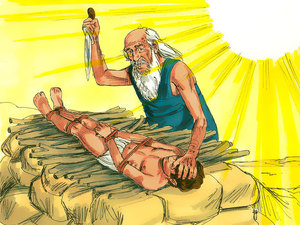
In Genesis 22 we arrive at one of the greatest crisis recorded in Scripture. God tests Abraham with someone dear to his heart, his long awaited promised son.

You may read Genesis 22:1-19 here: Bible Gateway.

015-abraham-isaac

(SweetPublishing/FreeBibleimages.org)

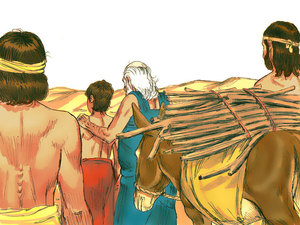
Abraham had learned the hard way the importance of  obedience. This time he didn’t question or hesitate when God told him to sacrifice his only son. The next morning he saddled his donkey and gathered wood, two servants, and his son, Isaac.

I wonder what went through Abraham’s heart and mind as he journeyed three days—50-60 miles—to Mount Moriah. His heart undoubtedly agonized over the difficult task ahead.

Several questions surface from this passage. I found the following commentaries both informative and encouraging.

How are God’s tests different than Satan’s tests?

God tests to confirm and strengthen; Satan tests to corrupt and weaken.”  –Layman’s Bible Commentary

Why did God test Abraham?

God tested Abraham, not to trip him and watch him fall, but to deepen his capacity to obey God and thus to develop his character.”  –NIV Life Application Bible

Why did God ask Abraham to perform human sacrifice?

The Bible does not explicitly give God’s reasons. Child sacrifice was common among the pagan Canaanite religions of the time. In this case, however, it was a test of faith, never an intention to eliminate a child’s life (Genesis 22:12). It was also a unique test that has not been used since and likely will never be used again. The test carries significance for us because it prefigured the act of God Himself offering His own Son, Jesus, as a sacrifice for us.” –500 Questions & Answers from the Bible

How does this account foreshadow Jesus Christ? 

  • Abraham placed God first by being willing to sacrifice his only son. God the Father loved us so much that He also was willing to sacrifice His only Son (John 3:16).
  • Isaac was willing to do what his father instructed. Jesus also obeyed His Father, even unto death (John 10:17-18).
  • Abraham’s sacrifice took place on Mount Moriah (Jerusalem). Jesus was sacrificed on the edge of Jerusalem (John 19:17-18).
  • A ram was provided as a substitute for Isaac. God the Father provided Jesus, the Lamb of God, as a substitute for us. He paid our sin penalty by death on the cross to spare us the eternal death we deserve. In exchange, He offers us eternal life (Romans 6:23; 2 Corinthians 5:21).
  • Abraham’s son (Isaac) was the child of the promise; he was connected to the idea of resurrection (Hebrews 11:17-19). God’s Son, Jesus, is the child of promise (Isaiah 9:6) who is resurrected (1 Corinthians 15:1-11).

Reflect

012-abraham-isaac

(SweetPublishing/FreeBibleimages.org)

Just as fire refines ore to mine precious metals, God refines us through difficult circumstances.

Abraham trusted that God would keep His word, even if that meant raising Isaac from the dead. Abraham’s story—along with many others in the Bible—entails sacrificing lives, desires, and wishes.

Abraham received abundant blessings for not holding back. God not only gave Abraham’s descendants the ability to conquer their enemies, but also promised Abraham that his descendants would bless the whole earth as a result of knowing his faith.

God’s blessings far outweigh our sacrifices. His gifts are meant to overflow to others. The greatest rewards, however, await God’s children in eternity.

Is God asking you to give up something of great value? What can we learn from Abraham’s example?

The Treaty at Beersheba, Genesis 21:22-34

At that time Abimelech and Phicol the commander of his forces said to Abraham, ‘God is with you in everything you do. Now swear to me here before God that you will not deal falsely with me or my children or my descendants. Show to me and the country where you are living as an alien the same kindness I have shown to you.” – Genesis 21:22-23

Review

After waiting years, God blessed Abraham and Sarah with their promised baby, Isaac. God also took care of Hagar and Ishmael, remembering His promise to greatly multiply their descendants (see Birth of Isaac).

You many Read Genesis 21:22-34 here: Bible Gateway.

***

Abimelech reenters the picture with his enforcer, Phicol. Having witnessed firsthand God’s power and blessing in Abraham’s life (see Abraham and Abimelech), he respectfully approaches Abraham with a treaty proposal: “. . . . Do not deal falsely with me or my children or my descendants. Show to me and the country where you are living as an alien the same kindness I have shown to you.”

Abraham complies.

We see a change in Abraham since his last conflict with powerful King Abimelech. Instead of being fearful, Abraham boldly confronts him with the issue that his servants had taken his well. Layman’s Bible Commentary notes: “The Hebrew verb translated complained implies that Abraham had to complain several times.”

And instead of Abimelech exhibiting generosity, Abraham supplies the sheep and cattle for their treaty.

The well is named Beersheba, which means “well of seven” (from the seven ewe lambs Abraham supplied), or “well of the oath”. Abimelech’s acknowledgment of Abraham’s legal right to water makes a permanent residence possible for Abraham. He now owns a small piece of the land God promised.

The existence of several wells may be the reason why Abraham settled in the land of the Philistines. His son, Isaac, also made his home in Beersheba, the southern city of Israel bordering a vast desert that stretched as far as Mount Sinai to the south and Egypt to the southwest. The phrase “from Dan to Beersheba” was often used to depict the traditional boundaries of the promised land (2 Samuel 17:11).

ccf024a7a2fb65afa133ff6a0407b7f2

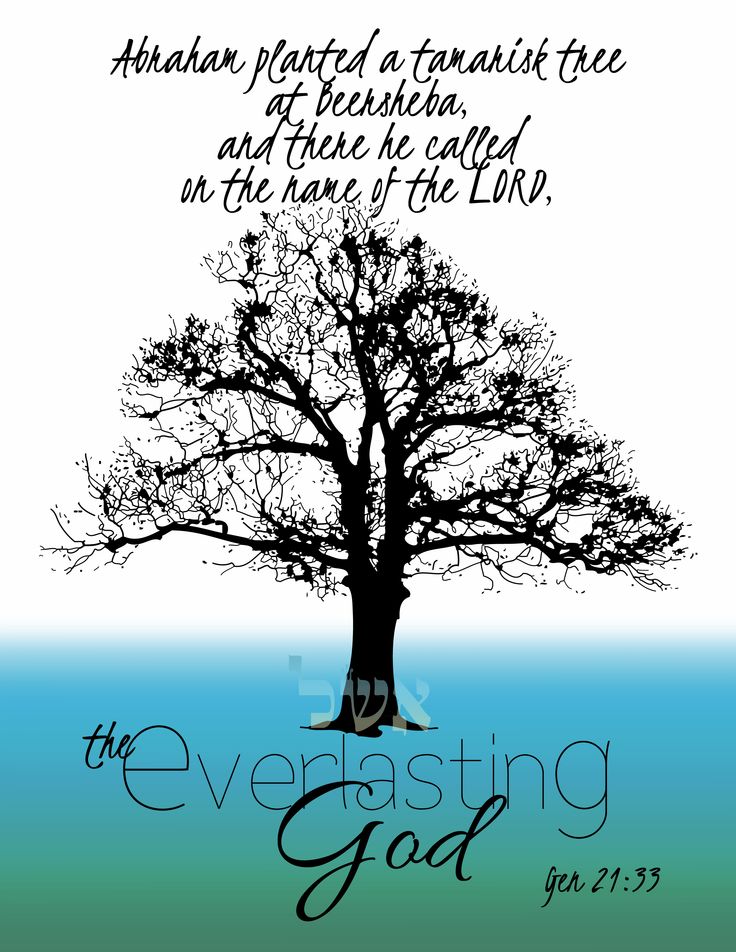
By planting a Tamarisk tree—a long lived evergreen—Abraham shows his intentions of staying in that region. This tree also symbolizes God’s enduring grace, faithfulness, and provision. Abraham’s use of the Hebrew phrase translated eternal God not only emphasizes God’s never-ending nature, but also perhaps Abraham’s growth in understanding God.

Reflect

This passage depicts Abraham as bolder, more generous, respectable and patient with King Abimelech. I wonder if Abraham ever questioned his progress in relationship with God, especially the dry times when he distorted the truth under heated pressure.

Tamarisk trees can grow in drought areas with rocky soil. Perhaps the Tamarisk’s growth reminded Abraham of his own spiritual growth as he worshiped God.

Because God is eternal, all His promises and covenants are also everlasting. I love His promise in Philippians 1:6: “He who began a good work in you will carry it on to completion until the day of Christ Jesus.”

When Christ took our place through death on the cross, He began His work for us. When we first believed, He began His work in us. Now we can be more like Christ daily because the Holy Spirit lives in us.

When God starts a project, He also finishes. Let’s not let anything rob us from the joy of knowing Christ or growing closer to Him in worship.

Have a great week!

Birth of Issac, Genesis 21:1-21

Now the LORD was gracious to Sarah as he had said, and the LORD did for Sarah what he had promised. Sarah became pregnant and bore a son to Abraham in his old age, at the very time God had promised him.”       Genesis 21:1-2

You may read Genesis 21:1-21 here: Bible Gateway.

Finally! After doubting repeated promises over the years, 90 year-old Sarah now has tangible evidence that God keeps His promises.

Can you picture Sarah cradling her newborn’s warm body against hers as she studies her son’s tiny features in adoration? In joy and awe she exclaims: “God has brought me laughter, and everyone who hears about this will laugh with me. . . . Who would have said to Abraham that Sarah would nurse children? Yet I have born him a son in his old age,” (vs. 6-7).

Abraham, at the ripe age of 100, responds to his son’s birth with obedience: 1) He names the baby Isaac (17:19; 21:3). Isaac means “he laughs,” or “may [God] smile”; 2) He circumcises Isaac on the eighth day (21:4).

Hagar and Ishmael Sent Away

The ripple effect from Abraham trying to jump-start God’s plan by previously sleeping with Hagar now hits him with hurricane force.

After 14 years of Ishmael being Abraham’s only heir, Ishmael despises the crowding of this new addition. His bitterness boils into mockery of Isaac at his weaning party. Sarah’s joy and laughter flee as fury steps in. She demands Abraham get rid of Hagar and her son.

Aware of Abraham’s angst, God tells him: “Do not be distressed about the boy and your maidservant. Listen to whatever Sarah tells you, because it is through Isaac that your offspring will be reckoned,” (vs. 12).

God encourages Abraham, “I will make the son of the maidservant into a nation also, because he is your offspring,” (vs. 13).

So Abraham sends Hagar and Ishmael into the desert of Beersheba with some food and water. As the water empties, Hagar—unwillingly to watch her son die—puts Ishmael under a bush while she sobs several yards away.

But God hears the boy’s cries. (Ishmael means “God hears”.) He remembers His promise to greatly multiply Hagar’s descendants (16:10). God not only provides a well of water, but also fathers Ishmael as he grows up in the desert and becomes an archer. This section ends with Hagar retrieving a wife for Ishmael from Egypt when he lives in the Desert of Paran.

Who are Ishmael’s descendants?

“Ishmael became ruler of a large tribe or nation. The Ishmaelites were nomads living in the Desert of Sinai and Paran, south of Israel. One of Ishmael’s daughters married Esau, Ishmael’s nephew (28:9). The Bible pictures the Ishmaelites as hostile to Israel and to God (Psalm 83:6).” – NIV Life Application Study Bible

448a6f4851a49cefb57ca43866da6c79Reflect

It seems a long stretch in reaching Genesis 21 with the birth of Isaac. Abraham and Sarah’s 14 year wait for their promised son probably felt like an eternity.

But God’s timing is not our timing. His ways are not our ways.

Who could have guessed that God would use a barren elderly couple to birth and raise a boy whose descendant would be Jesus the Messiah?

But our compassionate God is in the business of doing the impossible. He sees all of our problems. He hears all of our cries. Where we only see a piece of the puzzle, He sees the whole picture.

God’s timing and ways are perfect.

Let’s not forfeit God’s peace through worry as Sarah did. Instead, let’s bring our burdens before God and leave them with Him. Then let’s not forget to thank Him for loving us and acting on our behalf.

Have a great week!