Abraham and Abimelech, Genesis 20

Now Abraham moved on from there into the region of the Negev and lived between Kadesh and Shur. For a while he stayed in Gerar, and there Abraham said of his wife Sarah, ‘She is my sister.’ Then Abimelech king of Gerar sent for Sarah and took her.” – Genesis 20:1-2

You may read Genesis 20 here: Bible Gateway.

This account seems like a replay of Genesis 12:10-20 (see Abram In Egypt). As Abraham had schemed to protect himself from the Pharaoh in Egypt, he does so again with Abimelech. By falsely assuming the king is wicked, Abraham resorts to his half-truth/half-lie trick.

Believing Sarah is unmarried, Abimelech takes her as his wife. But God mercifully keeps him from the sin of adultery by somehow preventing him from touching her.

It must have been quite the shock when God confronted Abimelech in a dream: “You are as good as dead because of the woman you have taken; she is a married woman” (vs. 3).

Naturally, Abimelech questions Abraham’s motives. And we see a not-so-glorious moment for Abraham. He blames his conduct on God, saying that He made him wander from home to a place that doesn’t fear Him (vs. 11, 13).

As sin usually snowballs, Abraham’s fear of being killed also compels him to pull Sarah into his deception: “This is how you can show your love to me: Everywhere we go, say of me, ‘He is my brother.’”

God Punishes Abimelech

God punishes Abimelech for taking Sarah as his wife by preventing the women in his household from bearing children. In his dream, God commands him to return Sarah to Abraham. For “if you do not return her, you can be sure that you and all yours will die.”

This sounds harsh. But I found The NIV Life Application Study Bible footnote helpful when questioning why God would punish innocent Abimelech:

  1. Even though Abimelech’s intentions were good, as long as Sarah was living in his harem he was in danger of sinning. A person who eats a poisonous toadstool, thinking it’s a harmless mushroom, no doubt has perfectly good intentions—but will still suffer.
  2. The punishment, “closing up every womb in Abimelech’s household,” lasted only as long as Abimelech was in danger of sleeping with Sarah. It was meant to change the situation, not to harm Abimelech.
  3. The punishment showed that Abraham was in league with Almighty God. This incident may have made Abimelech respect and fear Abraham’s God.

Conclusion

Abimelech not only returns Sarah, but also generously showers Abraham with gifts and grants him permission to live anywhere on his land.

In response to Abraham’s prayer, God heals the women’s inability to bear babies. But so far in the Genesis account, Sarah remains childless.

Reflect

Although Abraham is a hero of faith, c669c140df16d6b094cd11ae9bb1fc3dapparently he didn’t  learn his lesson the first time. He also risked setting the pattern of lying anytime he felt threatened by danger. But God watched out for Abraham, and He does the same for us.

Sin’s poison not only hurts ourselves, but also those around us. No matter how sincere our intentions or love for God may be, all of us are vulnerable to certain temptations. Thankfully Jesus, who endured temptation without sinning, is more than able to help us in our struggles.

God kept Abimelech from touching Sarah and sinning. It may seem at times that God is silent. But He works as much in the invisible realm as He does in the obvious. I wonder how many times God has protected us from sin without us knowing?

Old Covenant Vs. New Covenant, Hebrews 8

Happy New Year! I’m not sure how this past year has flown by so quickly. But I’m sure having two teens and a preteen has something to do with it!

Thank you for your visit(s) and encouragement; I appreciate you! 🙂 I love how God opens our eyes to His truths and rich blessings through Bible Study.

Although I’m a fan of New Year resolutions, I’m trying to stay within Scripture and use the “newness” theme. But instead of picking up with Genesis 20, I’m jumping forward—backwards for us—with an overview of God’s plans and timing through His old and new covenants.

You may read Hebrews 8 here: Bible Gateway.

Why did God initiate these covenants in the first place?

Scripture declares that “the whole world is a prisoner of sin” (Galatians 3:22). So God set into motion a means to provide forgiveness of our sins.

Old Covenant

Fast forward about 450 years from when God gave Abraham His promise (Genesis 17:7, 8). God temporarily remedied our sin problem through His Old Covenant.

Under the old Jewish sacrificial system sacrifices were offered daily for forgiveness of sins (Hebrews 7:12-14).

The law God introduced to the Israelites through Moses included three categories: Ceremonial, Civil, and Moral laws. Although the moral laws still apply to us today (Ten Commandments – Exodus 20:1-17), the ceremonial laws primarily pointed forward to Jesus Christ.

And although the old laws revealed God’s character and will, they also pointed out our sin. For no one could please God by completely obeying every law. Hebrews 8-9 shows that the old covenant was a shadow of the real Christ. So the old covenant—a covenant of law between God and Israel—are no longer necessary.

7be436a74462fa1e28f0486de8bffc62

New Covenant

Although thousands of years have passed since God gave Abraham His promise (Genesis 17:7, 8), He has never revoked it. He saved Abraham through his faith, and blessed the world through his descendant: Jesus, the Messiah.

His new covenant reaches beyond Israel and Judah to include everyone. Christ offers a new way to forgiveness through faith. And instead of being bound to a temporal, external set of rules He writes His laws on our hearts and minds, reminding us of His words through the Holy Spirit.

Jesus’ death was the perfect sacrifice ending all need for further priests and sacrifices. “He sacrificed for their sins once and for all when He offered himself,” (Hebrews 7:27).

“Clearly no one is justified before God by the law, because the righteous will live by faith,” (Galatians 3:11).

Even though time marches on and circumstances change, I love that God remains the same. He doesn’t break His promises. We can be sure of His promise to forgive our sins through Jesus Christ.

Have you entered into this new covenant and enjoyed the better way with free forgiveness and unlimited access to God?

As you reflect on 2015, I hope you’ve evidenced God’s blessings through both the good and difficult times. Next week I will pick up with Genesis 20.

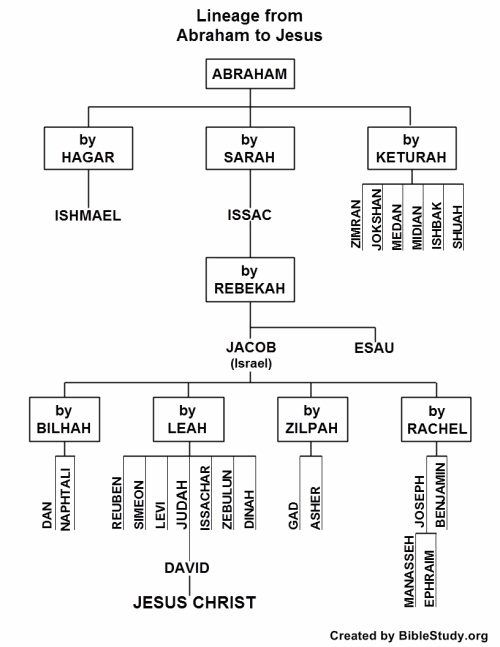
Jesus’ Lineage from Abraham

This is a condensed lineage to Jesus. For more on Jesus' lineage see Matthew 1. Here you will find a variety of people, 46 in all, whose lifetimes span 2,000 years in the first 17 verses. Some of Jesus' ancestors were heroes of faith, others had sketchy reputations. . . . But God—sovereign over history, the present, and future—worked through ordinary people to bring His Son into the world. He wants to continue His purposes through ordinary people like you and me!

This is a condensed lineage to Jesus. For more on Jesus’ lineage see Matthew 1. Here you will find a variety of people, 46 in all, whose lifetimes span 2,000 years in the first 17 verses. Some of Jesus’ ancestors were heroes of faith, others had sketchy reputations. . . . But God—sovereign over history, the present, and future—worked through ordinary people to bring His Son into the world. He wants to continue His purposes through ordinary people like you and me!

Lot and His Daughters, Genesis 19:30-38

The inward area is the first place of loss of true Christian life, of true spirituality, and the outward sinful act is the result.” – Francis Schaeffer

I hate being a bad news bearer. But there’s no getting around it. This passage is the sad sequel to Sodom’s destruction (Genesis 19:1-29).

You may read Genesis 19:30-38 here: Bible Gateway.

The angels—who admonished Lot to flee to the mountains—granted Lot’s request to flee to a nearby town instead (Gen. 19:18-22). But fear prompted him to move further away from the burning sulfur’s ashes. With his wife gone—turning into salt for disobediently looking back—he and his two daughters finally settle in a lonely mountain cave.

Neither daughters’ future grooms from Sodom had believed Lot when he warned them to flee because of God’s impending judgment, (Gen. 19:12-14). They died along with all the others.

So out of desperation, Lot’s daughters (who also adopted Sodom’s morals) stoop to manipulation and incest with their father to preserve their family line.

And both daughters become pregnant. The older daughter births Moab, while the younger daughter births Ben-Ammi. These two boys’ descendants would become two of Israel’s greatest enemies, the Moabites and the Ammonites. But interestingly, Ruth—David’s great-grandmother and ancestor of Jesus—was from Moab.

This section (verses 30-38) has similarities to Noah’s last days after his rescue from the flood.

Layman’s Bible Commentary observes: “In Noah’s case, he became drunk with wine and uncovered himself in the presence of his children. In both narratives, the act has grave consequences. Thus, at the close of the two great narratives of divine judgment—the flood and the destruction of Sodom—those who are saved from God’s wrath subsequently fall into a form of sin reminiscent of those who die in judgment. This is a common theme in the prophetic literature (Isaiah 56-66; Malachi 1).”

Reflect

We are more apt to sin when we find ourselves in a desperate situation.

Why didn’t Lot help his daughters find husbands? Abraham’s family wasn’t far away. But Lot’s lack of initiative and habitual compromise only complicated matters.

a6525010d11fdaef7d386b3e9e6b44c0

Jesus ~ The greatest gift of all!

Although this passage simply reports these events without openly condemning the sisters’ actions, Scripture elsewhere clearly condemns incest: Leviticus 18:6-18; 20:11, 12, 17, 19-21; Deuteronomy 22:30; 27:20-23; Ezekiel 22:11; 1 Corinthians 5:1.

We may never stoop to this kind of sin, but we have all sinned (Romans 3:23). Compared to our holy God even our best efforts “are like filthy rags” (Isaiah 64:6). And the wages of our sin is death (Romans 6:23).

But the great news is that God remedied our sin problem through the death and resurrection of His son, Jesus Christ. He stepped down from heaven’s glory into our dark, sinful world and offers us the gift of forgiveness and life (Romans 6:23), along with transformation of the heart.


Sodom and Gomorrah Destroyed, Genesis 19:1-29

By the time Lot reached Zoar, the sun had risen over the land. Then the LORD rained down burning sulfur on Sodom and Gomorrah—from the LORD out of the heavens. Thus he overthrew those cities and the entire plain, including all those living in the cities—and also the vegetation in the land. But Lot’s wife looked back, and she became a pillar of salt.”        Genesis 19:23-26

Genesis 19 seems more like a Hollywood scene than a real historical account with its action packed drama. I find myself both disgusted and intrigued after reading this chapter.

In review of Genesis 18:16-23, the Lord—along with two angels in the form of men—visit Abraham and share the news of God’s impending judgment upon wicked Sodom. Although Abraham prayed/negotiated for God to withhold destruction on Sodom and Gomorrah if ten righteous people could be found there, which God conceded, this small remnant apparently didn’t exist.

Aside from feeling like a movie, Genesis 19 gives us a snapshot of the Sodomites—and Lot’s—moral decay.

You may read Genesis 19:1-29 here: Bible Gateway.

The two angels find Abraham’s nephew, Lot, at Sodom’s gate. His presence there implies that his social and political goals have been realized since this was a place of authority and status.

There is no indication that Lot recognizes these men as angels. But like Uncle Abraham, he extends gracious hospitality and insists they stay at his house instead of in the square.

“Urged them persistently” (NET) translates from a Hebrew verb meaning “to press; to insist.” Layman’s Bible Commentary notes: “This word [persist] ironically foreshadows the hostile actions of the men of Sodom, where they pressed hard against Lot and came near to break the door (19:9).”

(source: christianpf.com)

(source: christianpf.com)

Lot’s hospitality and attempt to protect his guests seem noble, at first anyway. But offering his virgin daughters to the males outside in place of his guests show his rapid plunge down sin’s slippery slope.

As the lust hungry mob presses hard against the door, the men/angels pull Lot back inside while striking the guys with blindness.

“The word used to describe the blindness these men experienced (19:11) is a rare word that may indicate ‘a dazzled state,’ or a combination of partial blindness and a kind of mental bewilderment. Yet, despite their physical blindness, these men and boys persist to the point of weariness in their effort to satisfy their sexual cravings. . . . When the guests/angels explain to Lot the fate of the city the word translated destroy is the same word used twice in Genesis 6:13 of the judgment of the flood (19:13).” – Layman’s Bible Commentary

Although the angels warn Lot of the devastating consequences of sin, his attachment to this life is difficult to release (19:15-22; 1 John 2:15-17). But in God’s mercy—probably influenced by Abraham’s prayer—the men/angels grasp Lot, his wife, and daughters by the hands and safely lead them out of the city.

Flee for your lives! Don’t look back!” (19:17)

Lot’s wife doesn’t want to go either and she looks back. “The word translated ‘looked back’ signifies an intense gaze, not a passing glance” (Layman’s Bible Commentary). Reluctance and disobedience are her demise as she turns into a pillar of salt.

This section ends with Abraham witnessing the dense smoke rising from the plains that God destroyed. Lot and his daughters narrowly escape by God’s grace.

Reflect

Are we trying to move forward with God while holding onto pieces of our old life/sin? God demands we let go in order to move forward with Him (Luke 11:23; John 15:5-6).

Many argue: A loving God would never fire down judgment and/or send anyone to hell.

As difficult as this truth is, God—completely perfect in morality—hates sin. He has and will judge sinners. The consequence of our sin is death/hell – eternal separation from Him (2 Thessalonians 1:7-9; Revelation 21:27).

But praise God that He is just as thorough in His mercy for those who love and trust Him as He is severe in His judgment (Romans 6:23; 1 Thessalonians 1:9-10; Ephesians 2:8-9; John 3:36). He graciously provides forgiveness of sins through Jesus Christ to those who repent (1 John 1:9; Romans 5:8; John 3:17) and longs to transform us with His abundant, eternal life (John 3:16).

Where are you in relation to God?