The Rainbow Covenant, Genesis 9:8-17

Then God said to Noah and to his sons with him: “I now establish my covenant with you and with your descendants after you and with every living creature that was with you—the birds, the livestock and all the wild animals, all those that came out of the ark with you—every living creature on earth. I establish my covenant with you: Never again will all life be cut off by the waters of a flood; never again will there be a flood to destroy the earth.” – Genesis 9:8-11

God’s promises to Noah covered several items concerning responsibilities of Noah and his descendants, but the word “covenant” is first used in Genesis 6:18.

Covenant means “a binding promise”.

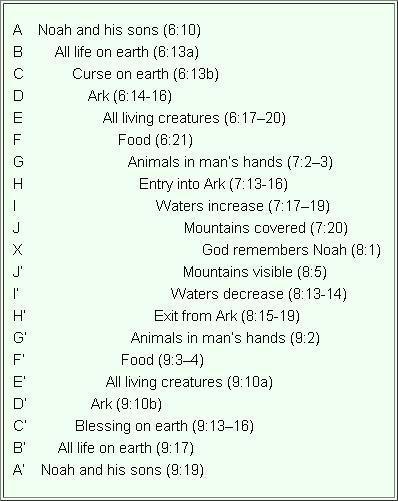
Alongside God’s judgment of the devastating flood is a promise. No doubt, God’s repetitive promises brought great hope to Noah and his family who had experienced great stress through the flood. (Click on Chiastic Structure of Gen. 9:8-17 to view the pattern of this Scripture, with the main point placed in the middle.)

(Found on letschipit.com)

(Found on letschipit.com)
“Never again will all life be cut off by the waters of a flood; never again will there be a flood to destroy the earth. . . . This is the sign of the covenant I am making between me and you and every living creature with you, a covenant for all generations to come: I have set my rainbow in the clouds, and it will be the sign of the covenant between me and the earth.” – Gen. 9:11-13

Layman’s Bible Commentary observes: The Hebrew word for rainbow is also the word for a battle bow. The point seems to be that the bow is now put away, hung in place by the clouds, suggesting that the storm is over.

God’s special sign is a beautiful reminder to both Him and to us: There would never again be a universal flood.

I like Henry Morris’ observation in The Genesis Record: The rainbow demonstrates most gloriously the grace of God. The pure white light from the unapproachable holiness of His throne (1 Tim. 6:16) is refracted, as it were, through the glory clouds surrounding His presence (1 Kings 8:10, 11), breaking into all the glorious colors of God’s creation. In wrath, He remembers mercy. The glory follows the sufferings; and where sin abounded, grace did much more abound!

Three Other Rainbow Appearances in Scripture

Morris also points out that the rainbow reappears only three more times in Scripture. The first two cases paint a picture of expected judgment and suffering, but they are limited judgment and suffering. We also see God’s grace, which rules over all.

  1. Ezekiel 1:28 – The rainbow surrounds God’s throne as He prepares to judge His people Israel.
  2. Revelation 4:3 – The rainbow surrounds God’s throne again. This time preceding the Great Tribulation.
  3. Revelation 10:1 – This verse speaks of a mighty angel, which is Jesus Christ Himself. He pronounces “seven thunders” of judgment. And instead of wearing a crown of thorns when Jesus bore sin’s curse for us, there will be “a rainbow above His head” as He comes to claim dominion over the world.

God never changes (Psalm 55:19). He is faithful; His promises are sure (Numbers 23:19). Which promises of God do you need to remember today?

Bite Into A Chiastic Sandwich (Genesis 8:15-9:7)

In my last post, Chiastic Structures, I shared my discovery of Chiasms in the Bible.

A quick review of a chiasm: Repetition of similar ideas in the reverse sequence, put together much like a sandwich with the meat (main idea) in the middle.

2ec030e9692958b3b3fd8d0ff77da859The Chiastic Sandwich of Genesis 8:15-9:7

You may view this chiasm in a Word document here: Chiastic Structure of Gen. 8:15-9:7.

Okay, I’m reverting back to the American linear approach with the main idea first (meat of the sandwich); the bread second, and the condiments last.

The Meat/Main Idea:

7b8fe264406a76eeb9462ebecc9f0df7

God keeps His promises (Nehemiah 1:5).

God smelled the soothing aroma of Noah’s sacrifice and declared three promises (8:21-22). In response to Noah’s obedience and grateful sacrifice, God speaks openly to Noah (9:1-17), which includes the great Noahic covenant for post-flood mankind.

Covenant—a binding promise—is a common theme throughout Scripture, initiated by God with His people. The first covenant mentioned in the Bible is found in Gen. 6:17-18.

What are the three promises God declares?

  1. “Never again will I curse the ground because of man, even though every inclination of his heart is evil from childhood.”
  2. “Never again will I destroy all living creatures, as I have done.”
  3. “As long as the earth endures, seedtime and harvest, cold and heat, summer and winter, day and night will never cease.”

The Bread/First and Last Points

(1a, 2a) “Be fruitful and multiply” (8:15-19; 9:7).

God renews the mandate given to Adam with Noah: Repopulate the earth (Gen. 1:26-28). In this sense, we are all related.

The Mayo & Mustard/Second and Second to Last Points

  • (1b) Noah blessed God by offering the lifeblood of an animal sacrifice (8:20).
  • (2b) God blessed Noah; instructions of lifeblood concerning animals and men (9:1-6).

God instructs Noah on setting up a government system, emphasizing justice and the regard of the sacredness of God’s divine image stamped on man. Because we are made in God’s image, He considers man’s blood—representing life—even more sacred than animals.

God also gives Noah the okay to eat animals for food with the restriction of draining the animal’s blood first (9:4-5).

What is so significant about lifeblood?

“For the life of the flesh is in the blood; and I have given it to you upon the altar to make an atonement for your souls: for it is the blood that maketh an atonement for the soul” (Lev. 17:11).

The Old Testament sacrifices were temporary and figurative, pointing towards God’s ultimate sacrifice of His beloved Son: Jesus Christ, the Lamb who “now once in the end of the world hath appeared to put away sin by the sacrifice of Himself,” (Heb. 9:26).

Homework

Yes, I know. School’s out for the summer. Yes, I know. Most of you believe you’re no longer in school. But we’re all in this school of life together. And besides, this homework is fun!

Your assignment:

  1. Make a sandwich. So you’ve already eaten lunch or dinner, how about a dessert sandwich like S’mores?
  2. In the process, recall the themes in this chiastic structure (Genesis 8:15-9:7): the bread (first and last points), the condiments (the second and second to last points), and the meat (central point).
  3. Eat and enjoy your real sandwich (or S’more).
  4. Digest . . . . How are you going to apply these truths to your life this week?
  5. Have a terrific week! 🙂

Chiastic Structures (Genesis 8:15-9:17)

The Bible is more than just great stories with wonderful prose and poetry – it is personal instructions from our loving God who sometimes speaks in unexpected ways.” – Thomas B. Clarke
(Author of Joshua’s Spiritual Warfare: Understanding the Chiasms of Joshua)

I’ll be honest. This section in Genesis has thrown me for a loop.

It’s not the comprehension, but the structure of this passage that feels scattered to me: similar themes repeated, but in random order, kind of like a math pattern. (Math has always been a challenge for me.)

How Lord, I asked, can I organize this section without messing up the order. . . . Is there an order?

And then my husband told me about the chiastic structure of Matthew that our pastor taught one Sunday when I was gone. After looking up chiastic structure, I realized, there is an order to this passage! But it’s nonlinear, not in the kind of sequence I’m used to. And, I learned, the Bible is full of chiastic structures.

What is a Chiasm?

A quick definition: A chiasm is a repetition of similar ideas in the reverse sequence.

Chiastic structure is a literary structure used in the Torah, the Bible, and some other works. Concepts or ideas are placed in a pattern for special emphasis, such as ABC….CBA, with the main point in the middle, (much like a sandwich). This structure often places the same concept at the first and at the last, the second concept also appears second to last, etc.

Chiasm Structure in Gen. 6:10-9:19 (Source: michaeljloomis.wordpress.com)

Chiasm Structure in Gen. 6:10-9:19
(Source: michaeljloomis.wordpress.com)

So now you’ve been forewarned. This post strays from my usual linear approach. But I thought this was a neat discovery, another proof of the power and beauty of God’s inspired Word.

You may open the following Word Documents to see more chiasms in this Genesis section: 

Chiastic Structure of Gen. 8:15-9:7

Chiastic Structure of Gen. 9:8-17

For more on chiasms in the Bible see: What is a Chiasm?

Next week I’ll pick apart these chiasm sandwiches. 🙂 Have a great Fourth of July weekend!

The Ark: A True Type of Christ, (Genesis 8)

But God remembered Noah and all the wild animals and the livestock that were with him in the ark, and He sent a wind over the earth, and the waters receded. Now the springs of the deep and the floodgates of the heavens had been closed, and the rain had stopped falling from the sky.”    Genesis 8:1-2

4579512f32989497f93af3e45690edf4

Read Genesis 8 here: Bible Gateway

The Hebrew term for remember means “began again to act on their behalf”.

After 150 days of reeling on the water the ark finally came to rest, most likely on Mount Ararat since it was the highest mountain in the region, Gen. 8:5.

After another seven months—totaling 371 days—Noah, his family, and the animals finally exited the ark.

The Ark: A true type of Christ

The Bible is full of parallels or “types.” We can see God arranging the affairs of several Old Testament people and events to show us similarities to Jesus Christ, the focal point of the Gospel. Consider the following parallels:

  • After five months of providing refuge and laboring to accomplish its work of saving its occupants from judgment of sin, the ark finished its mission. After Christ came to earth and provided refuge and healing for many, He died on the cross and finished His mission: the work of salvation (John 19:30).
  • The ark’s construction was made to be waterproof and resistant to decay by sealing it with “pitch” inside and out. The Hebrew word for pitch—kopher—means a “covering”. But it’s also the Hebrew word for atonement. This is the Bible’s first mention of atonement. Henry Morris writes: “It sufficed as a perfect covering for the ark, to keep out the waters of judgment, just as the blood of the Lamb (Christ) provides a perfect atonement for the soul.”
  • The Jewish date that the ark rested (Gen. 8:4) and the date Jesus Christ rose from the dead are the same: “the seventeenth day of the seventh month”.
  • The ark became the bridge from the old evil world to the present one (Gen. 7:7, 2 Peter 3:6-7). God would help Noah and his family with their new life in their new world. God also graciously provides deliverance from spiritual death to us through His Son, Jesus. This is symbolized through water baptism (1 Peter 3:21). He saves us from God’s judgment of sin. He not only gives us the opportunity for a new beginning, but also offers help in our daily walk.
  • Although Noah wasn’t perfect, he is described as a “righteous man who walked with God” (Gen. 6:9). Jesus was the perfect, blameless man who consistently obeyed His Father (Heb. 4:15).
  • Noah was like a “second Adam” since all people come from him (Gen. 8:15-9:17). Christ is called “the second man (Adam)” since He is the only source of eternal life (1 Cor. 15:47; Acts 4:12).
  • Human evil had reached a deplorable high, so God decided to undo his creation with a flood (Gen. 6:6-7). In God’s timing, He will undo His creation again; this time by fire (2 Peter 3:12-13) and then re-create it (Rev. 21:1).

Questions

Each of us share some similarities with Noah as we look forward to the removal of sin and its curse.

  • How is Jesus like a bridge for us to God the Father and new life?
  • Have you accepted God’s gracious invitation of new life through Jesus Christ?
  • How should we be living today? (2 Peter 3:12-14)

*For scientific evidence of the worldwide flood, read Starling Evidence for Noah’s Flood. Also, The Genesis Flood by Henry Morris is a comprehensive geological book that includes Biblical commentary.

God is Patient and Long-suffering (Genesis 7)

I didn’t watch Hollywood’s version of the movie, Noah. But I’ve read about their false representation of God, portraying Him as a mean and cruel God.

The reality, however, is: Although our holy God and Judge won’t tolerate rebellious sinners forever, He is also long-suffering and extremely patient.

918bc99fb2c5baedac9b4c3698a6fc22

For an entire century, God used Noah—as he obediently finished the ark—to warn people of the coming worldwide flood and to turn from their wickedness (1 Peter 3:20; 2 Peter 2:6; Luke 17:26, 27).

God desires a relationship with us, but He gives us free will. He’s a gentleman and won’t force Himself on anyone.

Because Noah walked with God and demonstrated his faith through obedience, God delighted in having fellowship with him. The Bible records God speaking to Noah seven times, each time in blessing and/or fellowship (Gen. 6:13; 7:1; 8:15; 9:1, 8, 12, 17).

This contrasts with Psalm 29, which speaks of the flood. Here the “voice of the Lord” thunders seven times in judgment and majesty before those who have turned their backs on Him. This also corresponds to the “seven thunders” and their “voices” that will be uttered in the future judgment (Revelation 10:3, 4).

Time Frame of the Flood

Noah was 600 years old when the flood waters came upon the earth (7:6-9). This initiates the postdiluvian age.

f5e92a2afb9a7e8009ec43a51d5c9d42

Read Gen. 7 here: Bible Gateway

It’s significant that the Lord told Noah, “Come into the ark” instead of “Go”. For God would be with Noah and his family, keeping them safe just as He promised (6:18) long before they even chose to enter (7:7).

Just as God kept Noah and his family safe, we can also be assured that God will deliver us from certain coming judgment through a faith saving relationship in Jesus Christ (Jude 1:24).

Salvation is found in no one else, for there is no other name under heaven given to mankind by which we must be saved.”  – Acts 4:12.