Noah, Saved By Grace

But Noah found favor in the eyes of God the LORD . . . . Noah was a righteous man, blameless among the people of his time, and he walked with God.” – Genesis 6:8, 10

Sin grieves God’s heart. The flood of wickedness in Noah’s day prompted God to cleanse the earth by destroying all mankind, beasts, birds, and creeping things with a worldwide flood. But there was one exception: Noah.

Why did Noah find favor (grace) from the Lord?
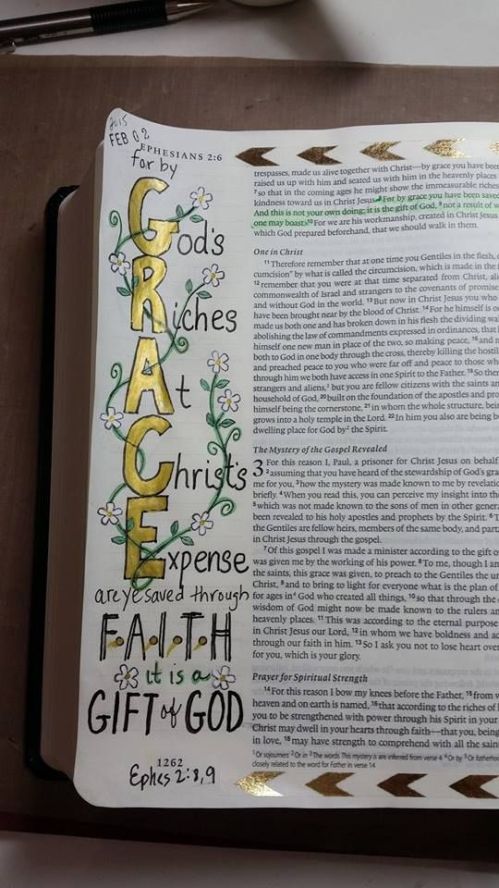
(found on Pinterest)

(found on Pinterest)

Noah wasn’t perfect; Genesis 9:20 shows that his sin nature traveled with him on the ark, (along with his family and the animals God designated).

So what set Noah apart from the people around him?

The Bible says that Noah was justified by God through his faith.  Noah is an exemplary model of one who had great faith. Of all the people listed in the “Hall of Faith” (Hebrews 11), his description is the only one that both begins and ends with “by faith” (Hebrews 11:7). Noah believed God’s promises and followed God’s will.

Walk describes the closest communion with God. It represents fellowship and obedience. Since Enoch, Noah was the only one left in his long life span who “walked with God” (vs. 10).

Noah was also recorded as a “preacher of righteousness” (2 Peter 2:5). Although no one responded to his message except his family.

Noah Declared Righteous By God

With unmerited favor, God looked upon Noah as a righteous man and enabled him to walk closely with Him step by step, day by day. It’s here in Genesis where grace is first mentioned; God giving undeserved favor to sinners (Noah and his family).

God deemed Noah righteous not because he was perfect, but because he believed and wholeheartedly loved and obeyed God (Gen. 6:22; 7:5, 9, 16):

  • Even though it had never rained before—the earth had been watered by underground springs—Noah didn’t question God.
  • When God told him to build this huge boat—the length of one and a half football fields and height of a four-story building—Noah got right to work.
  • Even though he was most likely ridiculed and labeled “crazy”, Noah chose to obey God rather than cave to the expectations and temptations surrounding him (1 Peter 3:20).
  • For 120 long years—longer than our life span—Noah pressed on to build the ark according to God’s detailed specifications.

So What?

Noah is our antediluvian link. Because Noah believed God and obeyed, he is a model of faith of how we too can please God.

As Noah and his family were saved by entering through the ark’s door, we are also saved by entering through the narrow door (gate) of Jesus Christ: “Enter through the narrow gate. For wide is the gate and broad is the road that leads to destruction, and many enter through it. But small is the gate and narrow the road that leads to life, and only a few find it,” (Matthew 7:13-14).

As in Noah’s day, living God’s way may not be popular, but it is true and right.

Have you entered through the narrow gate by placing your faith in Jesus Christ? Trust in Christ is the only way to heaven because He alone died for our sins so we can be right before our holy God.

Conditions Before Christ’s Return (Genesis 6-8; Mt. 24)

No one knows about that day or hour, not even the angels in heaven, nor the Son, but only the Father. As it was in the days of Noah, so it will be at the coming of the Son of Man. For in the days before the flood, people were eating and drinking, marrying and giving in marriage, up to the day Noah entered the ark; and they knew nothing about what would happen until the flood came and took them all away. That is how it will be at the coming of the Son of Man. Two men will be in the field; one will be taken and the other left.” – Matthew 24:36-41

The door to Noah’s ark represents salvation. As the door to the ark was the only way to preserve life, so Jesus is the only way to eternal life with God (Jn. 14:6).

(Source: alittleperspective.com)

(Source: alittleperspective.com)

Although we don’t know the exact time Christ will return, Jesus tells us to be watchful (Matthew 24; Mark 13:32-37; Luke 21:34-38). As the pre-flood days of violence and evil foreshadowed the coming world-wide flood, so will conditions in the last days foretell an even greater destruction for those who have rejected God’s son, Jesus Christ.

What Are these Conditions?

Henry Morris summarizes some similar characteristics of the pre-flood era to conditions in these last days preceding Christ’s return:

  1. Preoccupation with physical appetites (Luke 17:27)
  2. Rapid advances in technology (Genesis 4:22)
  3. Grossly materialistic attitudes and interests (Luke 17:28)
  4. Uniformitarian philosophies (Hebrews 11:7)
  5. Inordinate devotion to pleasure and comfort (Genesis 4:21)
  6. No concern for God in either belief or conduct (2 Peter 2:5; Jude 15)
  7. Disregard for the sacredness of the marriage relation (Matthew 34:38)
  8. Rejection of the inspired Word of God (1 Peter 3:19)
  9. Population explosion (Genesis 6:1, 11)
  10. Widespread violence (Genesis 6:11, 13)
  11. Corruption throughout society (Genesis 6:12)
  12. Preoccupation with illicit sex activity (Genesis 4:19; 6:2)
  13. Widespread words and thoughts of blasphemy (Jude 15)
  14. Organized Satanic activity (Genesis 6:1-4)
  15. Promulgation of systems and movements of abnormal depravity (Genesis 6:5, 12)

Sound familiar?

As the flood in Noah’s day was swift and sudden, so will the return of Christ be. This should motivate us to obey Him every day. Jesus’ warns us to be ready for His return (Mt. 24).

Like Noah, are we in right standing with God?

Will Christ find faith and obedience in us when He returns?

Next week I’ll explore more of Noah’s life and why he found favor (grace) in God’s eyes.

Have a great week!

Precursors to Noah’s Flood, Genesis 6:1-6

The LORD saw how great man’s wickedness on the earth had become, and that every inclination of the thoughts of his heart was only evil all the time. The LORD was grieved that he had made man on the earth, and his heart was filled with pain.” – Genesis 6:5-6

This next section—Genesis 6-8—covers a lot of territory: the society’s degradation, Noah and the great flood, and life after the flood with Noah’s three sons.

But before we get too scholarly, let’s not miss verse 6 (above).

God grieved. His heart was filled with pain. 4305becdcf62a8d04a95ff62ee2f8fcb

God has emotions like us. Or better stated: Since we are made in God’s image, we have emotions like God. Because God loves us, our attitudes and choices can either grieve Him or bring Him joy.

Precursors to the Flood

Two groups are named at the beginning of chapter 6: the sons of God and the daughters of men. The result of these two groups mixing brings an explosion of evil in the antediluvian period.

“And it came to pass, when men began to multiply on the face of the earth, and daughters were born unto them, that the sons of God saw the daughters of men that they were fair; and they took them wives of all which they chose,” Genesis 6:1-2.

This passage brings both mystery and controversial views on the “sons of God”. There are three interpretations. The first two interpretations are naturalistic, but have some gaps. The third interpretation sounds more like a scene from a Sci-Fi movie, but appears to have more backbone in biblical research.

Three Interpretations

  1. The descendants of Cain (daughters of men) intermarried the descendants of Seth (sons of God), (4:1-25). This view helps explain the erosion of righteousness on earth through intermarriage of the godly and ungodly. However, the Sethites—with the exception of Noah and his family—were also destroyed in the flood as God’s judgment on their wickedness. Also, Seth’s descendants were never mentioned as “the sons of God” in the spiritual sense.
  2. These marriages are between aristocrats and commoners. (Neither of these first two interpretations explain why the unions would result in giants or universal corruption and violence.)
  3. The “sons of God” were fallen angels acting in violation to God’s will. Henry M. Morris in The Genesis Record writes: “. . . . The only obvious and natural meaning without such clarification is that these beings were sons of God, rather than of men, because they had been created, not born. Such a description, of course, would apply only to Adam (Luke 3:38) and to the angels, whom God had directly created (Ps. 148:2, 5; Ps. 104:4; Col. 1:16). . . . Some commentators have said that, since the phrase “took them wives” is the same phrase as normally used throughout the Old Testament for “taking a wife,” there can be nothing involved here other than normal human marriage. . . . The word used for “wife” (Hebrew ishah) is commonly also used for “woman,” regardless of whether or not she was a married woman.”

Furthermore, Morris believes that these fallen angels (demons) likely indwelled (possessed) individuals in an organized rebellion against God. The offspring of this violation resulted in giants (Nephalim). They were people probably nine or ten feet tall. (Goliath—nine feet tall—appears in 1 Samuel 17.) The Nephilim took advantage of their height and strength by oppressing those around them.

Truthnet.org also offers insight into this view. After a short summary of Genesis 4-5, they delve into chapter 6 and show fossil and rock records. Although it’s long (as is this post) it’s also interesting. For more details, you can read Truth Net’s article here: Noah’s Ark: Genesis 6. Henry M. Morris’ book, The Genesis Record, also offers a comprehensive study for all of you scholars.

I will pick up on Jesus’ comparison of the pre-flood conditions and the last days next time. Have a great week!

Genealogy: Adam to Noah, Genesis 5:1-32

Although this second genealogy, (the first is Gen. 4:17-34), doesn’t appear inspiring at first glance, there are some cool findings here.

Genealogies show that people as individuals, not just nations, are important to God.

This fifth chapter in Genesis lists the ten descendants of Adam to Noah and spans at least 1,600 years—the longest period in world history. The development of the human race and showing the time lapse between these two major individuals seem to be the primary purpose for this genealogy. Of the ten people listed, the average age is about 900.

I would love to see that many candles on a birthday cake.

Come to think of it, I would love to visit with a 900 year-old!

How did our ancestors live so long?

The NIV Life Application Study Bible offers three explanations:

  1. The human race was more genetically pure in this early time period, so there was less disease to shorten life spans.
  2. No rain had yet fallen on the earth, and the expanse of water “above” (1:7) kept out harmful cosmic rays and shielded people from environmental factors that hasten aging.
  3. God gave people longer lives so they would have time to “fill the earth” (1:28).

Grace Trumps

Although the death theme rings loud in this chapter as a reminder of the consequence of sin, God’s grace trumps. References to fertility (sons and daughters), life, and other blessings illustrate God as a loving parent who provides an inherited blessing and insures the future well-being of His children, (Seth down to Noah’s family).

I find Enoch’s story mysterious and fff9ade3efebdb1f86636aed7f01af0aintriguing. Interestingly, Enoch and Lamech (Cain’s descendant) were both the seventh generation from Adam. They exemplified the contrasting positions toward God.
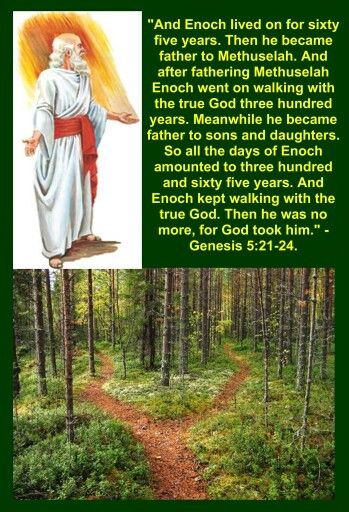
Only two men have been recorded as “walked with God” (NEV): Enoch and Noah (5:22; 6:9). Walk describes the closest communion with God—as if walking by His side—representing fellowship and obedience. Divine blessing are the results.

Enoch never experienced death. He was just 365 years when God took him to be with Him.

Our History: Two Distinct Groups Arise (Genesis 4:16-26)

So Cain went out from the LORD’s presence and lived in the land of Nod, east of Eden. Cain lay with his wife, and she became pregnant and gave birth to Enoch. Cain was then building a city, and he named it after his son Enoch.” – Genesis 4:16-17

Cain’s Descendants         

This account begins a history of Cain’s descendants. Since Nod means “wandering”, it’s likely that this was a figure of speech rather than an actual geographical area that Cain and his wife journeyed to after he murdered his brother, Abel.

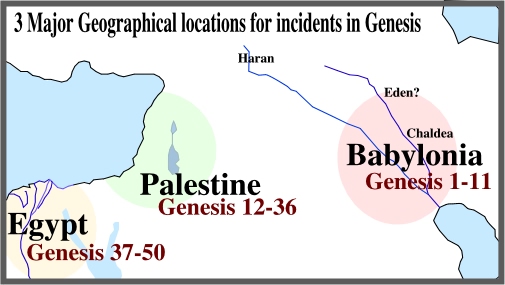
GenesisOutlineMap

Cain may have tried to derail God’s prophecy of him becoming a wanderer by building a city. The Hebrew verb “was building”, however, is indefinite and suggests that he never finished. But Cain’s descendants did prosper by taking the lead in building cities, developing music, advancing agriculture, creating weapons, and spreading civilization.

Cain’s family record jumps down to Lamech, the seventh generation from Adam. His family not only epitomizes the variety of talent and ability God gives people, but also shows the rise of sin.

Lamech held a high view of himself and wore polygamy, murder, and revenge as a badge of honor. He defied God’s principle of monogamy (Gen. 2:23, 24) by taking two wives. He also killed a young man in self-defense, then arrogantly bragged to his wives: “If Cain is avenged seven times, then Lamech seventy-seven times.”

Henry M. Morris notes the significant elements that modern evolutionary archaeologists and anthropologists identify of evolving men from the stone age into true civilization—namely urbanization, agriculture, animal domestication, and metallurgy. These were all accomplished quickly by the early descendants of Adam. It did not take hundreds of thousands of years as evolutionists suggest.

Two Distinct Groups Arise

Another branch of Adam’s family tree takes shape. Seth—born to Adam and Eve—took Abel’s place as leader of God’s faithful people. Seth’s name means “appointed” or “substituted”.

Two distinct groups arise: 1) Those who are apathetic to sin and evil, (although the Cainites sought to exercise dominion over the earth as God commanded, their motivation stemmed from rebellion against God); and 2) those who call on the name of the Lord (the descendants of Seth, 4:26). This shows the probable shift from individuals personally meeting with God to the beginning of regular public worship and prayer. It also shows faith on the part of those who “called upon His name”.

Although Seth and his family line also inherited Adam and Eve’s sin nature, they would carry the “seed of the woman” (God’s prophecy to Eve) that would eventually defeat the Serpent: Jesus Christ through His death and resurrection.