Three Effective Evangelism Plans (Part 5)

Along with Billy Graham’s plan “Steps to Peace with God,” which I posted last week, the following plans have helped millions of Christians share the Gospel in a simple, but effective way.

1) The Romans Road of Salvation
  • Human Need (Rom. 3:23)
  • Sin’s Penalty (Rom. 6:23)
  • God’s Provision (Rom. 5:8)
  • The Person’s Response (Rom. 10:9)


2) Four Spiritual Laws (Campus Crusade for Christ)
  • God loves you and offers a wonderful plan for your life (John 3:16; 10:10).diagram_2
  • Humans are sinful and separated from God. Thus, they cannot know and experience God’s love and plan for their lives (Rom. 3:23; 6:23).
  • Jesus Christ is God’s only provision for humanity’s sin. Through Jesus, you can know and experience God’s love and plan for your life (Rom. 5:8; John 14:6).
  • We must individually receive Jesus Christ as Savior and Lord; then we can know and experience God’s love and plan for our lives (John 1:12; Eph. 2:8-9).
3) Bridge to Life (Navigators Resource/Tool link: http://www.navigators.org/Tools)bridge-illustration
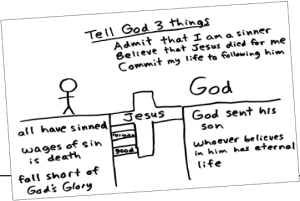
  • The Bible teaches that God loves all humans and wants them to know Him (John 10:10; Rom. 5:1).
  • But humans have sinned against God and are separated from God and His love. This separation leads only to death and judgment (Rom. 3:23; Isa. 59:2).
  • But there is a solution: Jesus Christ died on the cross for our sins (the bridge between humanity and God) (1 Peter 3:18; 1 Tim. 2:5; Rom. 5:8).
  • Only those who personally receive Jesus Christ into their lives, trusting Him to forgive their sins, can cross this bridge. Everyone must decide individually whether to receive Christ (John 3:16; John 5:24).

William Brent Ashby’s reference, 24 Ways to Explain the Gospel (Rose Publishing), is also great resource that uses word pictures. He highlights biblical illustrations and metaphors to clarify difficult concepts about salvation in a fold-out pamphlet. You can find it here: http://www.amazon.com/Ways-Explain-Gospel-Rose-Publishing/dp/1596363525

This wraps up my Evangelism series. Please come back next week for a new study. Have a fun and safe Memorial weekend!


Benefits of Suffering

Shannon Moreno’s post, Benefits of Suffering, really ties into the theme of Faith Writers’ book, Trials and Triumphs. Shannon has also written a great inspirational book called: Finding the Light (Prayerful Poetry). You can find it here: http://revelationsinwriting.wordpress.com

But before you read Shannon’s post, a little business is in order: CONGRATULATIONS . . . .
SAMSUNG CAMERA PICTURES
You’re the WINNER of:

Trials_&_Triumphs_Final_Cover

****

Revelations in Writing's avatarRevelations In Writing

Trials and troubles touch the lives of everyone, eventually. Often, when the struggles squeeze, people begin to wonder why. Though I know not all the answers, I appreciate the footnotes found for 2 Corinthians 4:17  that speak of the following benefits of our suffering: (1) They remind us of Christ’s suffering for us; (2) they keep us from pride; (3) they cause us to look beyond this brief life; (4) they prove our faith to others; and (5) they give God the opportunity to demonstrate His power.

“For our light and momentary troubles are achieving for us an eternal glory that far outweighs them all. So we fix our eyes not on what is seen, but on what is unseen. For what is seen is temporary, but what is unseen is eternal.” – (2 Corinthians 4:17-18)

Not only should we recognize the opportunities presented in our suffering, but also…

View original post 349 more words

Trials and Triumphs book give-away

Yes, I promised last week I would give away Faith Writers Trials and Triumphs to a lucky winner.Trials_&_Triumphs_Final_Cover For those of you who would like more information on this book, click on Amazon’s link: Trials and Triumphs. I am privileged to have my testimony included in this anthology along with 39 other writers. Although we are a diverse group, we share a unifying saving grace in the person of Jesus Christ.

But first, will you please fill out my poll? Don’t forget to click “vote”. I greatly appreciate your feedback! (Don’t worry, your name won’t appear when you vote, only percentages.)

Blessings,

K.D.


Seven Primary Spiritual Gifts

We have different gifts, according to the grace given us. If a man’s gift is prophesying, let him use it in proportion to his faith. If it is serving, let him serve; if it is teaching, let him teach; if it is encouraging, let him encourage; if it is contributing to the needs of others, let him give generously; if it is leadership, let him govern diligently; if it is showing mercy, let him do it cheerfully.”          Romans 12:6-8 (NIV)

Every believer has one primary motivational gift

According to the above passage, the seven motivational gifts are:

  1. Prophecy – Communication of revealed truth that builds up believers
  2. Service – Practical service to help others
  3. Teaching – To provide guidance and moral instruction
  4. Encouragement – Encouraging, comforting, and exhorting others
  5. Giving – Cheerfully contributing to the needs of others
  6. Leadership – Service carried out for the benefit of others
  7. Mercy – Helpful activities such as feeding the hungry, caring of the sick and aging

Not only does the Bible command the church to lovingly exercise all seven of these motivational gifts, but every believer also needs these seven areas in order to grow as God desires.

Do you know your primary motivational gift? It’s our job to discover what that gift is. Spiritual gift inventories may be helpful, but I’ve found the best way is to jump in and try an area of service that seems fitting, (see God’s Masterpiece & Sublime Design).

Taking a class at church and/or talking to someone who knows you well will also help you discover your primary gift. I really like how our church encourages and gives people permission to volunteer for 90 days in an area of service. By the end of three months, the individual has a pretty good idea if he/she has that particular gift. If it’s not a good fit, we’re encouraged to try another area of ministry.

We are most effective for Christ when we lovingly use the gift(s) He has given us, (see 1 Corinthians 13). But this shouldn’t be an excuse for not occasionally taking out the trash, or lending a helping hand for someone whose primary gift isn’t service.

I love that God shapes us uniquely. Our gifts will look differently in the way they are expressed through a variety of ministry. When we exercise our gifts through ministry, the Holy Spirit is the One who determines what impact another believer will receive (1 Corinthians 12:8-11).

How do you know what your primary gift is?

Joy and fruitfulness are often the results when exercising your primary gift.

God’s Plan for Spiritual Gifts

You are a paintbrush. God uses the paintbrush in your hand (your gifts) to help change and transform others in the body of Christ. And God uses others in your life to make you like Christ.”  – Chip Ingram

3f73044661493e2f1249e6980758ca24

God’s ultimate makeover is to produce the life of Christ

I found Chip Ingram’s analogy of spiritual gifts and paintbrushes interesting (Your Divine Design). This is my paraphrase:

  • Some believers’ gifts are like a paint roller. Although they may not be as personal, they are more effective in a large group setting with their broad paint strokes.
  • Some believers’ spiritual gifts are more like a refined artist, patiently painting detailed color and techniques on an individual’s canvas/heart.

You get the picture . . . . There are different paintbrushes for specific jobs; God uses different spiritual gifts for His specific purposes.

1 Corinthians 12:4-6 (NIV) says: There are different kinds of gifts, but the same Spirit. There are different kinds of service, but the same Lord. There are different kinds of working, but the same God works all of them in all men.

Where does God do His extreme makeover?
  • In His people—the church (Ephesians 2:18-22)
  • In the believer’s heart (Ephesians 3:14-19)
How does God do His extreme makeover?

Jesus’ victory over sin, death, and Satan is witnessed through spiritual gifts in His church (Ephesians 4:7-13).

10 Principles for Understanding Spiritual Gifts

(Source: Chip Ingram)

  1. Every Christian has one or more spiritual gifts.
  2. Many believers have received more than one spiritual gift.
  3. Spiritual gifts are given the moment of regeneration, but they may lie undiscovered and dormant for a long period of time.
  4. Spiritual gifts can be abused and neglected, but if they are received at regeneration, it would appear that they cannot be lost.
  5. Spiritual gifts are not the same as the gift of the Holy Spirit.
  6. Spiritual gifts are not the same as the fruit of the Spirit.
  7. Spiritual gifts are not the same as natural talents.
  8. Some spiritual gifts are more useful in local churches than others because they result in greater edification of the body.
  9. Charismata literally means “grace gifts”. These gifts are sovereignly and undeservedly given by the Holy Spirit.
  10. Gifts are God’s spiritual equipment for effective service and edification of the body [church].

Do any of these 10 principles surprise you? If so, which ones? Why?

Related posts: