Evangelism (part 2)—The Message

Hi friends! I hope this Friday finds you well. The following is a recap from last week’s post:

  • Evangelism is not reserved just for the pastor or professional.
  • The gifts of teaching and evangelism are closely related.
  • Only God can save and transform souls.
  • Although living a quiet, godly life honors God, evangelism requires words—with respect and gentleness—in addition to service.
  • Leslie Flynn, 19 Gifts of the Spirit, defines evangelism:

The gift of proclaiming the Good News of salvation effectively so that people respond to the claims of Christ in conversion and in discipleship.”

What is this Good News Message?

The short, but sweet truth: Jesus came to save us!

This message should appeal to both the emotions and intellect. A longer version, such as below, tells of the historic event that can bring incomparable riches both today and in the future:

Jesus Christ—God and man—died on the cross for my sins over nineteen centuries ago. He was buried and rose the third day. If through faith, I receive Christ as my Savior, God will declare me righteous through Jesus’ shedding of His blood. God the Father will accept His Son’s sacrifice as full satisfaction for the guilt and penalty of my sin. This is a free gift, which can’t be earned or deserved. Because I am no longer under the penalty of the Old Covenant’s broken law, I am pardoned once and for all. God also adopts me as His child. He strengthens me through the ministry of His Holy Spirit, which indwells and regenerates my inner being.

What are some Bible verses that speak about our fallen, sinful nature and God’s plan to save/redeem us?

Salvation Verses

The following verses speak about our sin and the wages of sin, God’s grace and justification, provision and salvation through faith in Jesus Christ:

  • Wages of sin: Romans 5:12; Romans 3:23; Romans 6:23a
  • God’s wrath & spiritual death toward the disbelieving: John 3:36; 1 John 5:12-13
  • Grace and justification: Ephesians 2:8-9; Romans 3:24; Romans 6:23b
  • Jesus’ provision for our sin: Romans 5:8; 1 Corinthians 15:1-4; John 3:17
  • Eternal life through faith in Jesus Christ: John 3:36a; John 3:16; John 1:12; Ephesians 2:8-9; Romans 6:23; Romans 10:8-10; 1 John 5:11
  • Confession of belief in Christ: Romans 10:10; Matthew 10:32

Next week I’ll explore more on this topic. Have a wonderful week!

Philip the Evangelist (Part 3)

I’ve always wondered what went through Philip the Evangelist’s mind when WHOOSH, he found himself transported to Azotus via the Holy Spirit. After sharing the Good News and baptizing an Ethiopian treasurer, POOF, “the Spirit of the Lord suddenly took Philip away” (Acts 8:39). He learned first-hand that God isn’t limited in the ways He uses His children. (The entire story is recorded in Acts 8:26-40.)

We’ll probably never share Philip’s means of express transportation; yes, there’s the rapture, but that’s a different subject! However, we can learn from Philip’s obedience to God.

"Remain in me, and I will remain in you. No branch can bear fruit by itself; it must remain in the vine. Neither can you bear fruit unless you remain in me. I am the vine; you are the branches. If a man remains in me and I in him, he will bear much fruit; apart from me you can do nothing."  - John 15:4-5

“Remain in me, and I will remain in you. No branch can bear fruit by itself; it must remain in the vine. Neither can you bear fruit unless you remain in me. I am the vine; you are the branches. If a man remains in me and I in him, he will bear much fruit; apart from me you can do nothing.” – John 15:4-5

Acts 8:40 records Philip preaching the gospel in all the towns near Azotus, where God whirled him away. Perhaps God knew He could count on Philip’s obedience to proclaim the Good News.

Philip not only obeyed Jesus’ command to spread the Gospel, but also heeded Jesus’ example of only acting and saying what the Father directs:

For I did not speak of my own accord, but the Father who sent me commanded me what to say and how to say it. I know that His command leads to eternal life. So whatever I say is just what the Father has told me to say.”   -John 12:49-50

Philip’s example offers us several lessons:
  • We have the same Holy Spirit to teach and empower us to be an effective witness for Christ.
  • Upon persecution, Philip went directly to Samaria—a forbidden place to most Jews due to prejudice—and spread the gospel. The gospel is for everyone, not for a select few.
  • In the middle of his successful evangelism efforts, God’s directive for him to go south on the desert road must have first seemed like a demotion. But because of Philip’s willingness to hear God’s voice and obey—going near the Ethiopian treasurer’s chariot and engaging him in discussion—God placed a Christian (the treasurer) in a significant position in a distant country. Perhaps the entire nation was then influenced by the Good News.
  • Interestingly, Philip only used the Old Testament in leading this man to faith in Christ even though Jesus is found in both the Old and New Testaments.
  • Philip met this man where he was—immersed in the prophecies of Isaiah—and then helped clarify the passage as he shared how Jesus fulfilled that prophecy.
  • When sharing the Gospel, a great place to start is where the other person’s concerns and/or questions lie.
  • God finds great and various uses for those who obey Him wholeheartedly.
  • Like Philip, we can take advantage of the opportunities God gives us through active listening and obedience.

Following God may be risky and difficult at times, but I’m sure Philip would testify: It’s worth the ride!

Next week I’ll explore some simple evangelism plans that have helped many Christians share their faith.

Evangelism Plans (Part 4)

Although evangelism plans vary, the truth of the message must not. While false teachers flourish, it’s important to know and guard the main doctrinal points of the Bible (1 Tim. 4:1-3, 16). Any tampering with the Bible’s message will be under God’s scrutiny and judgment (Dt. 4:2; Rev. 22:18-19).

How Many Roads to Salvation?
"There is a way that seems right to a man, but in the end it leads to death."  - Proverbs 14:12

“There is a way that seems right to a man, but in the end it leads to death.” – Proverbs 14:12

One hiccup that many people have with Christianity is the “narrow viewpoint” that Jesus Christ is the only way to salvation. Matthew 7:13-14 not only agrees with this narrow viewpoint, but admonishes us to go there: “Enter by the narrow gate; for the gate is wide, and the way is broad that leads to destruction, and many are those who enter by it. For the gate is small, and the way is narrow that leads to life, and few are those who find it.”

Many believe that a loving God won’t turn anyone away who has done his/her lion share of good deeds and/or has achieved much in life. This is a dangerous assumption. A great resource that addresses what’s wrong with this popular theory is Andy Stanley’s book, How Good is Good Enough?

Jesus, the Only Way

Gregory Koukle addresses critics who embrace religious pluralism in his booklet, Jesus the Only Way: “. . . . When a hundred [Bible] passages argue the same point [Jesus the only way] from a variety of angles it cannot be mistaken, only ignored.”

Everyone follows something or someone. When one receives eternal life through Christ, it’s important that he/she realizes that he/she isn’t just saved unto salvation, but also is receiving a new leader—Jesus Christ— to follow.

Billy Graham Crusades Evangelism plan

Billy Graham Crusades “Steps to Peace with God” emphasizes four simple steps:

  1. God’s Plan–> Peace and Life (Rom. 5:1; John 3:16; 10:10)
  2. Humanity’s Problem–> Separation (Rom. 3:23; 6:23; Isa. 59:2)
  3. God’s Remedy–> The Cross (1 Tim. 2:5; 1 Peter 3:18; Rom. 5:8)
  4. Human Response–> Receive Christ (John 1:12; 5:24; Rom. 10:9)

Billy Graham Crusades also offers free tracts and hosts online evangelistic resources:

  • A downloadable worksheet to help share “Your Faith Story”
  • A customizable downloadable tract
  • Examples of how the Grahams have shared their faith story
  • How God uses ordinary people in extraordinary ways
  • Short videos with different styles that share the Good News

You can check out their resources here:

https://secure.billygraham.org/testimony-tract/testimony-tract.aspx?SOURCE=BY120TTCG&gclid=CI-h4s-jlb4CFcuVfgod6D8ANA

Next week, I’ll wrap this series up with some other evangelism plans to check out.

Any thoughts, questions, comments?

My week has flown by with my boys’ baseball games and daughter’s play. It’s been a crazy-busy, but fun week. While driving my kids around, the thought occurred: I’m grateful that most drivers heed the law to drive on the right side of the road, the correct/one way to drive on a U.S. highway. Similarly, I’m grateful God made a way—even though it’s the only way—to receive forgiveness and eternal life through His son, Jesus.

May your week be fun, full and sane!


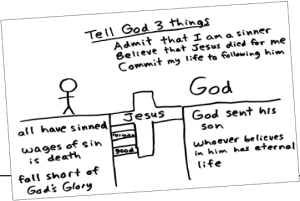
Three Effective Evangelism Plans (Part 5)

Along with Billy Graham’s plan “Steps to Peace with God,” which I posted last week, the following plans have helped millions of Christians share the Gospel in a simple, but effective way.

1) The Romans Road of Salvation
  • Human Need (Rom. 3:23)
  • Sin’s Penalty (Rom. 6:23)
  • God’s Provision (Rom. 5:8)
  • The Person’s Response (Rom. 10:9)


2) Four Spiritual Laws (Campus Crusade for Christ)
  • God loves you and offers a wonderful plan for your life (John 3:16; 10:10).diagram_2
  • Humans are sinful and separated from God. Thus, they cannot know and experience God’s love and plan for their lives (Rom. 3:23; 6:23).
  • Jesus Christ is God’s only provision for humanity’s sin. Through Jesus, you can know and experience God’s love and plan for your life (Rom. 5:8; John 14:6).
  • We must individually receive Jesus Christ as Savior and Lord; then we can know and experience God’s love and plan for our lives (John 1:12; Eph. 2:8-9).
3) Bridge to Life (Navigators Resource/Tool link: http://www.navigators.org/Tools)bridge-illustration
  • The Bible teaches that God loves all humans and wants them to know Him (John 10:10; Rom. 5:1).
  • But humans have sinned against God and are separated from God and His love. This separation leads only to death and judgment (Rom. 3:23; Isa. 59:2).
  • But there is a solution: Jesus Christ died on the cross for our sins (the bridge between humanity and God) (1 Peter 3:18; 1 Tim. 2:5; Rom. 5:8).
  • Only those who personally receive Jesus Christ into their lives, trusting Him to forgive their sins, can cross this bridge. Everyone must decide individually whether to receive Christ (John 3:16; John 5:24).

William Brent Ashby’s reference, 24 Ways to Explain the Gospel (Rose Publishing), is also great resource that uses word pictures. He highlights biblical illustrations and metaphors to clarify difficult concepts about salvation in a fold-out pamphlet. You can find it here: http://www.amazon.com/Ways-Explain-Gospel-Rose-Publishing/dp/1596363525

This wraps up my Evangelism series. Please come back next week for a new study. Have a fun and safe Memorial weekend!

Faith Factor

Faith: (noun) Strong belief or trust in someone or something.”  – Merriam Webster Dictionary

We exercise this kind of faith daily. When we sit on a chair, we trust it will hold us without collapsing. When we pour a cup of coffee, we trust our mug will not leak. When we fill our vehicle’s gas tank, we trust our car will drive.

But our faith is only as good as the object we place it in. Eventually chairs break, mugs crack, and vehicles break down.

God’s Take on Faith

“Now faith is confidence in what we hope for and assurance about what we do not see.”  – Hebrews 11:1 (NIV)

This is the kind of faith God commended the ancients for (Hebrews 11).

How Important is Faith to God?

588deb7efc0d926f65da660a74f6f277

A Strong Case for Faith in Jesus Christ

The New Testament book of Hebrews presents a strong case for placing our faith in Christ.

  • Christ is Superior: Jesus—greater than any angel, religion, priest, or leader—is the ultimate authority and complete revelation of God. He alone forgives sins: past, present, and future. Through His death on the cross, He has secured our forgiveness and salvation.
  • Jesus is High Priest: In the Old Testament, the high priest represented the Jews before God. But now—under the New Covenant—Jesus connects us to God. Jesus not only guarantees our access to God the Father, but He also intercedes for us so we can come boldly before the Father with our needs and seek forgiveness.
  • Jesus Sacrifice: Because Jesus lived a sinless life, He is the perfect substitute to die for our sin.

God not only wants us to be reassured of salvation, but also wants to grow our faith. This process takes time, daily commitment, and service. When we mature in our faith, we will be able to face trials with endurance and be unshaken by concerns or temptations. (Disclaimer: I’m in process.) 🙂

Peace with God and real meaning for life are found when trusting Christ. When we completely trust Him, He will completely transform us (Philippians 1:6). Our faith and obedience please God.

My righteous one will live by faith. And I take no pleasure in the one who shrinks back.” – Hebrews 10:38

Are you completely trusting in Christ?